Vetty Creations header

Back to Vetty Creations website

White Threads

How did you celebrate World Embroidery Day?

Yesterday I wore my new Hardanger embroidery shirt/blouse with pride to celebrate World Embroidery Day! As far as I know, no-one particularly noticed it, but that’s ok because I really enjoyed wearing it. It was really nice to think, “I made this, and I think it is beautiful!”

The pattern for this shirt will be in my upcoming book “Early-Style Hardanger”.

World Embroidery Day

I sat in the local mall which had it’s Thursday growers markets on, and enjoyed the ambience while I stitched for a while. It was a beautifully sunny day, and only a little bit cold.

So, how did you celebrate the day? Did you get together with friends and stitch? Did you sit in a quiet corner by yourself and stitch? Or did you do something else entirely?

July 31st, 2015 | Category: Early-Style Hardanger, embroidery musings, hardanger | 7 comments

Happy World Embroidery Day!

Celebrate World Embroidery Day 30th JulyToday is World Embroidery Day!

The initiative for World Embroidery Day came from Skåne Sy-d, a local group of Broderiakademin, the Swedish Embroiderer’s Guild. The first World Embroidery Day took place in Vismarlöv, 30th July 2011. They feel that the importance of embroidery must be made known so that World Embroidery Day will spread around the world. They suggest that we make 30th July a day filled with creativity for the sake of Peace, Freedom and Equality.

You can read more about it here.

I hope you will celebrate World Embroidery Day with me and thousands of others around the world by doing some embroidery-related things.

Firstly, I’m going to do some embroidery. I might even do it in a public place. I have to go to the bank today, so I might take my embroidery with me, and sit in the mall outside the bank and do some open-air embroidery.

Secondly, I’m going to WEAR some embroidery today. I’ve finished my embroidered blouse, except for sewing on the buttons. So this morning, I will sew them on and wear my shirt with pride. I’ll probably be the most overdressed person in the mall, but I will enjoy wearing it!

Hopefully I’ll be able to find someone who will photograph me doing my embroidery in my embroidered shirt, and share it with you. Whatever you do today to celebrate World Embroidery Day, please take a photo and send it to me so that I can share them here, or post it on the Vetty Creations Facebook page.

Let’s make a loud noise, worldwide, about embroidery today!

July 30th, 2015 | Category: embroidery musings, making stuff | Leave a comment

Sitting stands and interchangeable hoops back in stock!

It’s been a long while coming… Finally, after a long break in supply, the beautiful Klass and Gessmann sitting stands and interchangeable embroidery hoops are back in stock! In the hands of a new supplier, the supply of these should be much more reliable now. YAY!

These are my very, very favourite hoops to use.
Klass and Gessmann embroidery hoops and stands

The stand goes between the legs or in underneath one leg. The hoop turns and swivels and flips up and down. You can easily position it where you want it to work on your embroidery and when you need to get to the back, you just flip it up. The screw for tightening the hoop has a screwdriver slot in the end, meaning you can really tighten it.

At the craft show each year, I get satisfied customers coming back to tell me how much they love their hoop that they previously purchased from me. That’s a very happy customer who bothers to do that!

These hoops are perfect for people who find it difficult to hold a hoop for any length of time. The stand does it for you! For people who have limited mobility due to arthritis or a stroke, this is so helpful!

Purchase your very own beautiful hoop and stand today from the Vetty Creations online shop.

July 27th, 2015 | Category: favourite needlework items, Introducing..., new products | Leave a comment

finishes and photography

Recently I’ve had a few days of finishing projects off for “Early-Style Hardanger”. Last week I finished the blouse – although I still have to sew on the buttons.

Today I constructed the biscornu. I discovered that while silk satin fabric is gorgeous, when it is flimsy, it’s very hard to work with to create something as structured as a biscornu as it slips all over the place. Take two involved backing the silk satin with some cotton to give it more body. It was a much more successful result!

As I am writing this, The Gymnast just picked up the biscornu and said “Yes! Yes! Wow! I want that!” She then discussed how she likes my embroidery but usually doesn’t want it. But this one she likes enough to want it! 🙂 Might have to put her name on the back of it, ready for my eventual demise (a long way away, thank you very much!) Tomorrow I’ll see about photographing it.

Yesterday I went to the second-hand bookshop to buy some nice looking old books as props for the photograph of the bookmark. That’s tomorrow’s job also.

photographing the cushionOn Saturday morning I got a bee in my bonnet about photographing the cushion. I set up the lounge in the lounge room with a temporary cover, and arranged white board around it to reflect more light. I asked The Husband to take a photograph of me photographing the cushion, so that you can see the sort of strange setup that I have! You might think this is all done in some nice studio somewhere, but no, it’s in a corner of our lounge room!

Yes, on the left, they are the two candlewicking cushions that were projects in Inspirations Magazine some time back. And the fabric that is temporarily covering the lounge is the Florence Broadhurst Peacock Feathers fabric that I made a dress out of. (You can see the cut out shapes of bodice pieces!) And that’s me holding up a big piece of white board to reflect more light back down onto the cushion.

I also have two Christmas stockings to photograph, and an apron, and if I put the buttons on the blouse, then there’d be that too. But I don’t think I’ll fit all that into tomorrow! After all, I’d like to do a bit of sewing as well. 🙂

If you’re interested in knowing more about how to photograph needlework, why not sign up for my course at the NSW Embroiderers Guild in November? You can find more information here.

July 21st, 2015 | Category: Early-Style Hardanger, Embroidery classes, hardanger, making stuff, photography | 2 comments

Finished Elizabethan Strawberries

A little while back one of my students from the cruise in April sent me a photo of her finished Elizabethan Strawberries project. She’s done a marvellous job and gave me permission to share the photo with you. Congratulations Judy P!

Elizabethan Strawberries stitched by Judy P, designed by Yvette Stanton

This was a small class, aimed at experienced embroiderers, with very dedicated students. There was not a lot to learn in the class, but there was a lot to master. We covered stitches including plaited braid stitch (that’s the gold stem), reverse chain stitch, Elizabethan corded detached buttonhole, Elizabethan corded Brussels stitch and my favourite – spiral trellis stitch. I was really pleased with how the students went, because some of them were very difficult stitches!

If you’ve completed one of my projects, either from a class or from one of my books, I’d love to see photos. It’s always nice to celebrate successes!

July 14th, 2015 | Category: customer embroidery, Elizabethan embroidery, Embroidery classes, travel | Leave a comment

Unicorn tapestries, Stirling Castle

One of my husband’s colleagues is currently on holidays in the UK. They visited Stirling Castle and she posted some pictures of the amazing unicorn tapestries on Facebook. She very kindly gave me permission to post the photos here for you all to enjoy.

Unicorn Tapestries, Stirling Castle

Unicorn Tapestries, Stirling Castle

Don’t they look amazing in situ?!

If these are new to you, I recently posted some links about them in my Exploring the Needlework Internet This Week roundup.

July 13th, 2015 | Category: historical embroidery, travel | Leave a comment

Why I choose not to use oxicleaners on linens

As you will have read in my report yesterday on The Big Mountmellick Boil Up, by boiling my antique Mountmellick piece white, I found that not all of the stains were removed. And so, of course, all the suggestions came (variations depending on where the commenter lives): “Have you tried using Napisan?” “Would you consider using Oxiclean, if you have that there?” “What about using Napisan?” “Can you get Biz?”

Yes, I can get Napisan (we have some in the laundry cupboard). No, I cannot get Biz or Oxiclean.

Will I use them?

My immediate response to this is “No, those sorts of oxygen activated cleaners actually eat away at the fabric, removing the stains – yes – but also removing the fibres.” That’s my stock standard answer for these questions. But is it true?

I’m not sure. I’ve done a bit of reading this morning to learn more about these products. The main ingredient in them is generally sodium percarbonate which breaks down to form the active ingredient of hydrogen peroxide.

So on finding this out, my question was then “Does hydrogen peroxide clean by eating away the fibres?” I haven’t determined the answer to this. I simply don’t know. However, several things I read also said “it eats away at the fibres” or “it weakens the fabric”. These were really just hearsay though. Were they scientifically based statements or just received wisdom? I don’t know. I suspect they might be received wisdom. I can find no scientific basis for the statements, but then I haven’t had an exhaustive search and maybe I’m not looking in the right places, and not using the right search terms.

So, given that my original statement that “it eats away the fibres” might be untrue, would I consider using Napisan/Biz/Oxiclean? Probably not.

Grey MountmellickMy aim was to use the time-honoured, traditional method of boiling Mountmellick embroidery to whiten it. Why did I want to whiten it? Ostensibly to remove the horrible black lines and general greyness. Why use that method? Because it is the traditional method, and I wanted to see if it worked to whiten. Did it? Yes and no. Yes, to the general appearance, no to the horrible black lines and greyness (though I think the general greyness has lightened). I also wanted to prove to myself that the method was suitable to use on antique embroidery, and wouldn’t damage it. There was no visible damage; no extra holes in the lace (though as the lace is not traditional, I wouldn’t have cared if it had!); and no failure of the stitches or fabric.

Does it matter to me if the piece now stays as is? No, it doesn’t. I’m quite happy to leave it now. I’ve proved to myself that boiling whitens whites and can reduce some staining significantly (most of the “rust” stains have gone). I have no need to try whitening it further. I will not be using this in my home and I won’t have it on display. If I was going to, I might try other cleaning methods. However, I intend only to use it as a teaching piece. As it is now, it’s got an excellent lesson contained in it: Don’t use horrible dark lines to draw your pattern on!

For me, with antique linens, my aim is not to use them, but to preserve them, as examples of the style for future generations. As an embroidery historian, I want to think of the others coming after me. I have now cleaned this piece, and that’s as far as I need to take it. I don’t need it to look new, because it isn’t!

If the antique linens were ones that had been passed down through my family, then I might choose to use them, because for me they have a different purpose: maintaining links with my forebears. So for you to choose to use Napisan etc. on your antique linens, I have no problem with that at all. If you want to use the linens and celebrate them, go right ahead and whiten them in any way that works for you. If having white linen makes you happy, go for it! 🙂

So I hope that explains why I’m choosing not to use oxicleaners. It’s about preservation really, even if the statement that “it eats away the fibres” isn’t true.

July 10th, 2015 | Category: embroidery musings, historical embroidery, mountmellick embroidery, whitework | 4 comments

Mountmellick: The Big Boil Up

This morning I finally got the chance to do The Big Boil Up. By the time I got to it, the embroidery had been soaking in cold water for about 36 hours.

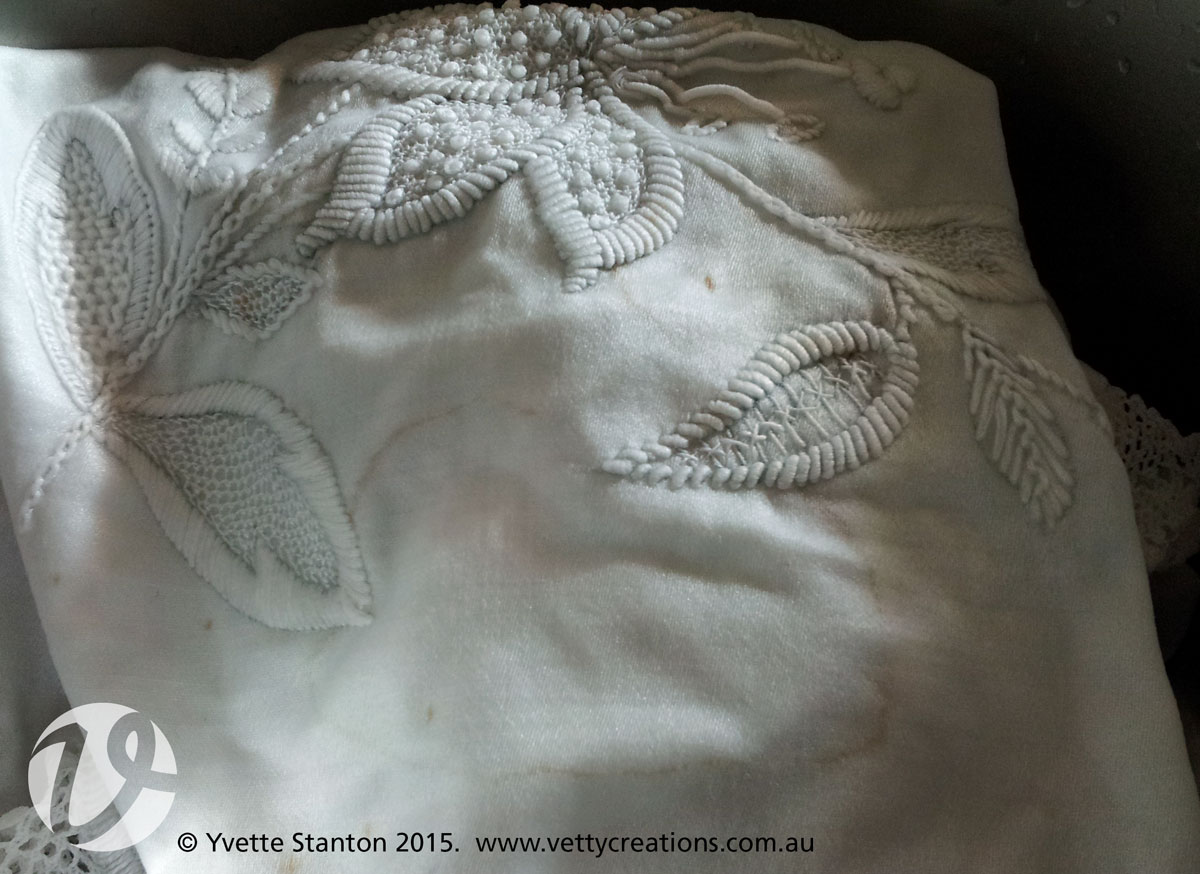
Grey MountmellickOn this photo, note the heavy black lines underneath the stamens of the lily. They have to go! You can also see various brown spots, and the petals and some of the leaves have a general greyness about them because of the black lines drawn onto the fabric.

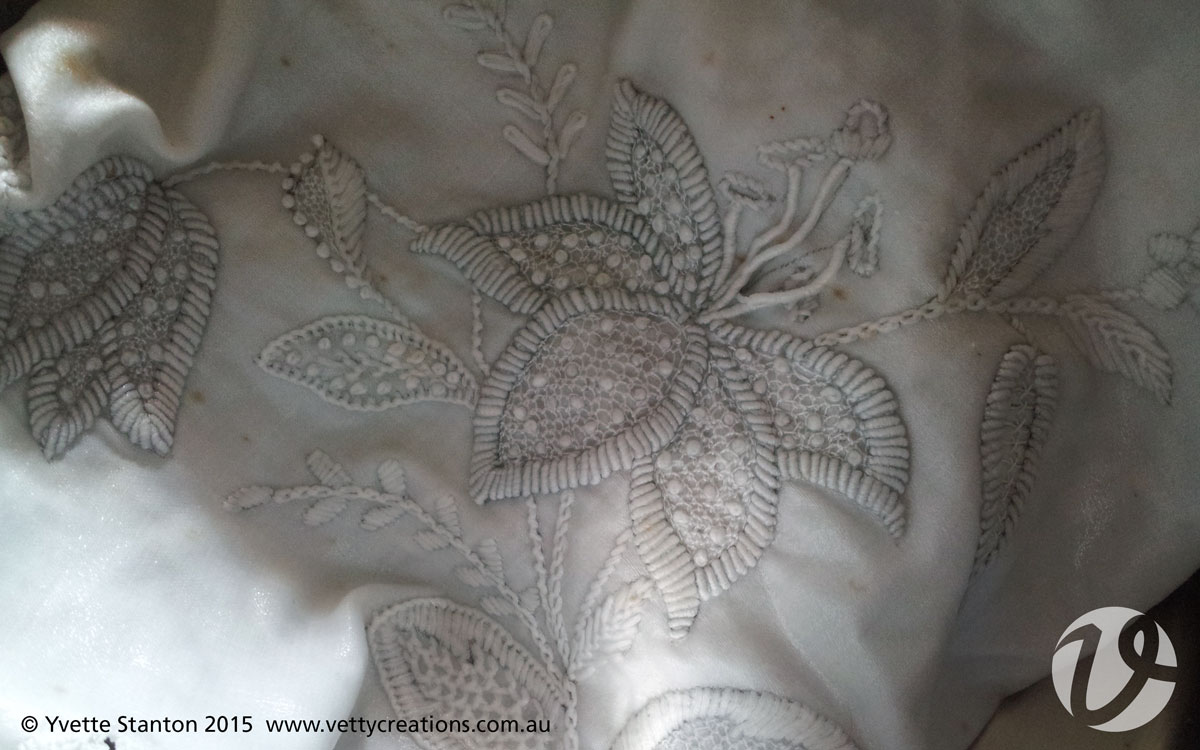
Grey MountmellickThis photo shows a large brown ring (which didn’t show up when it was dry, from memory) and again, greyness on the petals and some of the leaves. This is most obvious where the bullions form the petal edges and leaf edges.

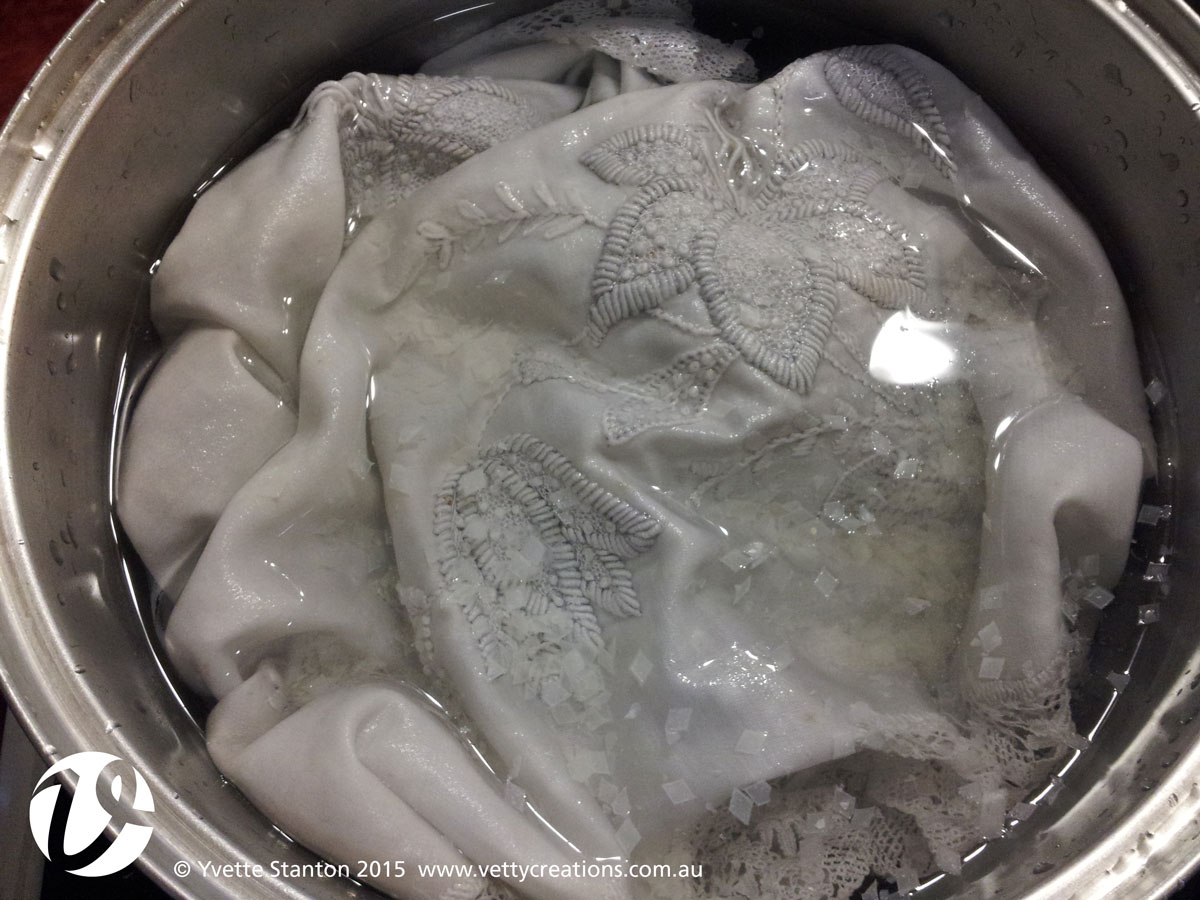
Into the potInto a large pot went the embroidery, a fair quantity of water, and pure soap flakes. I put the lid on and turned on the stove to full. Then I put the oven timer on for 10 minutes and went off to do other things.

Mountmellick-boiling4When the timer went off, I came back and soon it started boiling.

I let it boil at a rolling boil for about 20 minutes. I had to keep pushing the embroidery back down into the pot, as when the water boiled and the bubbles came up they would inflate the embroidery out of the pot! Sometimes I just put the lid on and let it boil happily away by itself.

I then carefully drained the water, replaced it and then boiled again. This time I added 1 teaspoon of cream of tartar to the water (just because this was something that had been suggested to me and I wanted to try it – it’s not part of the traditional process), brought it to the boil, then let it boil for another 15 minutes. And then I replaced the water one last time and boiled it again, this time without the cream of tartar.

At the conclusion of this process, the black lines were as black as they had been. Oh dear! However, the fabric, lace and thread had all stood up well to the boiling process.

I spun the piece in the washing machine to remove excess water, and then hung it up in the sun (winter sun, so not very strong) to dry. The sun can also bleach, so it was a deliberate decision to dry it this way.

Late in the afternoon I took it off the line and found that as it had now dried, I could tell that the piece had indeed whitened and brightened. Unfortunately the black lines had not whitened or brightened at all though. They’re still as dark and as black as ever. Most of the brown stains and “rust” marks have gone. There are one or two still clearly visible and others that are nearly gone.

In some ways the boiling was a success and in others, not so much. The success is due to the fact that it didn’t fall apart! And overall, it did whiten quite a bit. The non-success is that those heavy black lines are still heavy black lines.

Was it worth doing? DEFINITELY! It proved to me, yet again, that Mountmellick embroidery can take a beating! It’s sturdy stuff and copes really well with being boiled.

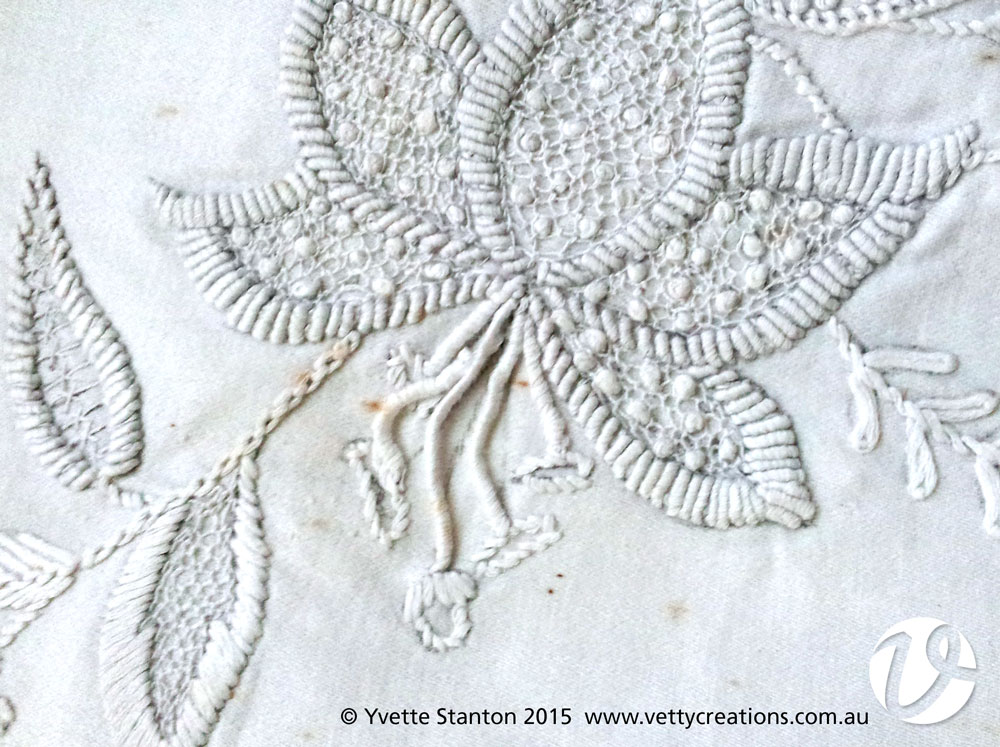
I gave it a good iron, and can now see how very beautiful this piece is. It’s a pillowsham, with sprays of lilies in two opposite corners. The lily petals are worked with a border of padded bullions, and filled with needlelace filling and dotted with French knots. They’re really very pretty. It’s not a petal treatment that I’ve seen before, but I’m thinking that I’ll give it a go at some point on one of my own projects.

So I’m very happy with my birthday purchase. Thanks to Thompson’s Country Collectables at Windsor, for the opportunity to purchase it!

July 9th, 2015 | Category: embroidery musings, embroidery stitches, historical embroidery, mountmellick embroidery, whitework | 2 comments

the antique Mountmellick is steeping

I have been cheered on by people around the globe, encouraging me to be brave about washing the antique Mountmellick piece that I bought. And so last night before going to bed, I put it in a bucket of cold water to steep.

Amazingly, I had the presence of mind to take some photos of it before I did this. (Amazingly, because while lying in bed this morning I realised I posted off an urgent order yesterday with no postage on it… Oh dear!)

Maybe some time today I will gather up all my courage and boil it.

The method I will use to boil the Mountmellick embroidery is a time-honoured one, used for hundreds of years in Mountmellick (and many other cultures boil white embroidery too). The fabric used for Mountmellick is very hard-wearing, and just right for the “rough” treatment of boiling.

The thing I’m concerned about in this case is the thread. It appears to be mostly stranded floss, though last night I did notice the buttonholing around the edge appears to be pearl cotton. I know that Mountmellick thread (very much like 4 ply knitting cotton) is strong and hard-wearing, but I’m not so sure about the floss.

If the bobbin lace falls apart, I don’t think I’ll care so very much, because it shouldn’t be there anyway! It should have a knitted fringe as was traditional.

Some years ago I wrote a post about boiling Mountmellick embroidery. Why not read it to acquaint yourself with the method I’ll use? The comments on the post are interesting too.

July 8th, 2015 | Category: historical embroidery, mountmellick embroidery, whitework | 2 comments

to wash or not to wash – Mountmellick

On the weekend, we took a little drive to Richmond and Windsor, north-west of Sydney, at the base of the Blue Mountains. We wanted to visit some antique shops for a project my husband is working on, and it used to be that there were quite a few in that region. Well, there aren’t anymore!

However, we did find four antique/collectables/old furniture shops. We weren’t looking to buy anything, just look. One of the ones we went to was Thompson’s Country Collectables in Windsor. They had some lovely old things there, including some beautiful furniture. I always am on the lookout for needlework tools and antique needlework in these sorts of places.

We were upstairs at Thompson’s, and The Reader started looking through some textiles (she is her mother’s daughter!). You know the sort: crochet edged doilies and tablecloths with simple, colourful embroidery on them, sometimes known as traced linen. This sort of work is lovely, but I don’t need to own any more of it, other than what I have inherited from family. To me the main attraction of such pieces is where someone who has come before me in my family has made it.

I said to her that the sorts of pieces I was interested in were really only Mountmellick embroidery, and they were always hard to come by. We continued our looking, then descended the stairs. As I went down, I saw a white piece of fabric on some furniture near the bottom of the stairs.

Surely not… no, it couldn’t be… but yes, it was! A real piece of Mountmellick embroidery. Distinctive in that it was worked on beautifully fine cotton satin jean, with a design I’m pretty sure I’ve seen before, using a lovely range of Mountmellick stitches, including padded satin, bullions, cable chain and cable plait stitch. It was edged in bobbin lace, which as we know is not traditional, and seemed to be stitched in stranded cotton rather than knitting cotton type thread. But it was unmistakably Mountmellick embroidery. I had a birthday in recent times, and so used some of my birthday money to purchase the piece.

The tag said “c1900” which would be right for a piece like this. It would be interesting to know if it was stitched in Ireland and brought to Australia, or stitched here by an Irish settler. Of course, I’ll never know!

Mountmellick lily flower showing black lines underneath the stamens and general blackness. Also "rust" spots.

Mountmellick lily flower showing black lines underneath the stamens and general blackness. Also “rust” spots.


It’s horribly starched – really stiff and spiky! And it has some rust marks on it. Underneath some of the stitching, the black lines drawn on as a pattern are still dark and strong. Why do people do this? Draw your pattern light, people!

And now I have a dilemma. Do I wash it, or not? Do I take the chance that it could fall apart on me, or do I wash it white as snow?

The thing about Mountmellick is that it IS very hard-wearing. It’s heavy fabric, and the stitches are also very heavy. It is designed to be boiled white.

When we visited Mountmellick back in 2002, we visited a lovely lady named Annie Kelly, who had borrowed a large Mountmellick bedspread from An Grianan, which is a cultural organisation that amongst other things has many embroidery classes, including in Mountmellick embroidery. Annie had borrowed the bedquilt because it had been on display for many years and had gone grey and she had convinced them to let her wash it.

She showed us the washed piece (it’s shown in our book, Mountmellick Embroidery: Inspired by Nature). It was snowy white. She’d steeped it in her bath in cold water, then boiled it back to white. It worked very successfully. However, I’d also say she was very brave! It wasn’t even her bedcover, yet she trusted the integrity of the fabric and thread to know that they’d survive her washing of them. What if it had fallen apart and all she’d had to hand back to An Grianan was pieces?! I think I need to be brave like Annie too…

It might take a little while to get the courage up to do this. 🙂 I’ll let you know how I go.

July 7th, 2015 | Category: historical embroidery, mountmellick embroidery, Mountmellick Embroidery: Inspired by Nature, whitework | 8 comments
« Newer Entries  
  Older Entries »
Yvette Stanton White Threads is the blog of Yvette Stanton, the author, designer, publisher behind Vetty Creations' quality needlework books and embroidery products.

New book now available!

Hardanger Filling Stitches
Hardanger Filling Stitches by Yvette Stanton. Order your copy today!
Find us on Facebook

Archived posts

Categories

  • book reviews (88)
  • Christmas ornament swap (13)
  • colour (6)
  • crazy hair (6)
  • customer embroidery (49)
  • designing (119)
  • dressmaking (26)
  • Early-Style Hardanger (91)
  • Elegant Hardanger Embroidery (42)
  • Elizabethan embroidery (25)
  • Embroidery classes (189)
  • embroidery musings (436)
  • embroidery stitches (206)
  • errata notices (11)
  • Ethnic embroidery (49)
  • exhibitions (111)
  • exploring the needlework internet (10)
  • favourite needlework items (69)
  • FlossTube (102)
  • Frisian whitework (73)
  • goldwork (12)
  • hardanger (232)
  • Hardanger Filling Stitches (72)
  • Hardanger Filling Stitches (1)
  • hints and tips (114)
  • historical embroidery (119)
  • how-to videos (34)
  • illustration (1)
  • Inspirations (25)
  • Introducing… (90)
  • left handed embroidery (78)
  • magazines (10)
  • making stuff (271)
  • merezhka (35)
  • mountmellick embroidery (176)
  • Mountmellick Embroidery: Inspired by Nature (60)
  • mountmellick supplies (49)
  • new products (104)
  • online book previews (7)
  • pattern darning (19)
  • pattern drafting (11)
  • photography (2)
  • Portuguese embroidery (166)
  • Portuguese Whitework: Bullion Embroidery from Guimarães (74)
  • public thanks (32)
  • published projects (27)
  • Punt 'e Nù (32)
  • Sardinian Knotted Embroidery (77)
  • sewing tips (9)
  • Smøyg (41)
  • Smøyg: Pattern Darning from Norway (39)
  • soapbox (6)
  • stitch along (44)
  • stitch dictionary (45)
  • teaching embroidery (192)
  • The Left-Handed Embroiderer's Companion (104)
  • The Right-Handed Embroiderer's Companion (70)
  • travel (172)
  • Ukrainian Drawn Thread Embroidery (35)
  • Uncategorized (169)
  • video previews (5)
  • White Threads Blog (91)
  • whitework (364)
  • writing books (306)