

On the weekend, we took a little drive to Richmond and Windsor, north-west of Sydney, at the base of the Blue Mountains. We wanted to visit some antique shops for a project my husband is working on, and it used to be that there were quite a few in that region. Well, there aren’t anymore!
However, we did find four antique/collectables/old furniture shops. We weren’t looking to buy anything, just look. One of the ones we went to was Thompson’s Country Collectables in Windsor. They had some lovely old things there, including some beautiful furniture. I always am on the lookout for needlework tools and antique needlework in these sorts of places.
We were upstairs at Thompson’s, and The Reader started looking through some textiles (she is her mother’s daughter!). You know the sort: crochet edged doilies and tablecloths with simple, colourful embroidery on them, sometimes known as traced linen. This sort of work is lovely, but I don’t need to own any more of it, other than what I have inherited from family. To me the main attraction of such pieces is where someone who has come before me in my family has made it.
I said to her that the sorts of pieces I was interested in were really only Mountmellick embroidery, and they were always hard to come by. We continued our looking, then descended the stairs. As I went down, I saw a white piece of fabric on some furniture near the bottom of the stairs.
Surely not… no, it couldn’t be… but yes, it was! A real piece of Mountmellick embroidery. Distinctive in that it was worked on beautifully fine cotton satin jean, with a design I’m pretty sure I’ve seen before, using a lovely range of Mountmellick stitches, including padded satin, bullions, cable chain and cable plait stitch. It was edged in bobbin lace, which as we know is not traditional, and seemed to be stitched in stranded cotton rather than knitting cotton type thread. But it was unmistakably Mountmellick embroidery. I had a birthday in recent times, and so used some of my birthday money to purchase the piece.
The tag said “c1900” which would be right for a piece like this. It would be interesting to know if it was stitched in Ireland and brought to Australia, or stitched here by an Irish settler. Of course, I’ll never know!
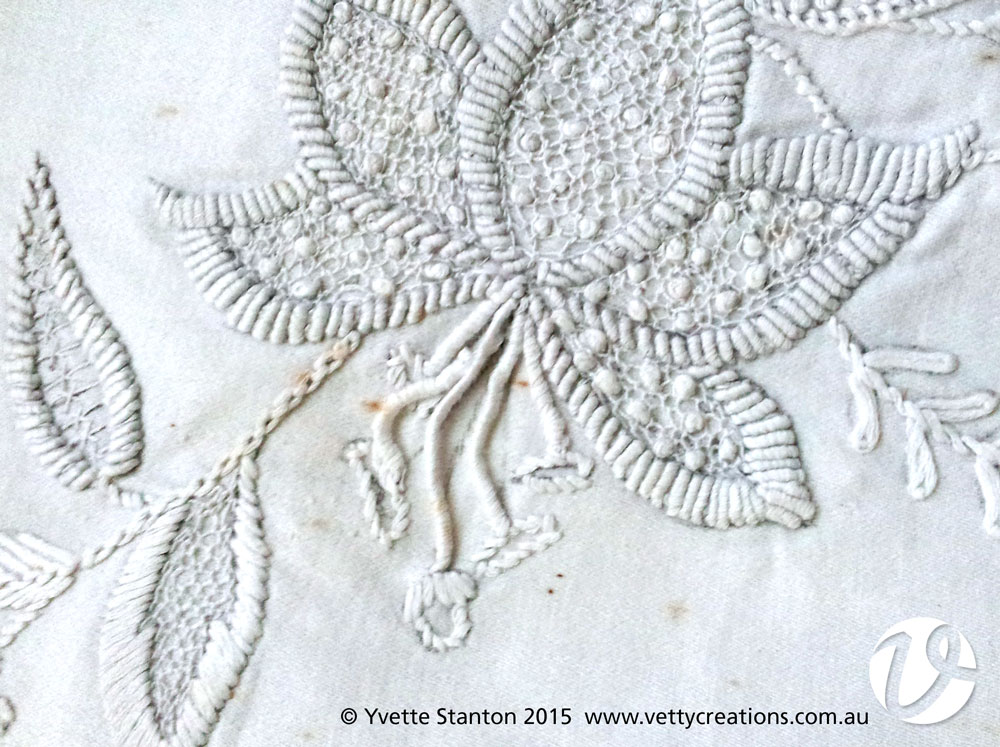
Mountmellick lily flower showing black lines underneath the stamens and general blackness. Also “rust” spots.
It’s horribly starched – really stiff and spiky! And it has some rust marks on it. Underneath some of the stitching, the black lines drawn on as a pattern are still dark and strong. Why do people do this? Draw your pattern light, people!
And now I have a dilemma. Do I wash it, or not? Do I take the chance that it could fall apart on me, or do I wash it white as snow?
The thing about Mountmellick is that it IS very hard-wearing. It’s heavy fabric, and the stitches are also very heavy. It is designed to be boiled white.
When we visited Mountmellick back in 2002, we visited a lovely lady named Annie Kelly, who had borrowed a large Mountmellick bedspread from An Grianan, which is a cultural organisation that amongst other things has many embroidery classes, including in Mountmellick embroidery. Annie had borrowed the bedquilt because it had been on display for many years and had gone grey and she had convinced them to let her wash it.
She showed us the washed piece (it’s shown in our book, Mountmellick Embroidery: Inspired by Nature). It was snowy white. She’d steeped it in her bath in cold water, then boiled it back to white. It worked very successfully. However, I’d also say she was very brave! It wasn’t even her bedcover, yet she trusted the integrity of the fabric and thread to know that they’d survive her washing of them. What if it had fallen apart and all she’d had to hand back to An Grianan was pieces?! I think I need to be brave like Annie too…
It might take a little while to get the courage up to do this. 🙂 I’ll let you know how I go.
 White Threads is the blog of Yvette Stanton, the author, designer, publisher behind Vetty Creations' quality needlework books and embroidery products.

My inherited stash includes two pieces of unfinished ‘Mountmellick’ work: a mantel cloth and a tray cloth, both with iron-on transfer designs; age unknown but I believe no later than 1920s. The quote marks are because the fabric is cream linen, not white cotton sateen, but both have an appropriate variety of surface stitches, some heavily padded. They include some cut areas with coarse needle-lace, which I believe was fairly usual as well in later incarnations of Mountmellick work. Would like them?
PS: The designs are relatively simple and both are badly rust-stained, so you could always try your washing technique on these less valuable pieces first!
Hi Elaine, They sound wonderful! Cut work is never part of Mountmellick embroidery, even in later pieces, so is it possible that they’re not actually Mountmellick? Perhaps you could send me a picture or two and we can try to identify them here on the blog as a way of all of us learning? If you’re wanting to pass them on, well how could I say no to such a lovely generous offer?! But if you’ve got any hint of wanting to keep them yourself, then please keep them. 🙂
Yvette
I am very interested in what you have to do to remove the rust spots. I have some stitched pieces (LOL and some clothes) that have these brown spots.
Will love to hear what you do
Good luck!!
Julie in Melbourne
Hi Julie, I don’t know what I will do to remove the rust spots. I may not manage that! I plan to use the time-honoured method of boiling the work, as is traditional for Mountmellick embroidery and has been done for hundreds of years. I’ve written a post about it in the past. http://vettycreations.com.au/white-threads/2010/09/14/sal-boiling-mountmellick-embroidery/ If this method removes the rust spots, well and good. If it doesn’t, then I guess they stay!
Oh, and I will probably give the piece a good lay in the sun. The sun does wonderful things for whitening and brightening.
Yes, I have wondered about doing what my mother used to say: Wet the fabric with the stains, put some lemon juice over the marks and then lay in the sun. Pretty cold here in Melbourne so I can happily procrastinate can’t I!!!!
I’ve got some lemons, so I could give that a try if the boiling by itself doesn’t work. Thanks for the tip, Julie!