Vetty Creations header

Back to Vetty Creations website

White Threads

White Threads FlossTube #38 – Hardanger buttonhole edging tutorial

White Threads FlossTube 38 – Following on from the previous episode’s Hardanger tutorial, we have a tutorial about the Hardanger buttonhole edging. In this demonstration by the Whitework Queen, Yvette Stanton, she shows how to start, four different corner variations, how to change threads, joining the end to the beginning, how to finish threads, and how to cut the piece out of the surrounding fabric.


If you’re reading this in an email, the video can be found at https://youtu.be/-PREKpGBgQk

Episode notes:

0:00 Introduction
3:47 Explanation of how handedness affects the demonstration
5:10 Starting the thread and the buttonhole edging
7:37 Stitching corner A
12:25 Stitching corner B
14:43 Stitching corner C
17:20 Stitching corner D
19:55 Changing threads
24:40 Joining the end to the beginning
27:03 Finishing threads
28:13 Cutting out the piece

Step-by-step right-handed instructions for this stitch can be found in Elegant Hardanger Embroidery by Yvette Stanton.
June 29th, 2020 | Category: Elegant Hardanger Embroidery, embroidery stitches, FlossTube, hardanger, hints and tips, how-to videos, left handed embroidery, whitework | Leave a comment

The elephant in the room

In all this talk of respect for others’ work and not breaching copyright, there is an elephant in the room. Maybe you’ve noticed it. Maybe you haven’t. I certainly have.

You may have been thinking, and I have certainly heard this in my mind from silent accusers: “Yvette, isn’t your work derivative? Don’t you base much of your work, particularly in your books, on others’ work?”

The simple answer is yes, I do.

So why is that ok?!

Copyright considerations

I will interject here to say I am not a lawyer. Do not take this to be legal advice. You must make your own enquiries.

Now we get into the nitty gritty of copyright law, which, not at all helpfully, differs around the world according to the jurisdiction you’re in. Some have very weak copyright laws, and others have very strong copyright laws. So let’s assume we’re dealing with the strongest of copyright laws. My understanding is that the longest period that copyright exists is 75 years past the death of the creator. (And there are probably all sorts of exemptions to this that I admittedly know nothing about. Who’d be an intellectual property lawyer?! What a minefield!)

In some places, copyright has to be registered. Here, in Australia, it does not. When something is created (not just an idea, but has some sort of physical form) it automatically is covered by copyright. If I create a work – a book, a photograph, an embroidery, a poem, a blog post – in Australia, as soon as it leaves my head (or fingers) and ends up in physical form, it is covered by copyright. And it will remain covered by copyright for 75 years after my death. Obviously, we don’t know when that will be, and I’m certainly not planning for it!

For something to come out of copyright TODAY, generally its creator will have had to have died 75 years ago. They will have created it some time during their life, so let’s add another 80 years on. That means I need to look at least 155 years back for things such as embroideries to be out of copyright. But to be on the safe side, I’ll add a few more years. So let’s say 160 years. That takes us back to 1860.

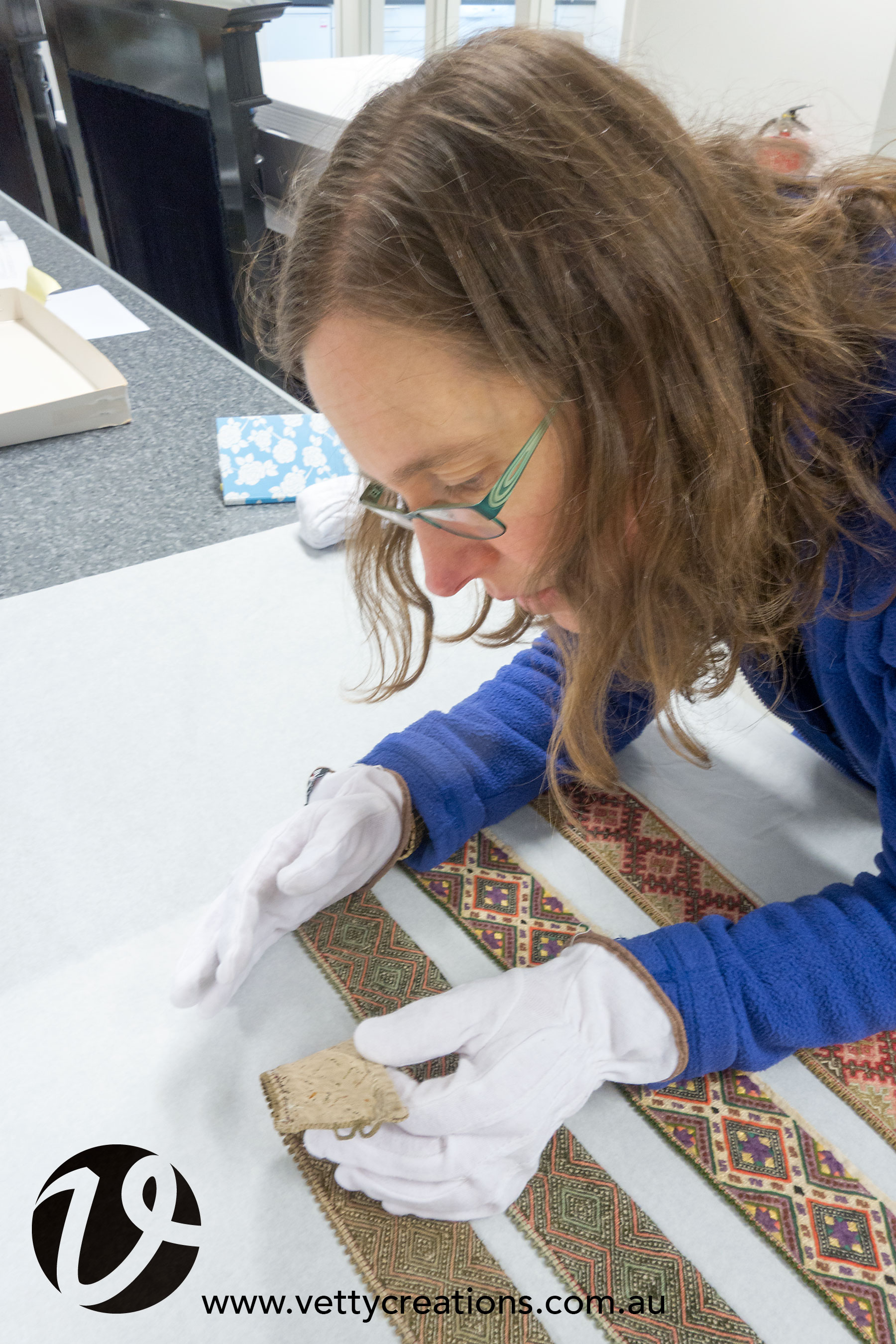
Studying old examples of smøyg collars in Skien, Norway

I focus on OLD embroideries. I do my research in museums looking at pieces that can be hundreds of years old. For me to be safe, copyright-wise, they need to date from earlier than about 1860, give or take a bit. So you can see that a work from the 1600s, as are many of the ones I’m focussing on in my next book, “Friesian Whitework”, is no problem at all. They’re most definitely out of copyright.

Photographs of those embroidery works are a different matter. The copyright in the embroidery might have expired, but when the photo’s copyright expires depends on when the photographer dies. When I am including photographs of embroideries in my books, any that are *not* taken by me (I’m still alive and still hold my copyright!), require permission for me to use, and often payment, which assigns me a licence to use the copyrighted work. Any that *are* taken by me still need permission from the owner of the embroidery (maybe a museum or a private collector) to reproduce the photo in my book.

Back to the old embroideries themselves: while on things like my band samplers, I do often reproduce old designs all combined together (in other words, *copies*), most of the projects I make are my own embroidery designs based on the motifs and principles of the traditional style of design for that technique.

Ethical or moral considerations

The other thing that is important to me, morally – which is quite different to legally – is that I want to show respect for the work, and for the original creator of the work. I’m really big on the idea that I want to create books that show great respect for the original custodians of the embroidery. I want to honour them by presenting their work in a way that makes them say, “She’s represented our work well”, and the rest of the world say, “WOW! That’s beautiful!”

I’m not “ripping off” other people’s work. I’m presenting old styles of embroidery to the world with great respect for them and their creators. I want others to see these beautiful works and admire them. I also want people to be able to make works like them, thereby keeping the skills and techniques bound up in these beautiful old embroideries, ALIVE!

To me, it all comes down to respect. I want to make my way through this world in a way that shows respect to those around me and those who have come before me.

June 27th, 2020 | Category: embroidery musings, historical embroidery, writing books | 6 comments

White Threads FlossTube #37 – Hardanger kloster block tutorial

Today’s White Threads FlossTube video is a Hardanger kloster block tutorial. Hardanger kloster block are the satin stitch building block on which Hardanger embroidery is built. They need to be precisely placed and precisely stitched so that everything else can be put in the right place and worked perfectly as well. With this video from Whitework Queen, Yvette Stanton, you’ll learn all the things you should do, as well as the things you shouldn’t do!


If you are reading this in an email, the video can be found at https://youtu.be/mUUhXnfoJ9w

Episode notes:
Elegant Hardanger Embroidery by Yvette Stanton
Early-Style Hardanger by Yvette Stanton
The Right-Handed Embroiderer’s Companion by Yvette Stanton
The Left-Handed Embroiderer’s Companion by Yvette Stanton

June 26th, 2020 | Category: Early-Style Hardanger, Elegant Hardanger Embroidery, embroidery musings, embroidery stitches, FlossTube, hardanger, hints and tips, how-to videos, The Left-Handed Embroiderer's Companion, The Right-Handed Embroiderer's Companion, whitework | Leave a comment

Sharing photos of needlework you’ve stitched

Continuing on from my previous posts about Pinterest and copyright, you may have been thinking, “Well, what if I take a photo of the embroidery I’ve just completed, and it wasn’t my design? Is that ok?”

I’m not a lawyer. My advice therefore is as someone who wants to respect others and give credit where credit is due.

If you’ve stitched something, you’re right to want to celebrate that. Taking a photo of what you’ve made and sharing it with others so that they can celebrate with you is a lovely thing to do. I would go ahead and do it!

If the design is yours, you have every right to share that photo, and even the design, if you wish.

If the design is not yours, it would be courteous and respectful to credit the designer.

I have people who send me photos of their completed work, of my designs. With their permission (because they hold the rights to the photograph), I share these photos on my social media etc, crediting them as the stitcher. It goes both ways!

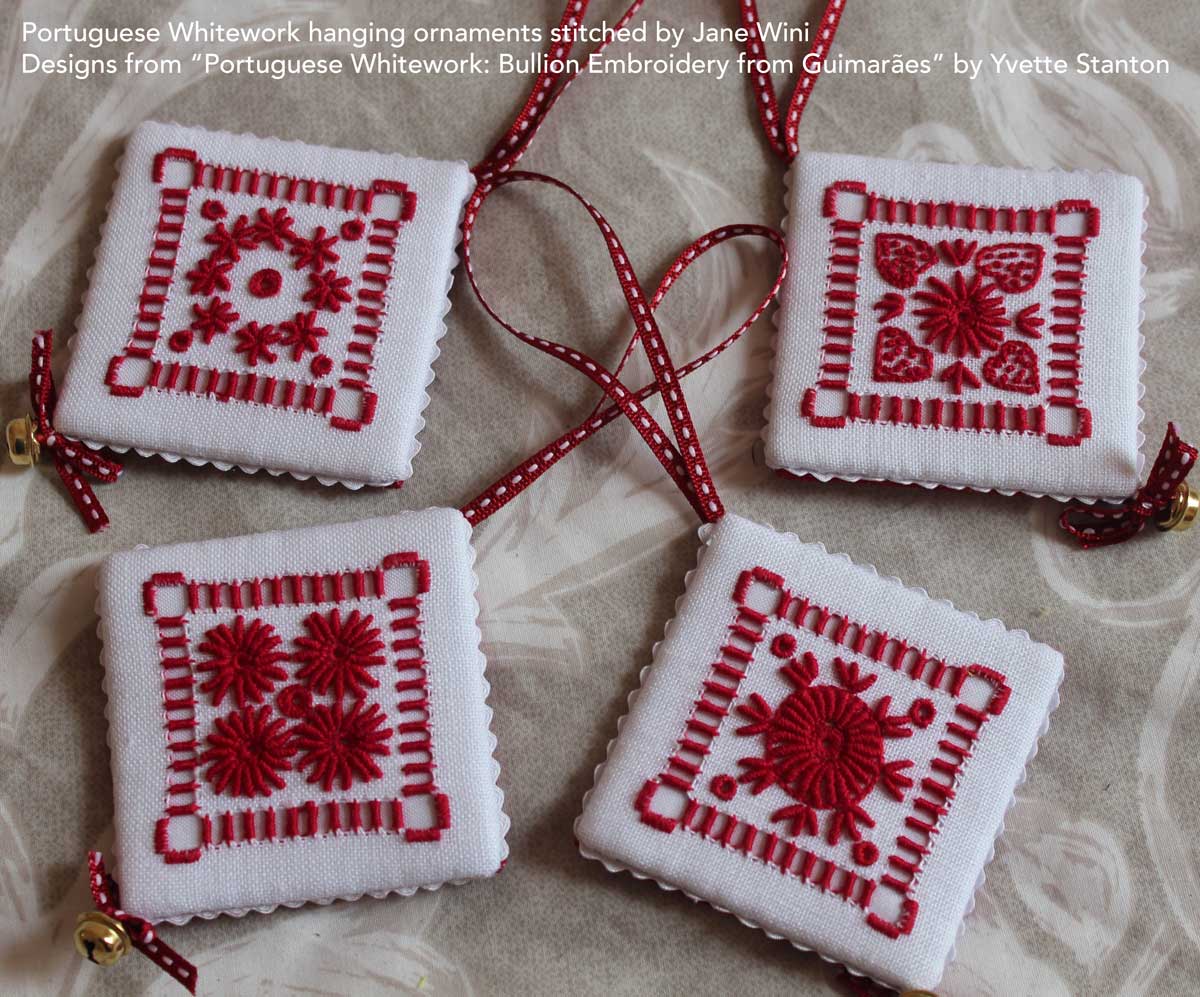
An example of Jane’s beautiful stitching that she gave me permission to share. These are designs from my book, “Portuguese Whitework”.

I know of at least one designer who does not generally allow photos of her own work to be shared. And if it is shared, she carefully curates what and how much is shared, and where. This is her right. I think her caution is because if the photograph shows enough detail, there is concern that someone could reproduce the design from the photograph alone.

This is certainly a concern. In some instances, this would indeed be possible, and we designers are counting on people to respect our rights and instead purchase the design.

However, from my point of view, most of my designs are not just designs only. Particularly in my books, you’re not just purchasing my designs, but you’re purchasing the detailed instructions with which to make them. In my books, you’re also purchasing background information about the style of the embroidery and its cultural context.

And then, a designer has to weigh up something else. Is the free publicity worth it? To most of us, it is definitely worth it for stitchers to be posting photos of their stitching of our work (if we are credited!).

It is generally accepted that word of mouth is the best form of advertising, so I’m very happy for you to do this. But mostly, I’m happy for you to celebrate your achievements!

June 26th, 2020 | Category: designing, embroidery musings, writing books | 5 comments

Pinterest can be useful

Despite my coming down on Pinterest rather hard yesterday for their perceived lack of interest in upholding copyright, I actually find Pinterest to be a useful tool. And I know many of you do too.

Darla commented on my blog post the other day saying,

I will use Pinterest to find things I might enjoy stitching, but if I can’t determine who designed it so I can purchase it, it remains where it is in cyberspace.

This is a perfectly good and acceptable way to use Pinterest. Darla uses the image searching capacity to find things of interest that she can then purchase through the regular channels. If she can’t find out who the designer is, then she doesn’t use it, however pretty or perfect it might be.

Dima said,

I always try to do a thorough search if I find something on Pinterest. I personally don’t like pinning stuff on Pinterest unless it’s from the direct source. To help find the source, you can do a google image search. It doesn’t always work, but I’ve gotten good results with this method.

I have noted before that many people don’t know how to do a Google image search. If this is you, and you’d like to know, please let me know and maybe I can do a video or write a post explaining how to do it.

Ways I have used Pinterest, that I feel show respect to other creators

I use Pinterest when researching unusual forms of embroidery. I look for images of folk dress to try to find embroidery that I might not have noticed before. When I find images of interest, I dump them onto a private Pinterest board so that I can find my way back to the source of those images again, which, in my case are usually museums. It’s a really useful visual research tool.

I’ve used it when researching product packaging, such as paper bags. When I find one that’s a suitable size and price, I create a pin for it on a private board. Then I can go through them all at the end and work out which one to purchase. It’s like a visual spreadsheet, where instead of having to type in (or paste in) the information, I just use a link to the original information instead.

I have also used it to build up reference for possible project applications. There are only so many framed things we can have on the wall. Maybe my readers would like to make embroidered potholders? If I think that’s a good idea, I can put a pin of a pot holder on a private board. Or a picture of a pencil case, or a long table runner, or a hand towel. Then the board becomes a repository of ideas that I can draw from. Note that I’m not collecting things I’m going to copy. I’m collecting ideas for things I could put embroidery on.

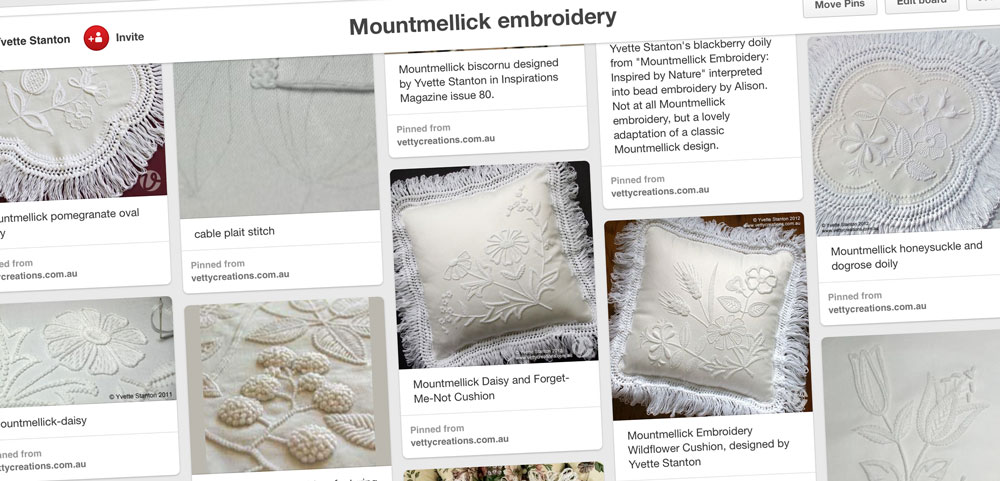
Mountmellick embroidery Pinterest board

My Mountmellick Pinterest page

Another way I have used Pinterest is to collect together reference images (usually from museums, or my own images) of embroidery for a class I might be running. Then I provide the link to the board to the students so that they can access the images, if they’re wanting to do more research. It’s like providing them with a bibliography, but instead being links to images.

There are many ways to use Pinterest that allow us to act in ways that show respect for other creators of work. It is just a pity that some use it for illegal and unethical means. (We could, however, consider that even the act of *pinning* an image that is not our own, breaches copyright, seeing we are “reproducing” an image that we do not own the rights to. As you can see, this is a legal minefield…)

Ways I don’t use Pinterest

I don’t upload charts – mine or anyone else’s. I don’t download charts. And if I did go looking for charts it would ONLY be so that I could then purchase them through legitimate means.

Using Pinterest to download charts that have not been put there by their copyright holders breaches the copyright of the copyright holder. And how do you know if they’ve been put there by the copyright holder? Chances are, they haven’t, so my rule of thumb is to make the assumption that they have not. And therefore I wouldn’t touch them with a barge pole.

Copying anything which is covered by copyright, whether it is for your own personal use, or to sell the resulting product, or to share the chart/instructions/pattern, deprives someone of the payment for that usage. It is stealing.

Uploading charts that you do not hold the copyright for, breaches copyright and also enables other people to breach copyright. It is stealing. In the case of “freebies” put out by designers, I still wouldn’t share these designs, because they’re not my designs to share.

How can you help?

If you are a concerned citizen, and you see things on Pinterest that you think might breach copyright, please report it to the designer, preferably with a link to where you found it. Then they can act on it.

The other thing you could do is to go through your Pinterest boards and if there are any charts pinned there, you could remove them. That way, others will not find them on your boards and re-pin them on their boards. You’d be removing yourself from the chain of “sharing”.

Pinterest is a great tool, and I’m glad to be able to use it. However, I want to use it only in ways that respects others and their rights.

Thank you to all of you who use Pinterest in a way that respects the rights of others.

—

Note: I’m not a lawyer, and I think that will be quite obvious from what I’ve written here. Do not take this to be legal advice.

June 25th, 2020 | Category: embroidery musings | One comment

White Threads FlossTube #36 – More plaited braid stitch

Today’s episode of White Threads Floss Tube (number 36 – I can’t believe I’ve done that many already!) has wide ranging topics. They include how to choose the right needle size for your thread; a reader sample of plaited braid stitch successfully made using only my instructions; two plaited braid stitch projects both of which feature strawberries (and I don’t even like eating strawberries!); and a run down of all the wonderful things you’ll find on my blog, White Threads, around now.


If you’re reading this in an email, the video can be found at https://youtu.be/bQgZNc_guhY

Episode notes:
0:00 Intro
2:01 Choosing the right needle size for your thread
4:13 Lesley Fudge’s plaited braid stitch sample
5:04 Strawberry Christmas ornament, with plaited braid stitch
5:31 Elizabethan Strawberries panel, with plaited braid stitch
6:49 What you’ll find on my blog, White Threads

The Left-Handed Embroiderer’s Companion by Yvette Stanton
The Right-Handed Embroiderer’s Companion by Yvette Stanton
Stitches mentioned: plaited braid stitch p122-123, buttonhole filling with return p30, spiral trellis stitch p154.
White Threads Blog – http://vettycreations.com.au/white-threads/

June 24th, 2020 | Category: Elizabethan embroidery, FlossTube, hints and tips, The Left-Handed Embroiderer's Companion, The Right-Handed Embroiderer's Companion | Leave a comment

Pinterest and copyright

The following quote is from Pinterest’s Copyright Policy.

Pinterest respects the intellectual property rights of others and we expect people on Pinterest to do the same. It’s our policy—in appropriate circumstances and at our discretion—to disable or terminate the accounts of people who repeatedly infringe or are repeatedly charged with infringing copyrights or other intellectual property rights. https://policy.pinterest.com/en/copyright

However, given the way these things play out in real life, it appears to me that Pinterest do not really respect copyright.

When I put my digital photos in to be processed at the camera store, I have to tick a box that says I am the copyright holder of the images and their content. When I upload something to Pinterest, I do not have to tick any such box. Now, ticking a box doesn’t guarantee that people are telling the truth, but it does alert them to the fact that there may be an issue here. Having such a box would be one way of Pinterest showing that they may actually have some respect for copyright. It would alert people to the fact that copyright should be considered.

I see things all the time on Pinterest that are breaches of copyright, such charts that have been uploaded by people who do not hold the copyright in them.

There is no easy way to report these things.

I went looking for charts of a well-known cross stitch designer, who I am *pretty sure* will not have posted her charts on Pinterest herself. Unfortunately, it was easy to find some.

report pinNear the top of the page, there are three small dots. By clicking on them, you’re given the opportunity to report the pin.
So I chose that option, and these are the options that were presented.

There is no option there to report a pin for copyright breaches. None at all. I cannot do it.

Back to the Pinterest copyright policy again, and it says this:

If you’re a copyright owner or authorized to act on behalf of one, you can report alleged copyright infringements on Pinterest by completing the DMCA Notice of Alleged Infringement and sending it to our designated copyright agent. https://policy.pinterest.com/en/copyright

I’m not the copyright holder or their agent, so therefore how do I know that it has been pinned without their permission? Well, apart from the fact that it is fairly obvious that it hasn’t been posted with their permission, I can’t know that, and nor can I prove it.

So the only people who can report breaches of copyright are the owner of the copyright and their agents. Look, I realise there will be a good legal reason for this. However, can’t we have some way of letting Pinterest know that there is a potential problem with some of their content?

If we were able to flag, “There may be a copyright breach with this content”, then Pinterest could have some idea of the magnitude of the problem. And quite frankly, my feeling is that it seems they’re happy to have their heads in the sand on that one. I wonder if this is really their intention?

So, until Pinterest provides a way, for concerned citizens who care more about copyright than they appear to, to flag potential copyright breaches, the only way to deal with this aspect of the problem, for now, is to alert the copyright holder.

My email address, for those who wish to know it, is yvette at vetty creations dot com dot au (remove the spaces and change the words to symbols where appropriate).

I have spent many hours reporting breaches of my copyright. I could probably make it my full time job. That wouldn’t leave me much time for actually writing my books, though, would it?

Thank you to all of you who use Pinterest in a way that respects the rights of others.

In my next blog post I’ll talk about safe and useful ways to use Pinterest. It is a good tool, after all!

—

Note: I’m not a lawyer, and I think that will be quite obvious from what I’ve written here. Do not take this to be legal advice.

June 24th, 2020 | Category: embroidery musings | 4 comments

It isn’t ok

Recently I saw a photo of an embroidery that someone had done, and rightly, they were very proud of it. It was beautifully worked.

They said that they had found the design on Pinterest, and they didn’t know who the designer was.

This made me incredibly sad, and sat extremely uncomfortably for me.

There is a designer out there who has not received just payment for their work. There is a stitcher out there who is quite happy to not pay the designer.

I know this happens everywhere. I know this happens all the time in the needlework world.

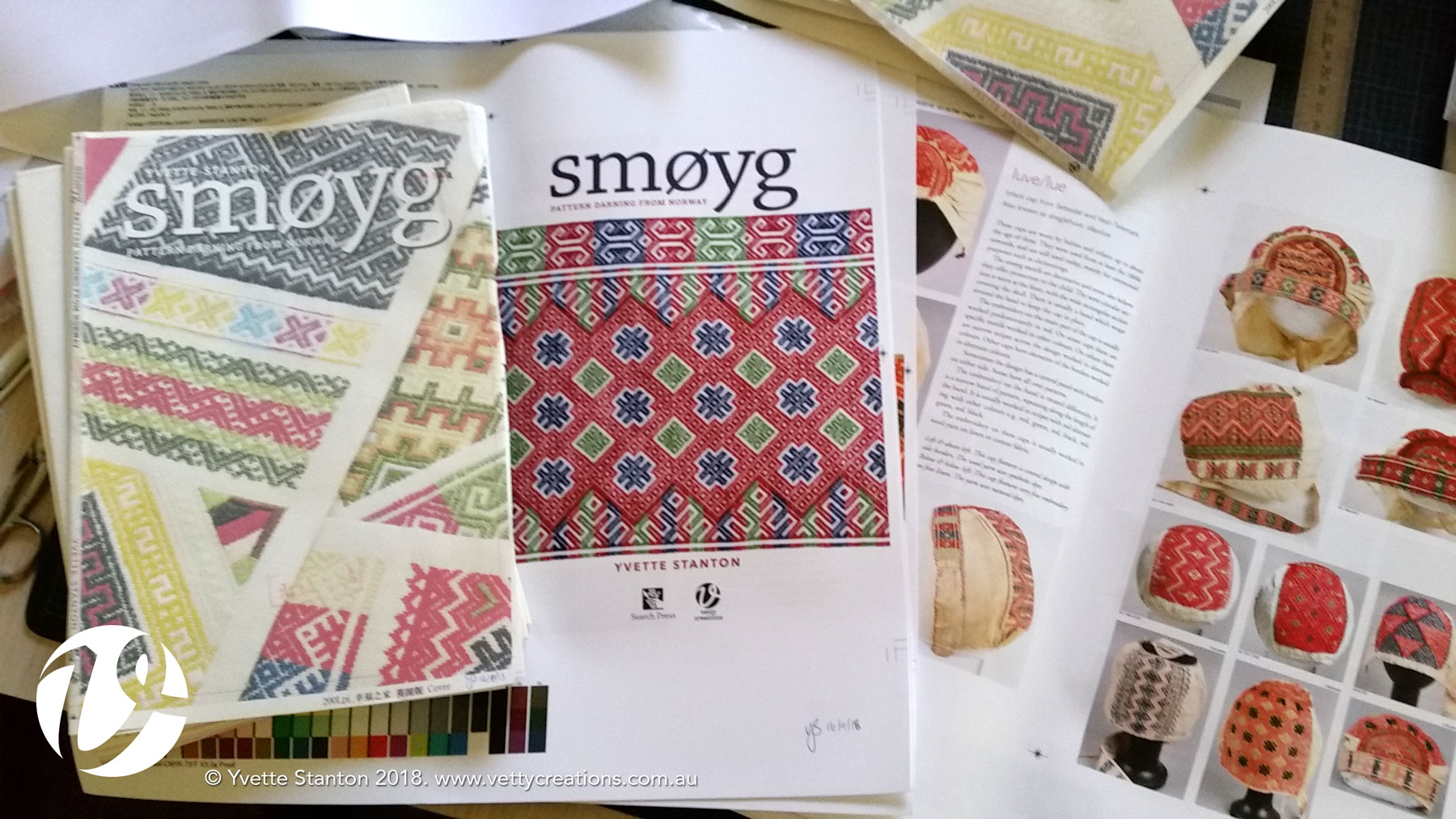
smoyg proofs

Smøyg proofs from the printer, for me to check. Just one small part of the process of writing a book.

I spend thousands of hours working on my books, which involves research, problem solving, designing, stitching, writing, photographing, and illustrating, amongst other things. I also spend many hours on my designs which are not part of my books.

Do I deserve to receive payment for these if you want to use my book or use my design? I think so.

Why do so many people think it is ok not to pay others for their work?

I don’t understand when it became ok to steal. It sounds harsh, but that’s what it is.

We should not be accepting that this is ok in the needlework world. It isn’t ok to not pay your plumber. It isn’t ok to steal the house plans the architect has drawn up. It isn’t ok to steal your groceries.

So why is it ok to steal needlework designs and use pirated copies of books, charts and designs?

June 23rd, 2020 | Category: embroidery musings, writing books | 14 comments

White Threads FlossTube #35 – Organza with Hardanger overlay

This episode of White Threads FlossTube has four examples of Hardanger with an organza overlay. Working with the overlay is an unusual technique, which makes the Hardanger quite difficult to do, but creates a gorgeous effect. There’s a bolster, an evening bag, a hanging ornament, and a needlecase, all with Hardanger worked on an organza overlay. If you’re wanting to try a small project, I have a pattern available on my website for the hanging ornament.


If you’re reading this in an email, the video can be found at https://youtu.be/h2vX87ya_ZI

Episode notes:
Organza bolster from Elegant Hardanger Embroidery by Yvette Stanton
Organza Hardanger ornament

June 22nd, 2020 | Category: Elegant Hardanger Embroidery, embroidery stitches, FlossTube, hardanger, making stuff, whitework | Leave a comment

White Threads FlossTube #34 – Sardinian dress ups

In today’s video I share some very precious holiday memories with you. While we were in Sardinia, for me to research my book, “Sardinian Knotted Embroidery”, we were fortunate to spend some time with some lovely Sardinian ladies who showed us some traditional costumes from Desulo, in Sardinia. I have heaps of photos of gorgeous embroidery, both whitework and brightly coloured work, for your viewing pleasure. And as always, there’s a story to go with it.

Thanks to the three lovely ladies who made this very special experience possible. It was the sort of beautiful cultural exchange that you never expect, and so therefore treasure forevermore. Grazie!


If you are reading this in an email, you can find the video at https://youtu.be/jcrJ4dwI55U

Episode notes:
Sardinian Knotted Embroidery by Yvette Stanton
Desulo, Sardinia
“Luoghi e Volti del Punto Filza” by Rosalba Lecca and Ebe Ciampalini Balestri. No ISBN.

June 19th, 2020 | Category: embroidery musings, Ethnic embroidery, FlossTube, travel | Leave a comment
« Newer Entries  
  Older Entries »
Yvette Stanton White Threads is the blog of Yvette Stanton, the author, designer, publisher behind Vetty Creations' quality needlework books and embroidery products.

New book now available!

Hardanger Filling Stitches
Hardanger Filling Stitches by Yvette Stanton. Order your copy today!
Find us on Facebook

Archived posts

Categories

  • book reviews (88)
  • Christmas ornament swap (13)
  • colour (6)
  • crazy hair (6)
  • customer embroidery (49)
  • designing (119)
  • dressmaking (26)
  • Early-Style Hardanger (91)
  • Elegant Hardanger Embroidery (42)
  • Elizabethan embroidery (25)
  • Embroidery classes (189)
  • embroidery musings (436)
  • embroidery stitches (206)
  • errata notices (11)
  • Ethnic embroidery (49)
  • exhibitions (111)
  • exploring the needlework internet (10)
  • favourite needlework items (69)
  • FlossTube (102)
  • Frisian whitework (73)
  • goldwork (12)
  • hardanger (232)
  • Hardanger Filling Stitches (72)
  • Hardanger Filling Stitches (1)
  • hints and tips (114)
  • historical embroidery (119)
  • how-to videos (34)
  • illustration (1)
  • Inspirations (25)
  • Introducing… (90)
  • left handed embroidery (78)
  • magazines (10)
  • making stuff (271)
  • merezhka (35)
  • mountmellick embroidery (176)
  • Mountmellick Embroidery: Inspired by Nature (60)
  • mountmellick supplies (49)
  • new products (104)
  • online book previews (7)
  • pattern darning (19)
  • pattern drafting (11)
  • photography (2)
  • Portuguese embroidery (166)
  • Portuguese Whitework: Bullion Embroidery from Guimarães (74)
  • public thanks (32)
  • published projects (27)
  • Punt 'e Nù (32)
  • Sardinian Knotted Embroidery (77)
  • sewing tips (9)
  • Smøyg (41)
  • Smøyg: Pattern Darning from Norway (39)
  • soapbox (6)
  • stitch along (44)
  • stitch dictionary (45)
  • teaching embroidery (192)
  • The Left-Handed Embroiderer's Companion (104)
  • The Right-Handed Embroiderer's Companion (70)
  • travel (172)
  • Ukrainian Drawn Thread Embroidery (35)
  • Uncategorized (169)
  • video previews (5)
  • White Threads Blog (91)
  • whitework (364)
  • writing books (306)