Vetty Creations header

Back to Vetty Creations website

White Threads

new Vetty Creations logo

As I mentioned recently, I’ve spent a bit of time lately working on a new Vetty Creations logo. It’s not that I didn’t like the old one, it’s that the old one doesn’t work very well in a digital environment. When I designed it, the digital environment wasn’t really important!

I had worked on it a bit, and was coming up with some things I really liked, particularly a symbol. But when I put it with the words “Vetty Creations” it just wasn’t working. My plan is that the symbol will be able to be used alone or in conjunction with the words.

I left it a week or two and came back to it, hoping that fresh eyes would help. They didn’t, so I emailed some ideas to two graphic designer friends for their feedback. One friend suggested that I should try a different typeface. I’d stuck with the old one in an effort to link the old and the new. But she was right – if I am changing the logo, then there’s no real need to keep a link.

The other friend had lots of great feedback about the symbol part of the design. I implemented her suggestions, and we both agreed it was much better!

I tried out all the typefaces installed on my computer and decided on one that I would never have chosen if I hadn’t tried it to see how it worked. It was not what I expected to choose, but I really liked the effect that it gave. This may sound a bit weird to non-designer types, but it looked really friendly, and I liked that about it.

I was all set to go, when I realised that I hadn’t checked the kerning on the letters. What is kerning? Kerning is the space between individual letters. Tracking is a different thing – it is the spacing across a word. So if you increase the tracking, the letters all spread out, and if you decrease the tracking, the letters all get closer to each other. With kerning, you kern individual letters – you adjust the space between pairs. This is often important beside letters such as v, and capital A, as with their sloped sides they have more white space between them and their neighbours than straight sided letters such as H.

These are really finicky little details, but us designers like to get these things right. With properly kerned letters, you shouldn’t notice. It will just “sing”! With badly kerned letters, you may just think something looks a little weird about a word. With really badly kerned letters, you may think it is two words.

I always check the kerning of any important lettering, such as a book title or the lettering in a logo. I don’t check the kerning of a page of text – that would be ridiculous!

The easiest way I have found to do this is to turn the lettering upside down. When you see words the right way up, you read them as words. You don’t generally see individual letters or the spaces between them (unless the kerning is bad!). If you turn it upside down, the words stop being words and letters so much, and your brain is more likely to register them as shapes and negative shapes (the gaps between the shapes). I find that it makes it much easier to adjust kerning because you are judging shapes and the spaces between them only, rather than thinking about letters, words and their meaning. Once I have fixed any kerning issues, I turn the lettering back up the right way, and merrily go on my way.

So, what does the logo look like?

Vetty Creations logo
It is not set in stone yet, so there may be a few more small changes, but for all intents and purposes, this is the new Vetty Creations logo.

September 18th, 2012 | Category: designing | 2 comments

questions and classes

Last week’s very interesting to write series on 38 count linen and whether it is evenweave or not, came about from questions that were emailed to me. I figured that if two people were asking such similar questions, then others might want to know the answers also.

If you have questions for me, please do not hesitate to ask them. It might be that I feel that the topic warrants explaining on the blog for the benefit of others, also.

I also heard last week from Berrima Patchwork that my Suzani Embroidered Applique Panel class is already half full. If you’d like to do this class, I suggest you should book in very soon!

Requests for teaching classes next year continue to come to me. I am nearly fully booked for next year, and then we will have to move on to 2014 bookings. It sounds quite ridiculous really! It you’d like me to come to your group, your shop, your retreat, your conference, or your country(!), please make your requests as early as you can. I cannot guarantee there will be a place in my calendar for you otherwise.

September 17th, 2012 | Category: Embroidery classes, embroidery musings, teaching embroidery | Leave a comment

Warp and weft revisited

The other day as part of my definition of evenweave, I explained what warp and weft were. One of my readers, Marilyn, who is both an embroiderer and a weaver wasn’t very keen on my definitions of warp and weft, so I am revisiting the subject.

Probably the best way to do this is to show you a video of someone weaving and then work from there. This video was taken at the Sabahar silk weaving workshop in Ethiopia.


For those of you who have daily blog posts delivered by email, you’ll need to view the video here.

The warp threads are those which are mounted onto the loom. They are long – long enough to stretch the whole length of the fabric, however long that is to be.

The warp threads are divided into two groups. Every second thread is grouped together in one group, and all the remaining are grouped in another group. Each group is threaded through a separate heddle (I believe that’s what they are called – they look like combs stretching across the entire width of the warp threads).

At the beginning of the video, you can see that the man has each of his feet on a pedal. He alternately pushes one up and one down. Depending on which pedal he presses determines which heddle moves up and which one is down.

When one heddle is up, it lifts those warp threads up, creating a little tunnel right across the width of the loom, with the warp threads from the other heddle at the base of the tunnel.

It is through this tunnel that the shuttle is moved from side to side. When the shuttle has passed one way, the heddles are switched, and the shuttle is threaded through from the opposite direction than it was previously.

thread spools and weaving shuttleThe picture right shows thread spools, and at the end of the www.vettycreations.com.au label, is a shuttle with a spool mounted into it. The thread on the spool forms the weft threads of the fabric.

In my previous definition of warp and weft, I said that weft is from side to side across the fabric or LEFT (rhyming with weft) to right and back again. Marilyn pointed out that what was left to right really depended on how you laid the fabric on the table and were looking at it. This was an excellent point. She suggested that from selvedge (edge of fabric) to selvedge was a better way to express it – and it is, but then we don’t get to use the “left rhyming with weft” memory aid!

However, if we think about it in terms of what the weaver is doing, he is indeed threading the shuttle/weft threads from left to right and back again!

sabahar scarf
Looking at the Sabahar scarf on the left, let’s go through those definitions again:

The warp threads go down the length of the scarf, and at the ends are gathered together in groups and tied into the fringe.

The weft threads go across the fabric from side to side, or from left to right. In the photo, they stretch horizontally across.

The selvedge (or selvage) goes down the sides of the fabric at the point where weft threads change direction and head back across the fabric to the other side. It is a woven edge.

Hopefully warp and weft are quite clear now. 🙂 But weavers are welcome to pick me up on anything I’ve gotten wrong!

September 14th, 2012 | Category: sewing tips | 2 comments

38 count linen – evenweave or not? Part 4

To pre-wash or not to pre-wash, that is the question.

Thanks to you, my lovely readers, over the last few days I have had some quite challenging questions. The main ones run along the lines of “do you pre-wash your linen before you count?” and “why don’t you pre-wash your linen before you count?”

Excellent questions.

With all the counting of linen that I did the other day, none of the linens were pre-washed. I have never pre-washed my linen before beginning a project.

Why not? I don’t know!

I pre-wash my polycotton Mountmellick fabric before using it. I pre-wash all my cotton patchwork fabrics before using them. I pre-wash all my dressmaking fabric before using it. I do this because it pre-shrinks the fabric, and removes any size from the fabric.

So why don’t I pre-wash my linen? I don’t know!

I suppose I’m being terribly inconsistent here! I guess it stems from the fact that I’ve always been taught to pre-wash dressmaking fabric, right back from when I did textiles at school, and probably from watching my mum making clothing when we were younger. But school never taught me to pre-wash linen, and my mum didn’t do embroidery, so she didn’t teach me. I’ve never read it in a book, either, come to think of it.

Does it make much difference, whether you pre-wash or not? Yes and no. It does in dressmaking, so why should it be any different for embroidery? When you pre-wash, the fabric shrinks a little. When on the loom for weaving, the threads get that little bit stretched, possibly to different extents depending on whether they are warp or weft threads. When the fabric is washed, those threads are able to relax back to their original state, thereby shrinking a little.

Marilyn, a reader who is both an embroiderer and a weaver, commented the other day that different fibres shrink different amounts. Linen is likely to shrink the least, cotton and silk a little more, and even more so with wool (on the whole). So while linen is the least likely to shrink, it is likely that it will shrink a bit. Jeanine, another reader, quoted Stefania Bressan who is an Italian embroidery designer and teacher, saying “Sotema 20L shrinkage is 7% for the warp and 4% for the weft.”

Shrinkage could therefore cause some problems if you’ve stitched on un-shrunk fabric, and then washed it later. If the amount of shrinkage was the same for both the warp and the weft, it would probably matter less, but as it can be different across both dimensions, it could make things go out of shape and pucker strangely. This is why we always pre-wash dressmaking fabric – we don’t want our clothes to fit us badly! Therefore it would make sense to pre-wash all linen fabric, as it is likely that we put MANY MANY more hours of time and effort into a hand embroidered piece than a machine sewn piece of clothing.

The more I write this, the more I am convinced that I have been terribly inconsistent in my pre-washing!

But on the other hand, with the amount of hand stitching I’ve done over the years, you would think that it might have been a problem before now. Surely, something would have ended up weird and puckered. However, nothing has…

If you’re never going to wash the fabric after you’ve stitched on it then it probably doesn’t matter, as long as you keep it extremely clean while you’re stitching on it. An example of this is if the piece is going to be framed. Unlike a piece of clothing, it will never require regular laundering.

Mary Corbet has written about pre-shrinking linen, and even gives instructions for how to do it well. On this page, if you scroll down a fair way (though all of it is interesting reading) you’ll find her tips on fabric preparation and shrinking.

Going back to our topic over the past few days, of whether 38 count linen is evenweave or not, pre-washing could definitely make a difference to whether a fabric is evenweave or not. Because the shrinkage of the warp and weft can be different, it could either make the fabric become closer to evenweave, or get worse.

So, over to you! Are you as inconsistent as I am with your pre-washing? Do you pre-wash linen? Or cotton? Or silk (most people I know don’t actually wash silk at all)? Or wool? Do you pre-wash some and not others? Why or why not? At the risk of opening up another can of worms, do you pre-wash your threads before stitching with them?

September 13th, 2012 | Category: dressmaking, embroidery musings, hints and tips, making stuff | 2 comments

38 count linen – evenweave or not? Part 3

On day 1 of this series we looked at the definition of evenweave. Yesterday, on day 2, we looked at the four 38 count linens with which I am familiar, and whether they are really evenweave.

Today we’re going to look at what to do if you have the linen for your Portuguese Whitework project and you discover it is not evenweave.

At the beginning of 2010, my family and I spent three months in Ethiopia. My husband was volunteering at an international school there, our children attended the school, and I just went along for the ride and learned how to run a household in a very different environment than what I was used to.

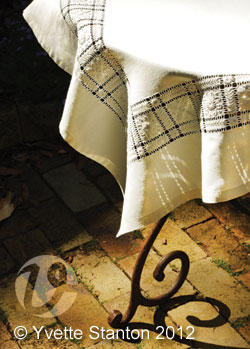
Portuguese Whitework tablecloth by Yvette StantonI’d decided to start the process of writing Portuguese Whitework: Bullion Embroidery from Guimarães with the largest project – the tablecloth – because that would probably keep me going for the whole time we were there (it certainly did!). I took some lovely Portuguese linen to work on. As we learned yesterday the Portuguese linen was the least evenweave of the four 38 count linens I have now used. But I didn’t know that at the time!

The first step was to work the counted tacking so that I knew that everything was going to end up in the right place. As I worked, it didn’t seem right. The square turned out very rectangular! I counted and counted and counted again, to make sure everything was right. All the counting was correct.

Oh no! The fabric wasn’t properly evenweave!

When you’re in Ethiopia, there’s nowhere local that you can go to get some replacement 38 count linen. I could have asked someone at home to purchase some for me and send it over, but that would have taken time and I didn’t even know of a source of other 38 count linen at the time!

I had to make do.

What do you do when you need evenweave linen, and the linen you have turns out to not be evenweave?

You fudge. 🙂

And so, I fudged. I realised the only way I could make it turn out looking square was to make adjustments to the thread counting, to add more threads into the short side, to bring it out to approximately the same length as the other side.

I worked out, through a process of trial and error, that if I added 2 extra threads into every repeat along the short side, it came out about the same as the longer side. I chose the places to include those two extra threads in each repeat (I made it so that some of the wrapped bars had 7 threads rather than the usual 6), and then had to remember that along that side, the counting was different for the tacking. Eventually I did it, and it worked out fine.

This is the sort of process you’ll need to go through if you have linen you have to use for your Portuguese whitework, and you discover it is not as evenweave as you would like it to be.

If you know the thread count of the total design, tack that out on the fabric for each dimension. You will see how much longer one side is than the other. Measure the long side and the short side over the full thread count of the design. Deduct the shorter measurement from the longer one. This measurement (in cm or inches) is the difference between the two sides. Using the measurement of the difference, lay that along the SHORT side, and count how many threads fit into that distance. Whatever that works out as is how many extra threads you need to add into that side to fudge it so that it matches the other side. If you have 60 extra threads, you’ll need to evenly distribute those 60 threads into the shorter side of the design.

This is not the easiest thing to do! Make sure you use counted tacking to lay out the whole design before you start any of the real stitching or you’re just going to get lost! And when you’re tacking along merrily, it can be difficult to remember to add those extra threads in where they are needed. But stick with it, and make sure you do it right, because in the long run, the results will be so much better for your perseverance!

Again, if you have any questions about this, please ask. There have been some really interesting questions asked and comments made over the last few days, so if you haven’t already read them, you may like to go back and check them out. Tomorrow, I think we will deal with the big question of to pre-wash or not to pre-wash.

September 12th, 2012 | Category: designing, embroidery musings, hints and tips, making stuff, Portuguese embroidery, Portuguese Whitework: Bullion Embroidery from Guimarães, whitework | Leave a comment

38 count linen – evenweave or not? Part 2

Yesterday we established what evenweave linen actually is. Today, let’s consider its relevance to 38 count linen.

In creating my book Portuguese Whitework: Bullion Embroidery from Guimarães, all the linens I used were 38 count (also known as 20L linen in some markets). I tried a number of different brands:

  • Sotema linen from Italy
  • Graziano linen from Italy
  • a Portuguese linen from a manufacturer just near Guimarães, sent to me by a Portuguese stitching friend

So, how did they rate as evenweave or not? Please note that I do not wash linens before I use them, so none of them are preshrunk.

Let’s start with Graziano. While doing the book, the Graziano linen that was available was Nuovo Ricamo. It was a lovely linen that I very much enjoyed using. It has now been discontinued by Graziano, and replaced by a linen called Pronto Ricamo. Pronto Ricamo is not as high quality as Nuovo Ricamo.

Graziano Nuovo Ricamo 20L/38 count linen
While this fabric is no longer available, some of you may have it in your stash, so I am including it in my survey.
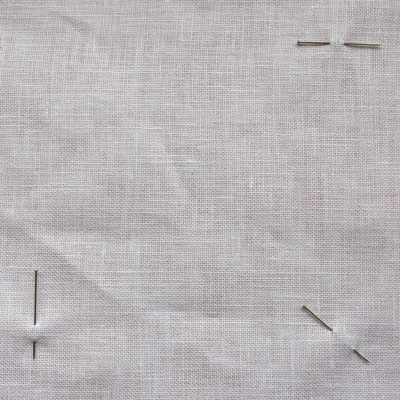
Graziano Nuovo Ricamo linenFor this linen, over a distance of 10cm (4 inches) I counted 150 x 153 threads.

Graziano Pronto Ricamo 20L/38 count linen
Graziano Pronto Ricamo linenFor this linen, over a distance of 10cm (4 inches) I counted 150 x 154 threads.

Sotema 20L/38 count linen
I used Sotema linen for the runner in the book, and I enjoyed it very much.
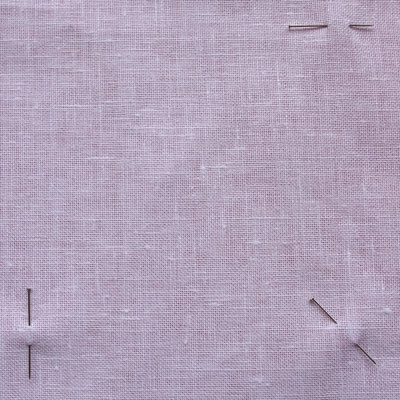
Sotema 20L/38 count linenFor this linen, over a distance of 10cm (4 inches) I counted 152 x 156 threads.

Portuguese 20L/38 count linen
I don’t know the brand of this linen, but it comes from a manufacturer very near to Guimarães.
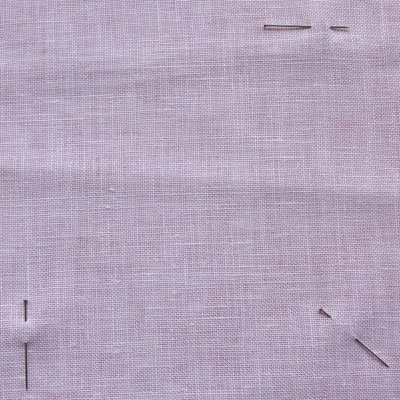
Portuguese 20L/38 count linenFor this linen, over a distance of 10cm (4 inches) I counted 152 x 158 threads.

So what do we learn from this?
Firstly, the Graziano Nuovo Ricamo linen is the one that has the closest number of threads, with a difference of only 3. The Graziano Pronto Ricamo and Sotema linens are the next closest, with a difference of only 4 threads. The Portuguese linen has a difference of 6 threads.

Over a small pattern of 10 x 10cm (4 x 4 inches) or less, none of these would be particularly noticeable. Over a large distance of 100cm (40 inches), then the differences would be much more noticeable:
Nuovo: 30 threads difference
Pronto: 40 threads difference
Sotema: 40 threads difference
Portuguese: 60 threads difference

The difference over that long span for the Portuguese linen is twice the number of threads than the Nuovo linen. That makes quite a lot of difference!

A interesting question was raised yesterday in an email to me: “If a fabric is sold as evenweave does that mean you can trust the designation or do you still recommend counting?”

If a linen is sold as evenweave, then I would expect it to be pretty close to having an equal number of threads across the same distance for the warp and weft. But it is highly likely that it will not be exact. Therefore, I do recommend counting if it is at all important – such as if your design is meant to turn out square. If you don’t count, and it is important to the project, you’ll soon find out, because you’ll see it is not turning out as you expected!

Tomorrow we will look at what you can do if there is a large difference between the quantity of warp and weft threads.

September 11th, 2012 | Category: embroidery musings, hints and tips, Portuguese embroidery, Portuguese Whitework: Bullion Embroidery from Guimarães | Leave a comment

38 count linen – evenweave or not? Part 1

At the end of last week I received two emails about whether the 38 count (also known as 20L) linens which are on the market are evenweave or not.

Let’s start with a definition of evenweave:
Evenweave linen means that over the same direction across both the weft and warp of the fabric there are the same number of threads. Therefore if you measured a distance across the weft of the fabric (to remember which one that is, it is from left to right or side to side across the fabric – and left rhymes with weft) of say 10cm or 4 inches, and counted up all the threads, in theory they should match the number of threads over the same distance of the warp (down the length of the fabric).

I will say this next point very emphatically: evenweave has nothing to do with whether some threads are thicker or thinner than others. Slubs in the linen have no bearing on whether the fabric is evenweave. Now that we have also established what evenweave is not, let’s go back to the effect it has practically.

If the quantity of threads over the same distance differ, then the linen is not evenweave. But are there really many “evenweave” linens that are truly evenweave and have exactly the same quantity of threads over the same distance on both dimensions of the fabric? Not often!

If this is the case, what can we consider evenweave, and what would we not consider to be evenweave?

If the thread quantities differ only slightly e.g. over a distance of say 10cm/4inches, there is a difference of only a 2 or 3 threads, then that’s actually pretty good, and probably as good as you can hope for.

If they differ by about 10 or more over that distance, then that’s not a great result, and I would definitely not consider the linen to be evenweave.

Why is evenweave important? Sometimes evenweave is not important. If you’re working on the surface of the fabric, and not counting threads to determine the placement of stitches, then it does not matter at all. However if you’re working counted embroidery, where the placement of stitches IS determined by the number of threads you’ve counted over, then it can be important.

For counted embroidery, usually the time that it has the most effect is if you’re working square designs. If your square is meant to span 100 threads, and on one dimension of the fabric that 100 threads spans 10cm, and on the other it takes only 8cm to span 100 threads, then your square is not going to be very square!

If your fabric seems to be nearly evenweave (say with a difference of only 1-2 threads over 1 inch), then will it be ok? If you’re only making a small embroidery, which spans only a small distance, such as 7cm or 3 inches, then a difference of 2 or 3 threads over that whole distance is not going to show up much. It will mean that if the design is supposed to be square, it will just turn out slightly rectangular, but probably not noticeably so.

But, if you’re making a large embroidery, such as the tablecloth in my book, then any difference in the thread count is going to show up much more over that very large distance.

When 10cm and a difference of 10 threads is multiplied out over a large distance e.g. 70cm (so that would be 70 extra threads over one dimension), you can see that it makes a very noticeable effect. A square pattern would not turn out square on the fabric!

When 10cm and a difference of 2 threads is multiplied out over a large distance e.g. 70cm (with an extra 14 threads over one dimension), you can see that it is not so noticeable. It IS different, but probably not so different that you can’t live with it.

Tomorrow we will look at the 38 count linens that I am familiar with, and how they rate as evenweave.

If there was any part of today’s post that you didn’t understand, please ask questions. This is actually a really important concept for most counted thread embroidery.

September 10th, 2012 | Category: embroidery musings, hints and tips, Portuguese embroidery, Portuguese Whitework: Bullion Embroidery from Guimarães | 12 comments

Class listings updated

I spent much of yesterday updating the class page on my website. It is fully updated now, with all the details that I have so far. There is a visual listing of all the projects, so you can see all the photos together, and a calendar listing so that you can see what will be near to you, and when. You will see that I really am going to be very busy with teaching over the next year or so!

I also added a new board, Embroidery Classes with Yvette Stanton, to Pinterest so that you can see all the upcoming class projects there too.

The big announcement is that I can now reveal what I will be teaching at the Berrima Patchwork Quilting in the Highlands Retreat in July next year. Registrations for the retreat classes opened yesterday. I will be teaching two two day classes:

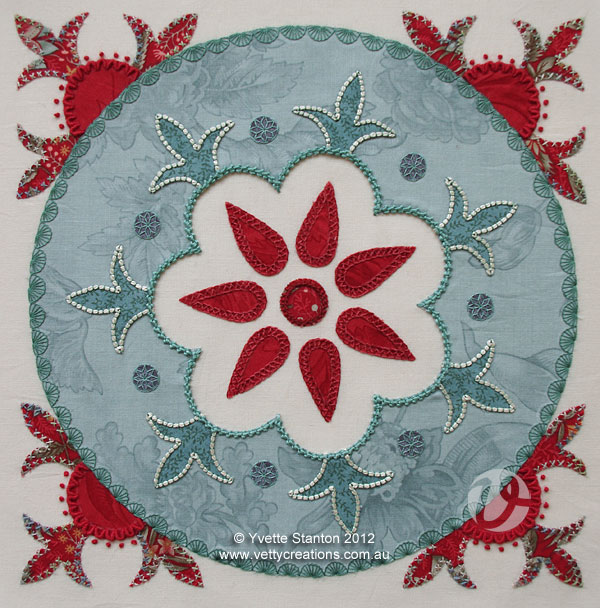
Suzani Embroidery Applique Panel
Suzani embroidery applique classExpand your embroidery stitch horizons with a range of stitches that can be used on raw edge appliqué. This panel (which is based on beautiful Suzani designs from central Asia) uses everything BUT the usual plain blanket stitch edging. Learn stitches such as Palestrina, overwrapped bullions, half chevron, couching and double chain stitch. Kits will be supplied with all fabrics already adhered so that we can immediately begin the fun stuff – working embroidery stitches! This class is suitable even for people who have never tried embroidery before – all skill levels are welcome!

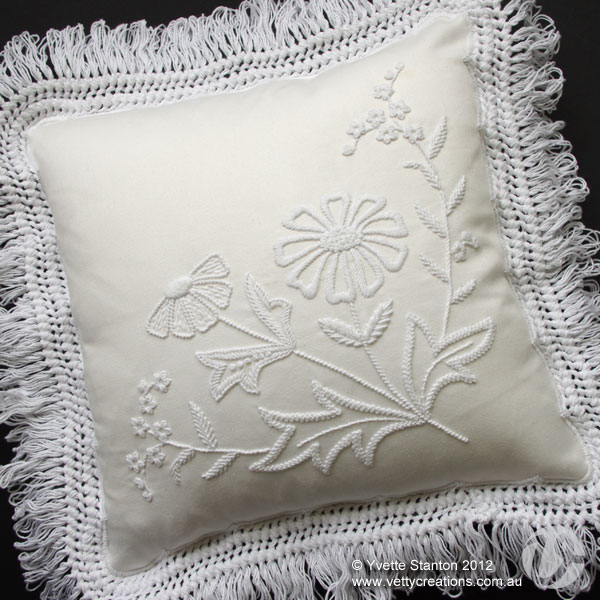
Mountmellick Daisy and Forget-Me-Not Cushion
Mountmellick Daisy and Forget-me-Not cushion classWe will be creating a cushion with a pretty design featuring daisies and forget-me-nots. All stitches will be taught in class, and a demonstration of the traditional knitted fringe will be given. This class is suitable even for people who have never tried embroidery before – all skill levels are welcome! The embroidery stitches will be learned and the cushion embroidery started in class. Cushion construction and knitting will be done in your own time following the class.

For more information on these classes, and to book in, please contact Berrima Patchwork.

September 7th, 2012 | Category: Embroidery classes, embroidery stitches, mountmellick embroidery, teaching embroidery, whitework | Leave a comment

customer embroideries on Facebook and Pinterest

If you haven’t already visited our Facebook page, perhaps you should. Yesterday I asked if anyone would like to share any photos of their embroideries done from my designs. I thought that we might be able to inspire each other!

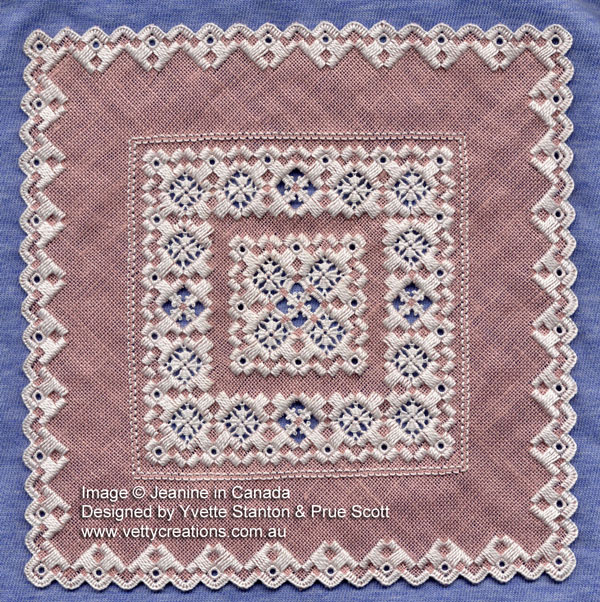
Olena Hardanger stitched by Jeanine in Canada

Olena Hardanger (featured in Finelines Magazine) stitched by Jeanine in Canada

Immediately, Jeanine in Canada (of Italian Needlework fame) emailed me two photos. One was of a Mountmellick project from “Mountmellick Embroidery: Inspired by Nature”, and the other was a hardanger doily, called “Olena” from an old edition of “Finelines” magazine. They were both beautiful!

I do have other photos that people have sent to me over the years, but I am not really willing to put them on Facebook or Pinterest without permission. So if I already have something of yours and you’re happy for me to put it on the Vetty Creations Facebook page or my new Pinterest board (which has precisely nothing on it yet!), then please let me know.

So if you would like to share the love, and let others see the beautiful embroideries you have created using my designs, then please send me your photos. I will properly credit them, so that everyone knows that you were the embroiderer. Credit should be given where credit is due!

September 6th, 2012 | Category: customer embroidery, embroidery musings | 7 comments

Sue Spargo visited Australia

Recently the amazing Sue Spargo, quilt maker and teacher extraordinaire visited Australia for a teaching tour. Sue teaches beautiful quilt designs often highly embellished with hand embroidery. You can see some of her gorgeous work at the blog of Addicted to Fabric, which was one of the shops she visited while she was here.

I was hoping to meet Sue while she was here, but the only time that was even slightly possible was going to the opening of the Hunters Hill Quilt Exhibition. Unfortunately I was unable to make it to that, so I didn’t get to meet her and thank her in person.

The Left- and Right-Handed Embroiderer's CompanionThank her? Yes. You see Sue Spargo is a wonderful promoter of my stitch dictionaries, The Left-Handed Embroiderer’s Companion and The Right-Handed Embroiderer’s Companion. I am incredibly grateful to Sue for her enthusiastic recommendations of my books. In a recent email to me she said “Thanks for the great books. I have used both your books for a while and have sold hundreds of them to my students.”

The thanks go both ways! Thank you Sue, for telling so many other people about how useful you find my books. I am so very grateful to you for your kindness!

Do go and explore Sue’s blog and see all the wonderful stitching!

September 5th, 2012 | Category: embroidery musings, embroidery stitches, stitch dictionary, teaching embroidery, The Left-Handed Embroiderer's Companion, The Right-Handed Embroiderer's Companion | Leave a comment
« Newer Entries  
  Older Entries »
Yvette Stanton White Threads is the blog of Yvette Stanton, the author, designer, publisher behind Vetty Creations' quality needlework books and embroidery products.

New book now available!

Hardanger Filling Stitches
Hardanger Filling Stitches by Yvette Stanton. Order your copy today!
Find us on Facebook

Archived posts

Categories

  • book reviews (88)
  • Christmas ornament swap (13)
  • colour (6)
  • crazy hair (6)
  • customer embroidery (49)
  • designing (119)
  • dressmaking (26)
  • Early-Style Hardanger (91)
  • Elegant Hardanger Embroidery (42)
  • Elizabethan embroidery (25)
  • Embroidery classes (189)
  • embroidery musings (436)
  • embroidery stitches (206)
  • errata notices (11)
  • Ethnic embroidery (49)
  • exhibitions (111)
  • exploring the needlework internet (10)
  • favourite needlework items (69)
  • FlossTube (102)
  • Frisian whitework (73)
  • goldwork (12)
  • hardanger (232)
  • Hardanger Filling Stitches (72)
  • Hardanger Filling Stitches (1)
  • hints and tips (114)
  • historical embroidery (119)
  • how-to videos (34)
  • illustration (1)
  • Inspirations (25)
  • Introducing… (90)
  • left handed embroidery (78)
  • magazines (10)
  • making stuff (271)
  • merezhka (35)
  • mountmellick embroidery (176)
  • Mountmellick Embroidery: Inspired by Nature (60)
  • mountmellick supplies (49)
  • new products (104)
  • online book previews (7)
  • pattern darning (19)
  • pattern drafting (11)
  • photography (2)
  • Portuguese embroidery (166)
  • Portuguese Whitework: Bullion Embroidery from Guimarães (74)
  • public thanks (32)
  • published projects (27)
  • Punt 'e Nù (32)
  • Sardinian Knotted Embroidery (77)
  • sewing tips (9)
  • Smøyg (41)
  • Smøyg: Pattern Darning from Norway (39)
  • soapbox (6)
  • stitch along (44)
  • stitch dictionary (45)
  • teaching embroidery (192)
  • The Left-Handed Embroiderer's Companion (104)
  • The Right-Handed Embroiderer's Companion (70)
  • travel (172)
  • Ukrainian Drawn Thread Embroidery (35)
  • Uncategorized (169)
  • video previews (5)
  • White Threads Blog (91)
  • whitework (364)
  • writing books (306)