Vetty Creations header

Back to Vetty Creations website

White Threads

Scurrilous claims in an old email

Studying smøyg in a museum in Norway

Me studying smøyg in a museum in Norway

A libellous email was sent to me many years ago by a person unknown to me, making scurrilous claims about a needleworker of note (not me).

Amongst their many complaints were:
– * is not formally trained at the Royal School of Needlework (RSN) and therefore is not qualified to teach or claim she is an expert.
– * is not creative because she only finds old designs in collections and copies them.
– * is not talented as she does not do the difficult techniques of stumpwork or goldwork.

My credentials: I have a university degree in design, with honours. Due to the reputation I have built through my books and teaching, I understand many see me as a whitework expert. I call myself the Whitework Queen, but only because someone else called me that first, and while initially I laughed it off, I then decided to own it.

Yet every single one of the claims above could also be said about me.

1. You don’t have to be trained at the RSN to be an expert or a good teacher. I have spent time with many embroiderers (or their work in museum collections) from whom I have learned much about traditional embroidery. Not one of them trained at the RSN, and nor did I. I have the utmost respect for some RSN graduates. However, I know many immensely talented, incredibly creative and highly skilled embroiderers and teachers who have never been there. It’s snobbery to say that’s the only way to be an expert or a good teacher.

2. My career is built on studying old items in collections and museums, then creating works based on those styles. It celebrates historical tradition and keeps those traditions alive. That does not mean I am not creative.

3. I do not do goldwork or stumpwork. Apparently that means I am not talented either. Oh well!

Many years on, I am still appalled by the email. The writer obviously felt they were saving the world from terrible peril. Apparently, we must fit the writer’s very narrow definitions of expert, creative and talented to be considered worthwhile. What a load of rubbish! Let’s celebrate people for their talent, their expertise, their skill and their creativity however they acquired it and demonstrate it.

(Why I did I keep this poison pen letter? I’m terrible at deleting emails. On checking, I have 101915 emails in my inbox! How embarrassing!)

Anyone suggesting who the subject of the email was will be blocked and their comment deleted.

May 16th, 2024 | Category: embroidery musings, historical embroidery, teaching embroidery | 6 comments

Purchasing seeing I won’t be at the Sydney Craft and Quilt Fair

Sydney Craft and Quilt Fair

Some of you may have been waiting to make purchases from me at the Sydney Craft and Quilt Fair in July. As I will not be attending due to continuing illness, sadly you won’t now be able to.

All is not lost! The Vetty Creations website (my website), is open 24/7, 365 days of the year! You can purchase books, supplies packs, kits, threads, fabrics, hoops, needles, scissors etc there at your convenience. If you have any questions about any of the products, please just ask.

If you were planning to purchase the supplies pack for the sampler from “Hardanger Filling Stitches” I planned ahead and ordered lots of supplies, so I’m ready to take your order now!

If you were planning to chat with me about something in particular, you can email me, or even call me (business hours, please. 🙂 ). If I’m not up to speaking with you when you call, we can arrange a time that suits us both. (I do love all the conversations that we have at the show!)

If you have a completed project of mine that you wanted to show me (I love it when people do this!) then please send me a photograph, because I’d love to celebrate with you!

In addition, Can Do Books will be at the show and will have my books available for purchase, in case you want to browse before you buy.

May 15th, 2024 | Category: exhibitions | Leave a comment

DIY Hardanger design

On the weekend, I had a question from Christine, who has nearly completed the sampler in Hardanger Filling Stitches. She’s now feeling like she’d like to design some of her own Hardanger pieces. I’m all for this! If I can teach you how to work the stitches and that makes you confident enough to embark on some of your own designing, that makes me incredibly happy!

Christine said that she’s tried designing on graph paper, but the grid was too small and her hand was too shaky. So she was wondering about other possibilities like computer programs.

When I design I use Adobe Illustrator. It’s not a program for the faint-hearted because it’s not like programs where you just drop the motifs on a grid – you start with nothing and create everything from scratch. All my charts are created from a library of motifs that I have created and built up over many years.

There are cross stitch design programs that say they can also be used for designing Hardanger, but I’m pretty sure I’d find them quite limiting, with the motifs provided. I have never used any of them, so I can’t make any recommendations. But they do exist, so you could look into them. Some names which I have heard, which may or may not exist anymore and which may or may not be suitable for you, include StitchGraph, EasyGrapher, WinStitch, and there are possibly others.

What I want to show you is where I started with my Hardanger designing. I started on paper. Then I progressed to doing it on my computer in a limited way, and my charts have evolved over many years to become what they are today.

Often I started with a very rough sketch of what the whole design could be, just on plain paper. This helped me to work out the overall design.

hand towel ideas

sketch of hand towel ideas

sketch of runner

Rough sketch of runner

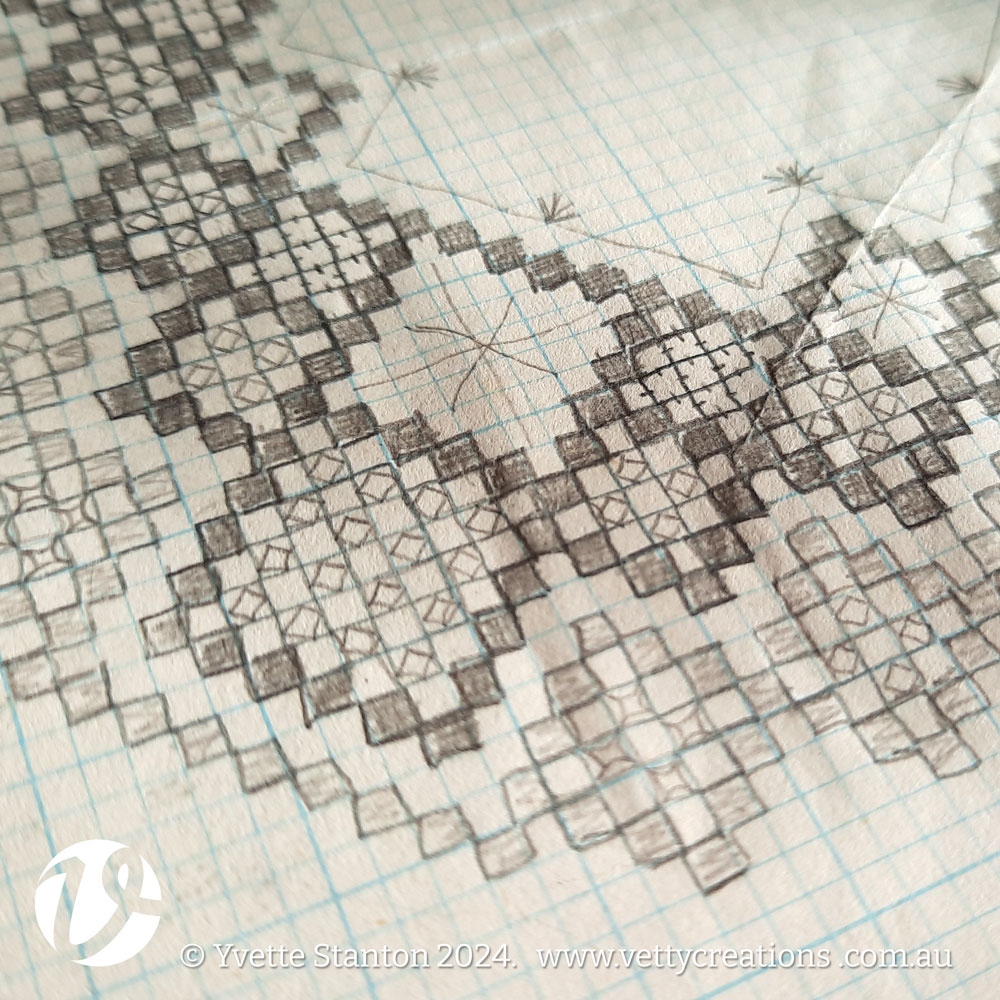
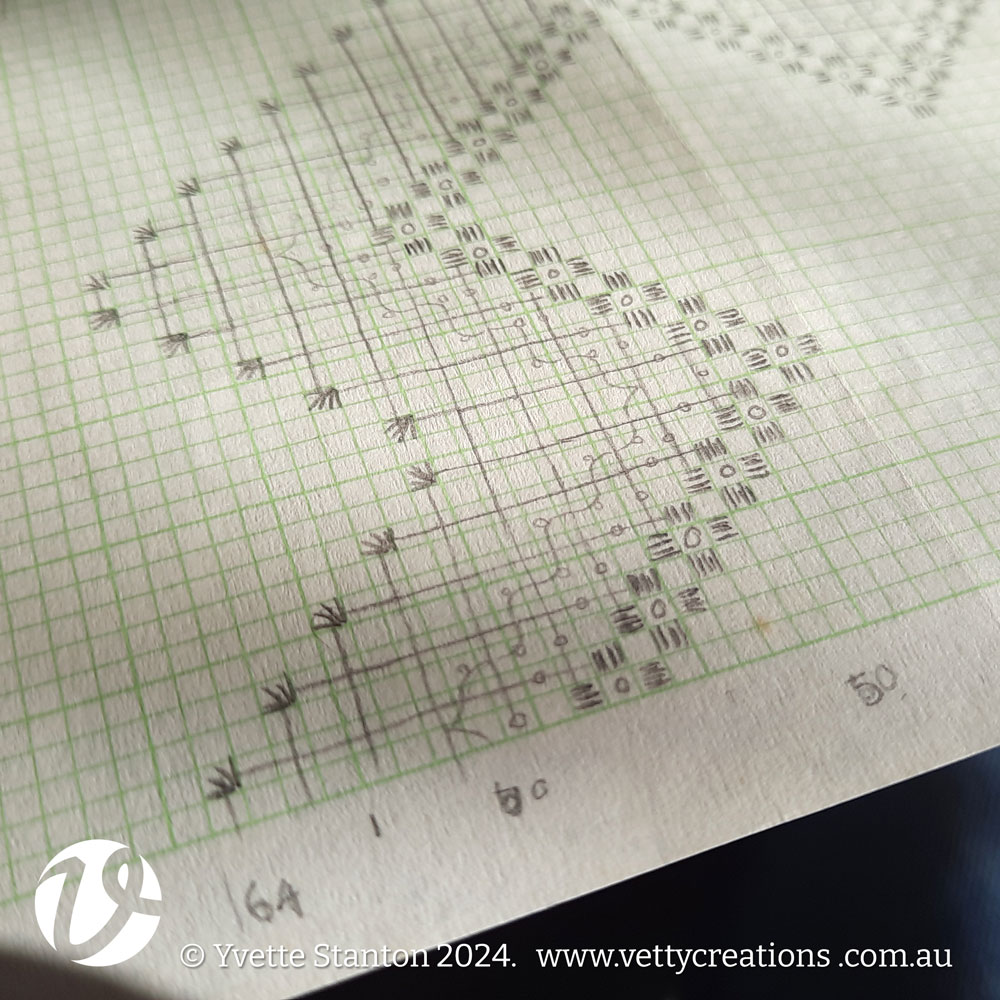
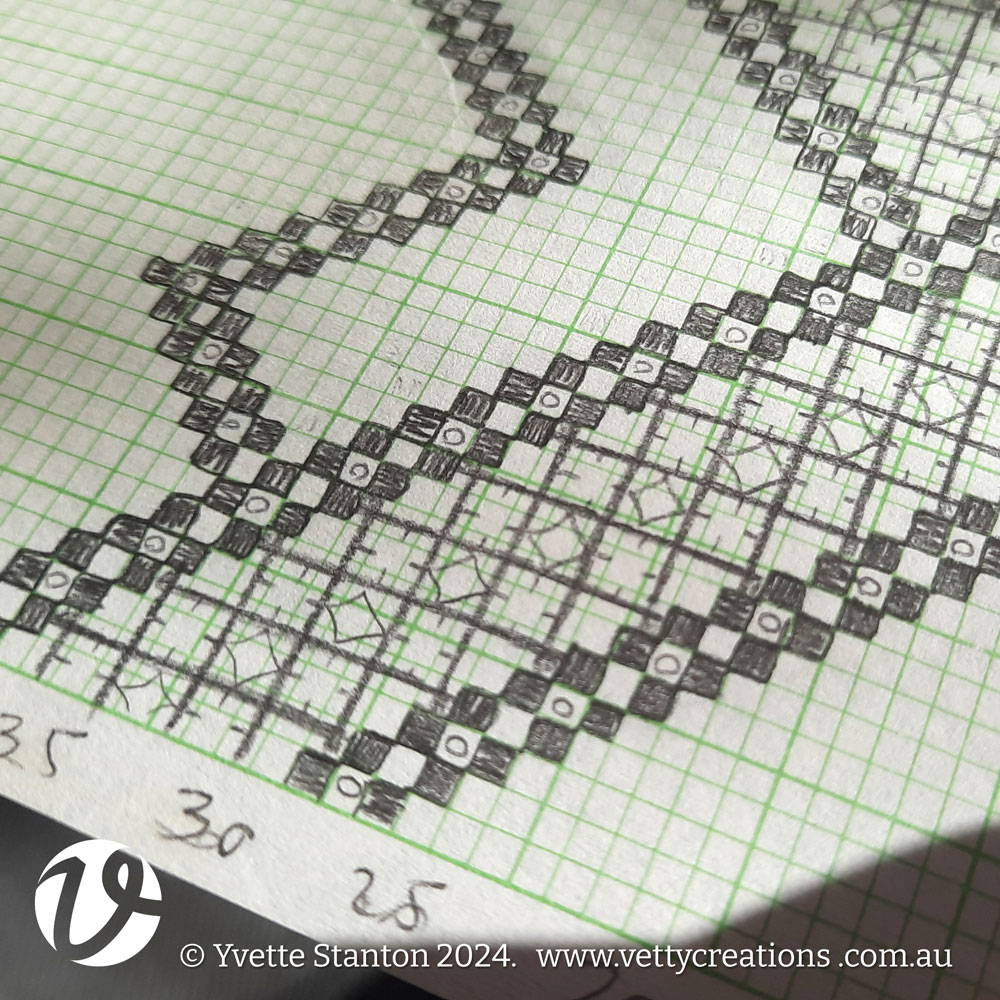
Then I used graph paper to add detail and work out the basic counting. For this I usually used 2mm grid squares. For the 2mm graph paper, each square was equivalent to 12 x 12 threads (3 klosters wide and high), or when I wanted more detail, each square represented a 4 x 4 thread block.

For those of you who use imperial/US customary measurements, somewhere between 1 and 2mm is 1/16th of an inch, and 5mm is just less than 1/4 in. (Do you know how much easier it is to work with decimal measurements?! ?)

chart

2mm squares. Each one represents a 12 x 12 block of threads; the span of 3 klosters.

chart

2mm squares. Each one represents a 4 x 4 thread block.

chart

2mm squares. Each square represents a 4 x 4 thread block.

chart

2.5mm squares. Each one represents a 4 x 4 thread block.

You could also use 5mm grid squares instead of the 2mm squares. It will turn out larger, so you’ll need more graph paper, but it may mean that it’s a little bit easier for unsteady hands or impaired eyes.

I did have some 1mm graph paper, so sometimes I did really detailed charts, where each grid line represented a fabric thread. Steady hands and a sharp pencil really help here!

1mm squares. Each grid line represents one fabric thread.

This was a basic chart done on computer. It was done in Illustrator, but it wasn’t designed to show full detail. This was just for my reference, and I would never release a chart like this to the public as there’s too much assumed knowledge.

chart

Basic chart on computer. Grid lines every 4 threads.

My later charts, done on computer, have more detail on them, so that you can stitch directly from them.

computer chart

Current day style of my charts

All this is to show, you *don’t* need a computer to be able to design Hardanger embroidery. It can make it easier, because it’s easier to move things around the page and try them out without the copious amounts of erasing. However, if you don’t have the skills to do it on computer, the learning curve to figure it all out is far harder than using paper, pencil and an eraser. It can also be far cheaper to use paper, pencil and an eraser than buying a computer and the software to use on it!

A hand drawn chart is not considered suitable for publication, so if you need charts for publication, I am available to create freelance charts based either off hand drawn ones or stitched projects. I have done this in the past for other publications.

May 14th, 2024 | Category: hardanger | 6 comments

replacement screw sets

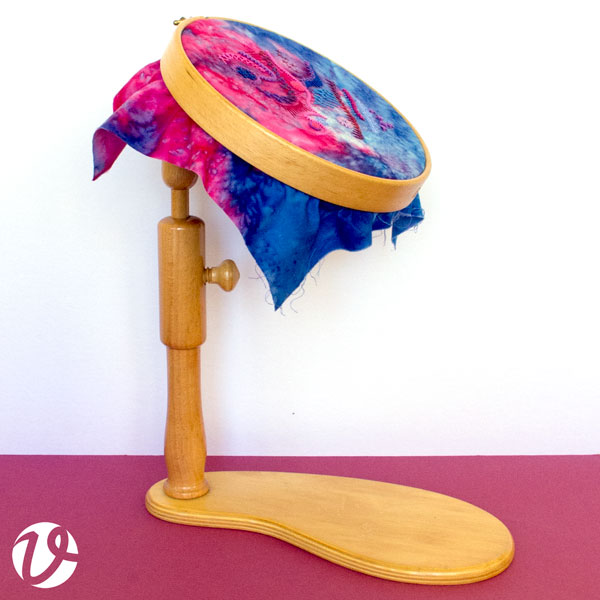
embroidery hoop with stand

One of my most favourite products that I sell (apart from my books!) are the Klass and Gessmann embroidery hoops with stands. They’re among my most favourite products because they’re some of the most useful.

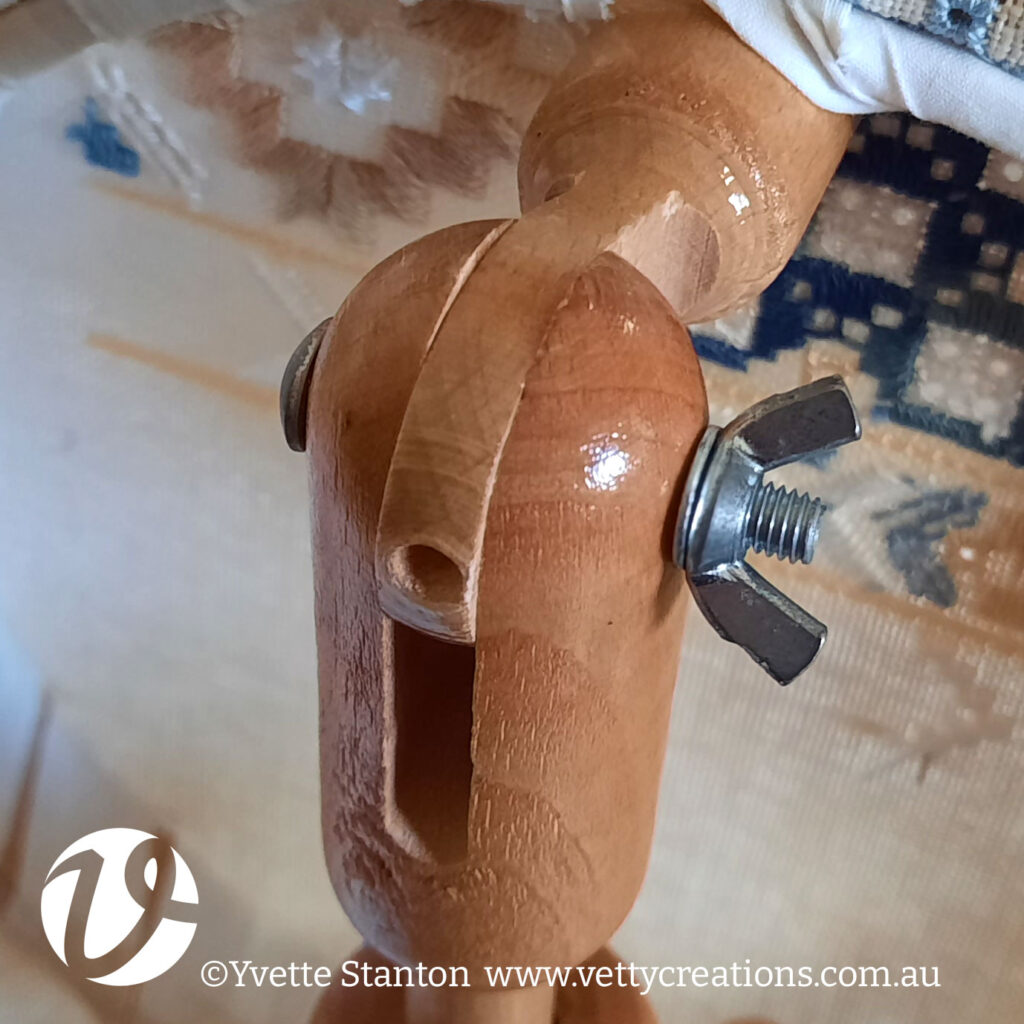
replacement screws for interchangeable hoop hinge

Occasionally someone will ask me if I have replacement screws for the hinge part of the interchangeable hoops, where the hoop joins the dowel. Sometimes the screw thread can become stripped, as the wingnut is repeatedly loosened and tightened when adjusting the tilt of the hoop.

replacement screw/bolt, wingnut and washer

If you’ve taken your hoop apart and lost them, or if the screw thread has been stripped, I have sourced replacement parts. I have them for purchase in sets with the screw/bolt, wingnut and washer.

https://www.vettycreations.com.au/catalogue-needles.html#screw
While I’d also like to say that I have replacements for the slotted screw in the hoop ring itself, or the wooden screw in the base, they’re slightly more specialised parts and I’m sorry, I do not. If this is what you are searching for, please do let me know. It may be that I can source these from the manufacturer.

May 14th, 2024 | Category: embroidery musings, favourite needlework items, new products | Leave a comment

Sydney Craft and Quilt Fair

Vetty Creations stand

Last week I had a big decision to make. It was basically crunch time for pulling out of this year’s Sydney Craft and Quilt Fair.

Sadly, I have pulled out due to ongoing illness. I had been hoping that I would be well enough to attend, but I have realised that it will just be too much for me. Four full days of the show, plus the setup day, and driving to and from Sydney, and all the preparation in the lead up is just not something that is possible for me right now.

*IF* I was having a really good day, I might get through one show day, with a lot of sitting down and doing the bare minimum – let’s face it though, it isn’t an event for putting in the bare minimum! There’s no chance I could do all the prep and the show, without causing myself to go backwards sharply and make things far, far worse.

This will be the first show in MANY years I have not attended (apart from Covid cancellations). I’m not sure when I started, but it was definitely more than 10 years ago. I’m sorry I won’t be there. I will miss the yearly catch up that I have with so many of you.

I am still booked to attend the Quilt NSW show in September at Rosehill. Let’s hope that I can make it to that one.

May 13th, 2024 | Category: exhibitions, travel | 2 comments

Norsk Husflid article

Norsk Husflid article

This morning, Laura, a Norwegian member of a Hardanger group that I’m in, posted these images of and from the latest issue of Norsk Husflid magazine. Lovely to be featured in a magazine in Norway!

So often, I send images and words off to magazines and never see the resulting article or review because I am not in the region where they publish. It’s lovely to see this one, thanks Laura! And with the help of Google Lens, I was able to read it, also. 🙂

Norsk Husflid magazine

May 9th, 2024 | Category: hardanger, Hardanger Filling Stitches, whitework | 4 comments

Sardinian knotted embroidery candle wrap

sardinian knotted embroidery candle wrap

This style of embroidery is called Punt’e Nù, and is from Sardinia, off the coast of Italy. It is a really unusual style of embroidery, in that it is made from hundreds (thousands?) of tiny knots worked on the surface of the embroidery. That makes it really textural and really quite unique.

Shown is the candle wrap project from the book. The wrap could go around a candle as shown here, around a glass with a tealight, or around a vase.

“Sardinian Knotted Embroidery” by Yvette Stanton teaches you how to create this style of embroidery, with the clear step-by-step instructions you expect from Yvette. With many photos of historical examples, you will learn about the motifs and the style, and how it was and still is traditionally used as part of the culture of Teulada, the town where it originates.

Purchase your copy of “Sardinian Knotted Embroidery” at https://www.vettycreations.com.au/sardinian-book.html

May 4th, 2024 | Category: historical embroidery, Punt 'e Nù, Sardinian Knotted Embroidery, whitework | Leave a comment

Help me fix my stitch! – cutting and withdrawing threads in Hardanger

Help me fix my stitch! - cutting and withdrawing threads in Hardanger

Diana asked me: “[For Hardanger] when you pull the threads, do you do it on a ring, or frame, or flat surface, or just in hand? I was taught that it should be done on frame (or at the least a ring) and bit by bit, not all of them, filling section by section as they are out.”

I started answering her question, but then realised I might be answering the wrong question, so my answer starts with a clarification, and then I proceed to answer, trying to be as complete as possible:

When you say “pull the threads”, do you mean “remove the threads”?

To me, pulled threads are to do with pulled thread stitches, like cable stitch, eyelets, and channel stitch. I do them in hand, because I can get better tension and open up the holes more. They don’t destabilise the fabric. If anything, they make it more sturdy.

For openwork (cut work), I only do small sections at a time. Generally I do it in hand, but for my most recent book, “Hardanger Filling Stitches”, I found that some specialty filling stitches were best worked in a small hoop. Until cutwork is rewoven/wrapped, it is quite unstable, hence working only small areas at a time.

When I cut the threads I definitely do it in hand as I can better access the threads I need to cut, with the scissors. My experience is that having the fabric in a hoop or frame when cutting means that people get whiskers along the edges of their stitches, as they can’t get close enough.

When I remove the threads, it is still in hand. As long as you’re careful, pulling them out should not distort the fabric.

May 3rd, 2024 | Category: Early-Style Hardanger, Elegant Hardanger Embroidery, embroidery stitches, hardanger, Hardanger Filling Stitches, hints and tips, whitework | Leave a comment

A different kind of whitework

mace made from paper

Nearly 30 years ago I did a degree in Design (Visual Communication). It was absolutely formative in bringing me to where I am today.

Probably because of some feedback from one of my uni assignments, I came to believe that I wasn’t very good at pushing my designs. I think I understood that I settled for “yeah, that will do” way too early. However, looking back at this project, I don’t think that was entirely true. (Since then, this is something that I have striven to do: push my designs hard to ensure that they are well resolved.)

I call this my mace and it was made for my model making class. It is made of glue and light-weight card only. It came from my imagination, from ideas gleaned elsewhere and reinterpreted through experimentation.

I wanted to make a sphere. I probably had seen in a book how they could be pieced together rather like patchwork, from geometrical shapes. And doing that would have been interesting enough, but I wanted to take my design further.

A square pyramid was substituted for a square “patch”. The triangular shapes became triangular pyramids. I still wanted to take my design further.

I inverted the point of the pyramids through a hole cut in the base. I didn’t bend the paper point through the hole in the base – that would not have worked as the paper would have crumpled! I cut the pattern shape, then folded and manipulated the parts through the hole and then glued them together in the final shape. Although it was 30 years ago, I still remember it was incredibly fiddly!

I made 30 of these square pyramids. They were glued together as the main framework. In the centre of each space between, I fitted an inverted pyramid with an equilateral triangle base. That left isosceles triangles between. I decided it was going to be WAY too hard to make isosceles inverted pyramids, so they are just “patches”.

Being 30 years old, some of the points are now looking a little bent, however I am still incredibly proud of it. I feel this is one of the most original things I have ever made. Somehow I turned flat paper and glue into this spiky, menacing ball!

May 1st, 2024 | Category: making stuff, whitework | 2 comments

Mountmellick embroidery – playing with stitches

Mountmellick embroidery with lily

One of the things I have always loved about Mountmellick embroidery is the playing with stitches. When you don’t have colour (it’s whitework embroidery), pattern and texture can be obtained from stitches.

Why work plain old buttonhole stitch, when you can work wavy top buttonhole stitch?!

This lily is from the Shamrock and Lily Doily in the book, Mountmellick Embroidery: Inspired by Nature by Prue Scott and Yvette Stanton.

April 30th, 2024 | Category: embroidery stitches, mountmellick embroidery, Mountmellick Embroidery: Inspired by Nature, whitework | 3 comments
« Newer Entries  
  Older Entries »
Yvette Stanton White Threads is the blog of Yvette Stanton, the author, designer, publisher behind Vetty Creations' quality needlework books and embroidery products.

New book now available!

Hardanger Filling Stitches
Hardanger Filling Stitches by Yvette Stanton. Order your copy today!
Find us on Facebook

Archived posts

Categories

  • book reviews (88)
  • Christmas ornament swap (13)
  • colour (6)
  • crazy hair (6)
  • customer embroidery (49)
  • designing (119)
  • dressmaking (26)
  • Early-Style Hardanger (91)
  • Elegant Hardanger Embroidery (42)
  • Elizabethan embroidery (25)
  • Embroidery classes (189)
  • embroidery musings (436)
  • embroidery stitches (206)
  • errata notices (11)
  • Ethnic embroidery (49)
  • exhibitions (111)
  • exploring the needlework internet (10)
  • favourite needlework items (69)
  • FlossTube (102)
  • Frisian whitework (73)
  • goldwork (12)
  • hardanger (232)
  • Hardanger Filling Stitches (72)
  • Hardanger Filling Stitches (1)
  • hints and tips (114)
  • historical embroidery (119)
  • how-to videos (34)
  • illustration (1)
  • Inspirations (25)
  • Introducing… (90)
  • left handed embroidery (78)
  • magazines (10)
  • making stuff (271)
  • merezhka (35)
  • mountmellick embroidery (176)
  • Mountmellick Embroidery: Inspired by Nature (60)
  • mountmellick supplies (49)
  • new products (104)
  • online book previews (7)
  • pattern darning (19)
  • pattern drafting (11)
  • photography (2)
  • Portuguese embroidery (166)
  • Portuguese Whitework: Bullion Embroidery from Guimarães (74)
  • public thanks (32)
  • published projects (27)
  • Punt 'e Nù (32)
  • Sardinian Knotted Embroidery (77)
  • sewing tips (9)
  • Smøyg (41)
  • Smøyg: Pattern Darning from Norway (39)
  • soapbox (6)
  • stitch along (44)
  • stitch dictionary (45)
  • teaching embroidery (192)
  • The Left-Handed Embroiderer's Companion (104)
  • The Right-Handed Embroiderer's Companion (70)
  • travel (172)
  • Ukrainian Drawn Thread Embroidery (35)
  • Uncategorized (169)
  • video previews (5)
  • White Threads Blog (91)
  • whitework (364)
  • writing books (306)