Vetty Creations header

Back to Vetty Creations website

White Threads

Hardanger stitching order

Hardanger table runner

This is the order I generally use for stitching Hardanger.

1. Satin stitch
I do satin stitch first as it forms the framework for all other parts of the design. I start near the centre and work outwards. I include buttonhole stitching here, as it usually has the same role as satin stitch in designs where it is included. As I stitch, I constantly check the positioning of the stitching. I want to know that everything is in the right place before I move on.

2. Pulled thread and surface stitching
Next, I work all the pulled thread stitches (and any surface stitching such as cable stitch with regular rather than pulled tension). Pulled thread stitches include eyelets, cable stitch, channel stitch. I want all of of this done before any threads are cut. If you pull threads after cutting, the ends can move within the fabric and even pull out. (Ask me how I know…)

3. Cutting
Cut and withdraw the threads that are required in the openwork areas. By this stage you should know that everything else is in the right place, and therefore if you cut threads, they should be the right ones. Don’t cut and withdraw all the threads required across the whole piece. Cutting destabilises the fabric significantly. Just work with the ones you’re about to weave/wrap.

4. Filling stitches
After you’ve prepared the areas of openwork, you need to restabilise the fabric by working the filling stitches. They can be as simple as woven or wrapped bars, but might include specialty stitches. Hemstitching, such as the long borders at the sides of the example shown, would also be worked at this stage.

5. Cut out the piece
If your project is required to be cut from the fabric, do this last. If you cut out earlier, there’s less fabric to hang on to while you’re working/or go in your hoop. Buttonhole edges can be fragile so you don’t want to handle the work too much after this step.

6. Hemming
Some projects, like the example, are hemmed at the edge. If the hemming will not stop you from working the rest of the project (moving a hoop around, if you use one; having enough fabric to hold at the edge) you can do it first. Otherwise, do it last.

The project shown is the table runner from my book, Early-Style Hardanger.

April 29th, 2024 | Category: Early-Style Hardanger, Elegant Hardanger Embroidery, embroidery stitches, hardanger, Hardanger Filling Stitches, hints and tips, whitework | 2 comments

Help me fix my stitch! – diagonal box stitch

Petra asked me for help with diagonal box stitch. By answering publicly, you can all learn from this too.

Happily, Petra let me know that the advice I gave her worked a treat!

If you’d like me to help you improve upon a stitch you’re working on, email me (yvette at vettycreations dot com dot au) a clear photograph of the stitch and explain the problems that you’re having. I may be able to help you improve upon the results you’re getting. Let me know whether you’re happy for me to use your name in a social media post, or if you’d prefer to be anonymous.

Purchase “Frisian Whitework” by Yvette Stanton:
https://www.vettycreations.com.au/frisian-whitework.html

April 27th, 2024 | Category: embroidery stitches, Frisian whitework, hints and tips, teaching embroidery, Uncategorized, whitework | Leave a comment

Help me fix my stitch!

I recently had an email from a reader who was struggling with a stitch for one of the projects in one of my books. She sent a very clear photo so that I could see her work and assess where she might be going wrong.

I was able to advise her on ways she could improve the stitch. Hopefully she will be able to use this advice and make the progress she hopes for.

When I do this, I help one person by answering them privately. I feel that it would be a good thing to be able to answer such questions publicly so that others can learn. Many people struggle with the same things, so if I can help more than one person at a time, that seems to me to be a good idea!

I’ve been watching some videos of an interior designer who shares a client’s room, their inspiration images, and then shows us how she would change their room to make it in line with their desires. It’s fascinating to see what she suggests. It’s informative and instructive.

I’d love to do something like that here for stitch problems rather than room problems (I’m not an interior designer!). If you’re struggling with a stitch and can send a bright, clear photo of it, I’d love to be able to post publicly about how it can be improved, so that many can learn. I don’t know how many requests for this I will receive, so it is possible that I won’t get to them all. But please email them to me and let’s all learn together! yvette at vettycreations dot com dot au (change the words to symbols where appropriate)

uneven stitching

For the stitch shown (my work, made poorly to illustrate a point), tension is the problem. Some of the eyelets have tight (though still uneven) tension, and others have very loose tension. They should be worked with tight tension to open up the holes, and make them nicely round. The square filet in the centre is WAY too loose. The bars are a mess and need tight, even tension. For a stitcher to improve on this, it is likely that they will need to practice using much tighter tension. It won’t be fixed immediately, but with practice, it certainly can be.

April 24th, 2024 | Category: customer embroidery, embroidery stitches, hints and tips, sewing tips, teaching embroidery | 2 comments

Stitch tension in Hardanger embroidery

Stitch tension in Hardanger embroidery

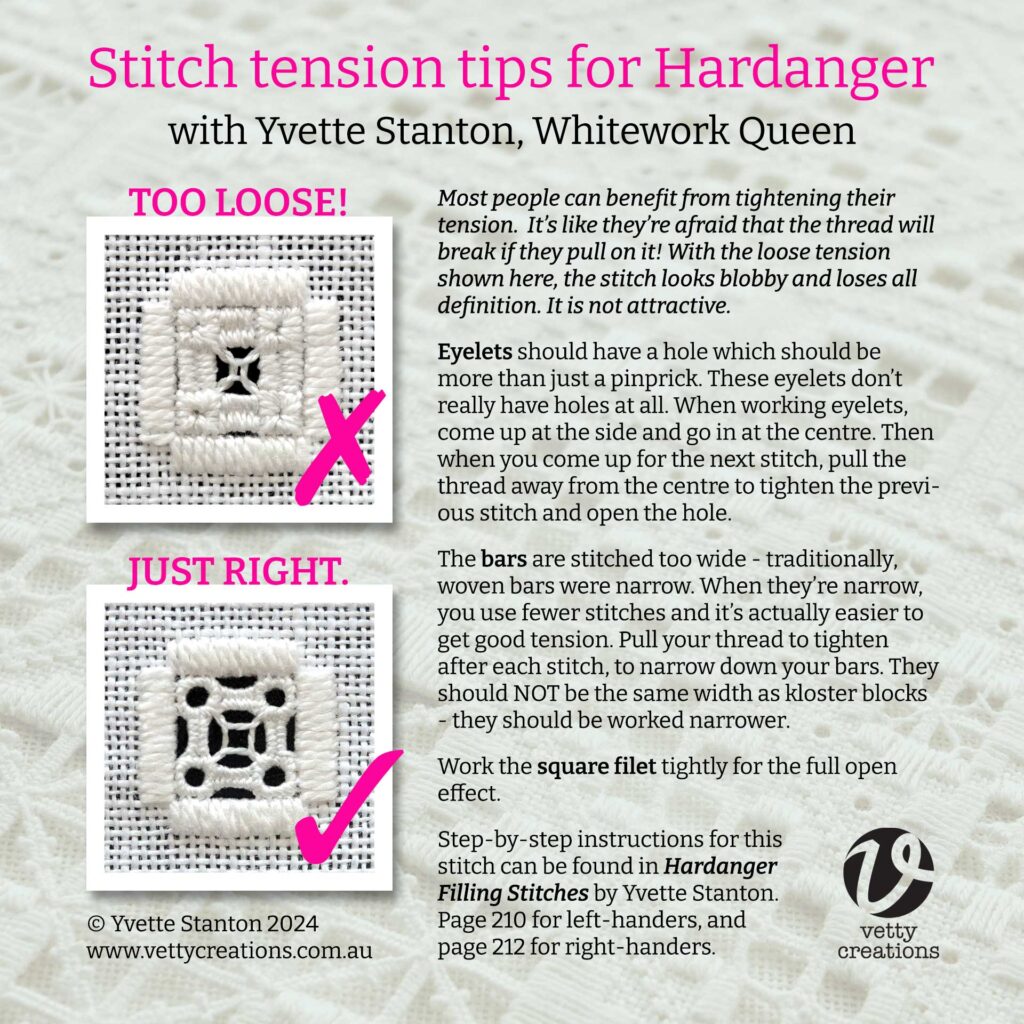
Stitch tension is the thing that most people told me they needed help with when I was writing my book Hardanger Filling Stitches. If you’re one of those people, page 42 is the page for you – it’s all about tension! The image above illustrates the difference poor and good tension can make. Good tension makes your work sing!

—

I have Facebook, Instagram and TikTok pages/accounts. The TikTok one is very new.

If you follow me on any of those platforms, something you may have noticed recently is that I’m creating more reels (videos). When I do this, sometimes I also try to provide the same information in an image post as well, particularly here, as I don’t post the reels here. Some people like reels, some people like images. Sometimes I’ll do one and not the other, and sometimes I’ll try to provide both.

Today, you get the image version of yesterday’s reel: it’s about stitch tension in Hardanger. This just shows the “too loose” and “just right” versions. The reel also had “uneven” and “too tight”. If you haven’t seen it, check my Instagram/Facebook/TikTok page for it.

April 10th, 2024 | Category: embroidery musings, embroidery stitches, hardanger, Hardanger Filling Stitches, hints and tips, whitework, writing books | 4 comments

3 inch hoops great for Hardanger

3 inch wooden embroidery hoop

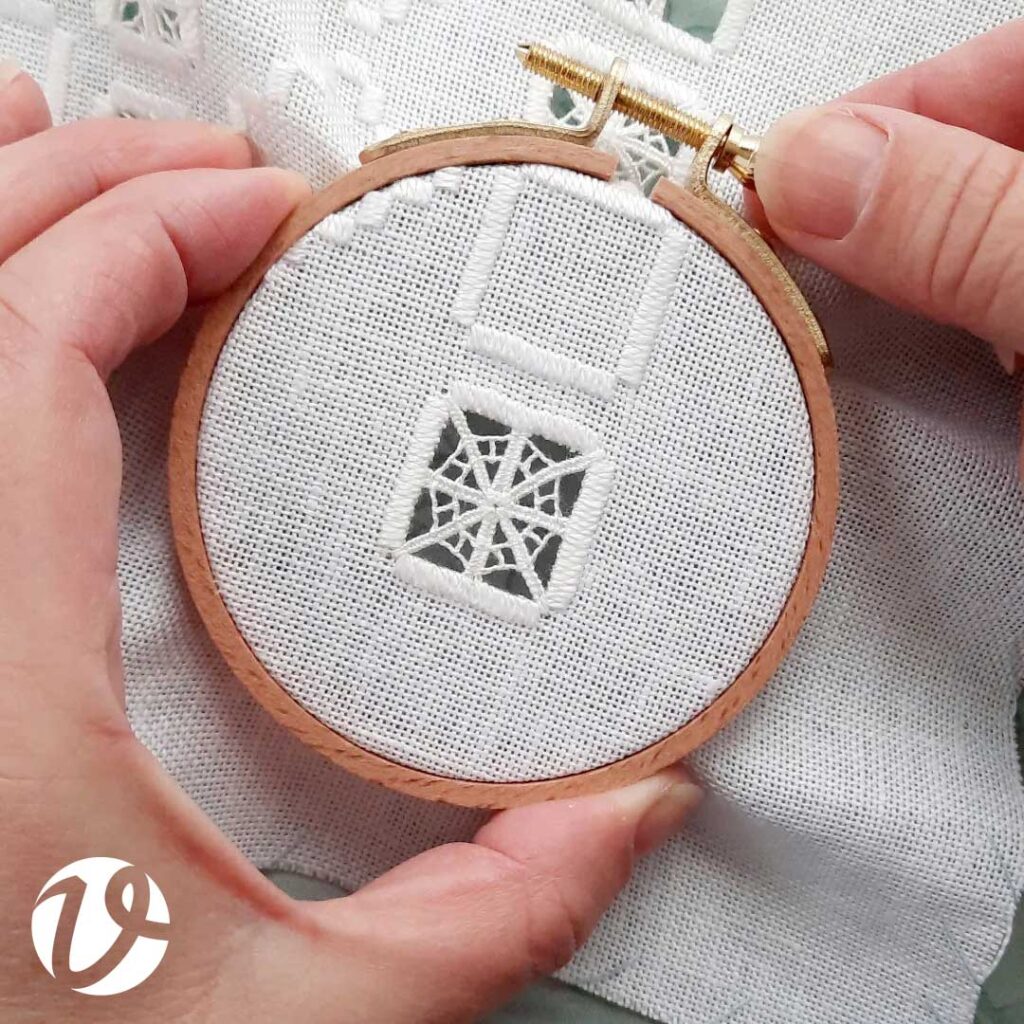
When I was working the samples for my book Hardanger Filling Stitches, I found that a tiny little hoop was really useful for working filling stitches with diagonals, such as the Wheel Stitch shown. Having the fabric flat in a hoop meant you couldn’t accidentally work the stitches too tight, resulting in unpleasant puckering of the fabric. Usually, I don’t use a hoop for Hardanger, but I did find it helpful for the fillings.

the screwdriver slot on the tightening screw

I have these great little 3inch/7.5cm diameter wooden hoops available. They’re just the right size for working a single motif. They have lovely smooth wood, and the screw has a slot for a screwdriver to get the hoop really tight. Available to ship around the world, from my website.

April 5th, 2024 | Category: Early-Style Hardanger, Elegant Hardanger Embroidery, embroidery musings, favourite needlework items, hardanger, Hardanger Filling Stitches, hints and tips, whitework | 2 comments

Marion Scoular on Hardanger Filling Stitches

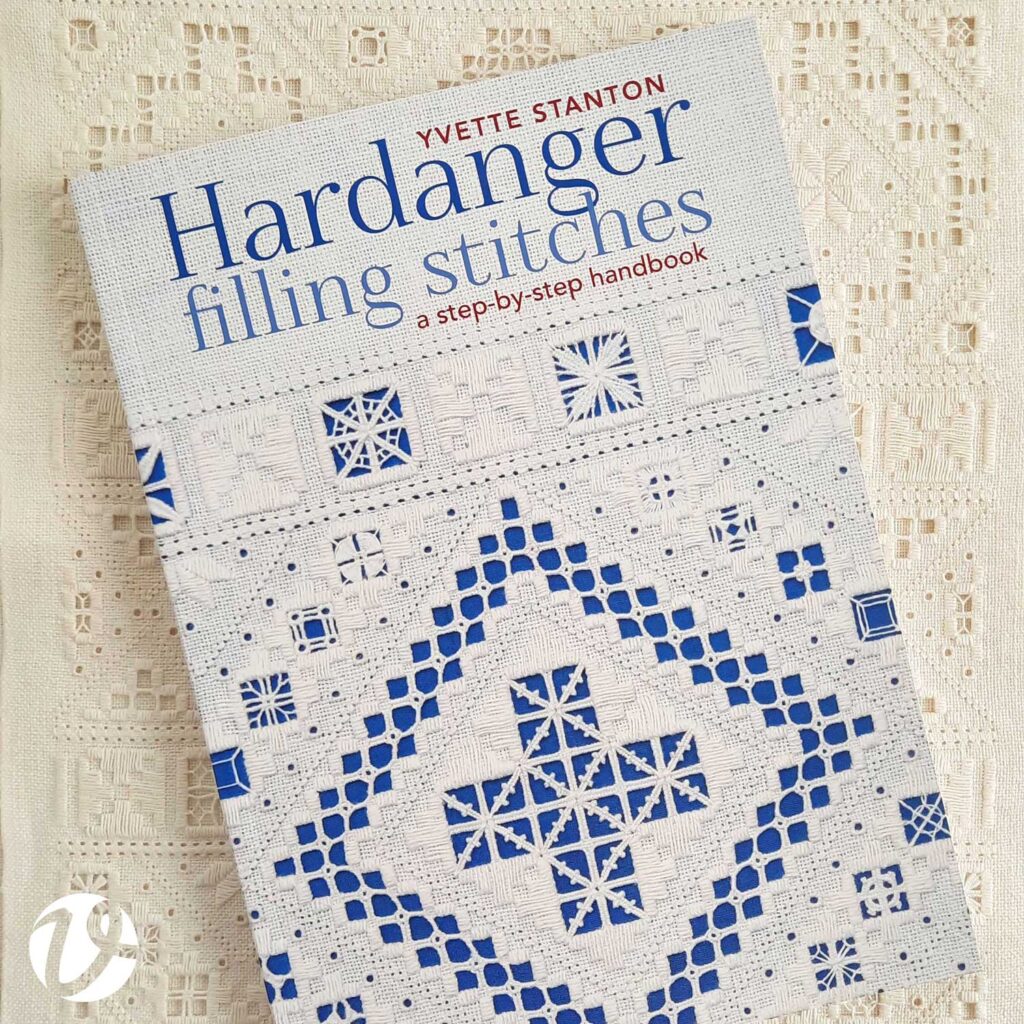
Hardanger Filling Stitches by Yvette Stanton

Marion Scoular, Hardanger embroidery author and teacher, graduate of the Royal School of Needlework, and City and Guilds Silver Medallist, said this of Hardanger Filling Stitchesby Yvette Stanton:

“I cannot imagine the time Yvette must have spent on this encyclopaedia andthe stitched models. It boggles my mind.

Not only does she provide explicit diagrams on “how to”,she also shares “the wrong way”, thus clarifying the technique. Further help is in the actual photos.

There are so many unfamiliar (to me!) motifs which I am eager to try.

Thank you, Yvette, for sharing your incredible knowledge.I wish you GREAT success.”

Thank you, Marion!

April 4th, 2024 | Category: book reviews, hardanger, Hardanger Filling Stitches, whitework, writing books | 3 comments

Fully integrated words and pictures

As an author, illustrator and photographer who also designs the layout of her books (I have a degree in visual communication and my major project was in book design), I feel that makes my books somewhat unique.

Most authors write their manuscripts and then their words get handed over to someone else to put them on the page, integrating them with illustrations and photographs, either supplied by the author or commissioned for the purpose. When I write my books, I write on the page. I don’t use a word processor then take the words into my page layout program (I use QuarkXpress, which makes me a dinosaur – the industry standard is now InDesign). I write on the actual pages in Quark.

I have developed a style which generally has 3 columns of text. The instructions go from left to right across the columns, then move to down to subsequent rows. For the page size I use, 3 columns means I have well-sized diagrams for each step, with a column width that’s not too narrow or too wide. Narrow columns mean more word breaks which interrupts the flow of reading. Wide ones can mean you tire before reaching the end of the line.

I sometimes write first, then create the diagrams to match the text, and sometimes I do it the other way around. When I fill a page, I move on to the next. Once the instructions for the entire stitch (including repeats, and other important things like how to handle corners or turns) are done, then I edit.

If the steps *just* go onto the next page, I try to edit to fit it all on the previous page. The words in my steps are usually so highly edited that it may as well be poetry: every word counts! I may make the diagrams shorter to fit more rows in. Maybe two steps can be collapsed into one without reducing clarity. I try to make the quantity of words for all steps in the row about the same as that makes the best use of the page’s space.

My unique process means the words and images are fully integrated, leading to a more pleasurable reading experience and greater understanding.

April 2nd, 2024 | Category: Early-Style Hardanger, Elegant Hardanger Embroidery, embroidery stitches, Hardanger Filling Stitches, Mountmellick Embroidery: Inspired by Nature, Portuguese Whitework: Bullion Embroidery from Guimarães, Sardinian Knotted Embroidery, Smøyg: Pattern Darning from Norway, stitch dictionary, The Left-Handed Embroiderer's Companion, The Right-Handed Embroiderer's Companion, whitework, writing books | One comment

The Left-Handed Embroiderers Companion – current status

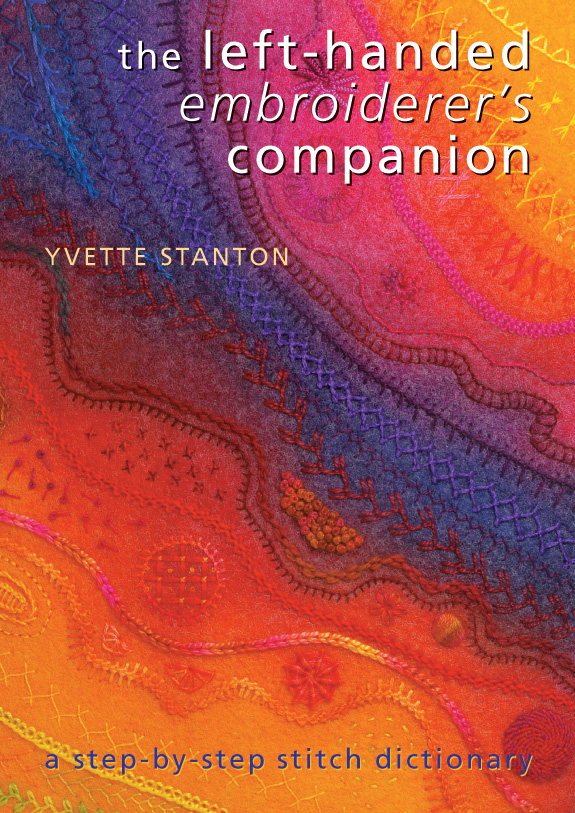
The Left-Handed Embroiderers CompanionA lot of people have been asking about “The Left-Handed Embroiderer’s Companion”. It is currently out of print, and has been for way longer than I had intended.

After I finished working on “Hardanger Filling Stitches” I planned to start work on a revision of this book, adding some new stitches. This plan has not yet come to fruition as I am still very unwell and not up to working on it. WHEN I am well enough – and I do not know when that will be – I will do the revision and it will be re-released.

I do not have a wait list as I have no timeline for anything about this. You’ll just have to continue to be patient. There is nothing I can do about this delay. It isn’t the way I want things to be, either.

March 28th, 2024 | Category: left handed embroidery, stitch dictionary, The Left-Handed Embroiderer's Companion, writing books | One comment

Kate, serious illness, demands…

I’ll never be Queen of England, but I might understand a little of what Kate is going through. I have people I don’t know demanding things of me, too.

I have been unwell for 4+ months, now. I have been quite open about it but haven’t announced a diagnosis – as is my right. As it happens, I am still working with medical professionals to puzzle a diagnosis out.

Australian journalist Julia Baird has written a thoughtful article about Kate, serious illness, the trauma it can bring, and the baying of the media. I’ll quote some of her wisdom here:
“You might also hope we’d pause… and think, for a moment, about what it might be like to be confronting your mortality as a baying mob rifles through your medical records, presses their faces up against your window and pounds on your front door, screaming, demanding you reveal yourself now.”

Thankfully, I haven’t had pressure from people to reveal my diagnosis (though some assume they know). I have had people who I’ve never met demanding things (or implying demands) from me, despite the fact that I am often able to get very little work done.

“I really want you to write a book on…”
“I want this book in French/Spanish/Norwegian/Portuguese!”
“I can’t get your left-handed book anywhere. When will you reprint it?”
“I ordered a week ago, but received no notification of my order being sent.”
“When will you have online classes?”

All these demands come from some level of not understanding my circumstances, and each time, I have to explain myself.

“I’m not well enough to work at the moment, let alone write another book.”
“I’d love that too, but…” [Answer is too long – please read my FAQ.]
“I need to revise the left-handed book but I am not well enough to do so.”
“I sent your order on the day I received it but I haven’t been well enough to also email about it.”
“I’m not well enough to be teaching. I’ve been unwell since November.”

As the world realises “Oops, Kate really is sick!”, I hope people will be more compassionate towards and understanding of those experiencing serious or chronic illness. Thankfully, many people are very understanding and add no pressure at all. If you’re one of those, thank you.

March 27th, 2024 | Category: teaching embroidery, writing books | 2 comments

Hardanger materials guide

Hardanger materials guide

What should I use to make Hardanger embroidery? First, choose fabric of a count that you can comfortably see. Then use my handy ready reckoner to find what size thread and needles to use with your fabric.

March 9th, 2024 | Category: Early-Style Hardanger, Elegant Hardanger Embroidery, hardanger, Hardanger Filling Stitches, hints and tips, whitework | One comment
« Newer Entries  
  Older Entries »
Yvette Stanton White Threads is the blog of Yvette Stanton, the author, designer, publisher behind Vetty Creations' quality needlework books and embroidery products.

New book now available!

Hardanger Filling Stitches
Hardanger Filling Stitches by Yvette Stanton. Order your copy today!
Find us on Facebook

Archived posts

Categories

  • book reviews (88)
  • Christmas ornament swap (13)
  • colour (6)
  • crazy hair (6)
  • customer embroidery (49)
  • designing (119)
  • dressmaking (26)
  • Early-Style Hardanger (91)
  • Elegant Hardanger Embroidery (42)
  • Elizabethan embroidery (25)
  • Embroidery classes (189)
  • embroidery musings (436)
  • embroidery stitches (206)
  • errata notices (11)
  • Ethnic embroidery (49)
  • exhibitions (111)
  • exploring the needlework internet (10)
  • favourite needlework items (69)
  • FlossTube (102)
  • Frisian whitework (73)
  • goldwork (12)
  • hardanger (232)
  • Hardanger Filling Stitches (72)
  • Hardanger Filling Stitches (1)
  • hints and tips (114)
  • historical embroidery (119)
  • how-to videos (34)
  • illustration (1)
  • Inspirations (25)
  • Introducing… (90)
  • left handed embroidery (78)
  • magazines (10)
  • making stuff (271)
  • merezhka (35)
  • mountmellick embroidery (176)
  • Mountmellick Embroidery: Inspired by Nature (60)
  • mountmellick supplies (49)
  • new products (104)
  • online book previews (7)
  • pattern darning (19)
  • pattern drafting (11)
  • photography (2)
  • Portuguese embroidery (166)
  • Portuguese Whitework: Bullion Embroidery from Guimarães (74)
  • public thanks (32)
  • published projects (27)
  • Punt 'e Nù (32)
  • Sardinian Knotted Embroidery (77)
  • sewing tips (9)
  • Smøyg (41)
  • Smøyg: Pattern Darning from Norway (39)
  • soapbox (6)
  • stitch along (44)
  • stitch dictionary (45)
  • teaching embroidery (192)
  • The Left-Handed Embroiderer's Companion (104)
  • The Right-Handed Embroiderer's Companion (70)
  • travel (172)
  • Ukrainian Drawn Thread Embroidery (35)
  • Uncategorized (169)
  • video previews (5)
  • White Threads Blog (91)
  • whitework (364)
  • writing books (306)