

This morning I was greeted by an email from Houzz in my inbox, in which it loudly proclaimed that macramé, the knotted craft that took the world by storm in the 70s and 80s, is making a comeback. “Hmm…” I thought to myself, “I wonder if they mean the large chunky stuff that people call macramé, or the fine, amazing stuff that is done in Italy?” You know the type I mean: pot planters, owl wall hangings with big fluffy eyes, other non-owl wall hangings, all usually in the palette of the day of yellows, oranges and browns.
Yes, they meant the large, chunky stuff. 🙁
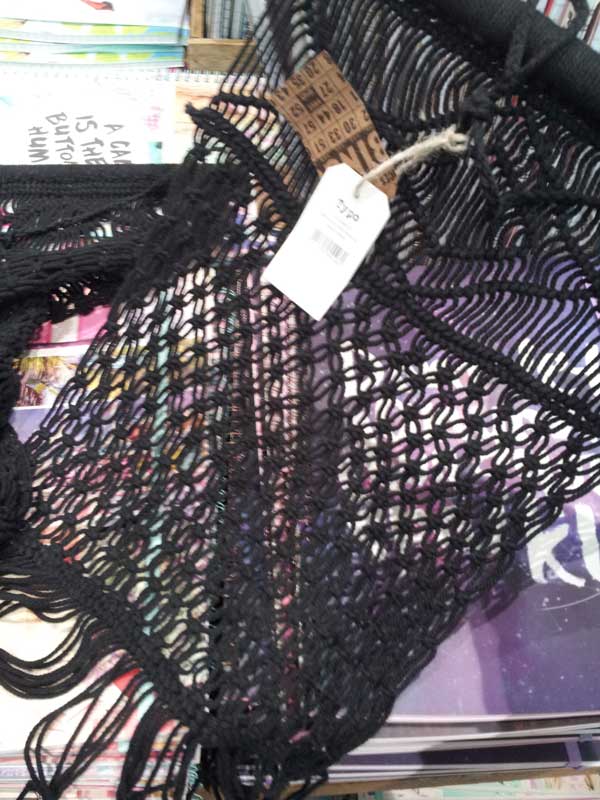 And as if to prove the point that macramé is on trend, this morning while shopping with The Gymnast, I came across this macramé wall hanging in one of the local “trendy, desirable” tween/teen stationery/accessory shops.
In recent years, Jeanine at Italian Needlework blog, has opened my eyes to what macramé *can* be. If you head over to her website, you can see a selection of posts dealing with Italian style macramé and a style of lace called Margarete lace (also known as Margaretenspitze, as the creator, Margarete Naumann, was German), which is a derivative of macramé.
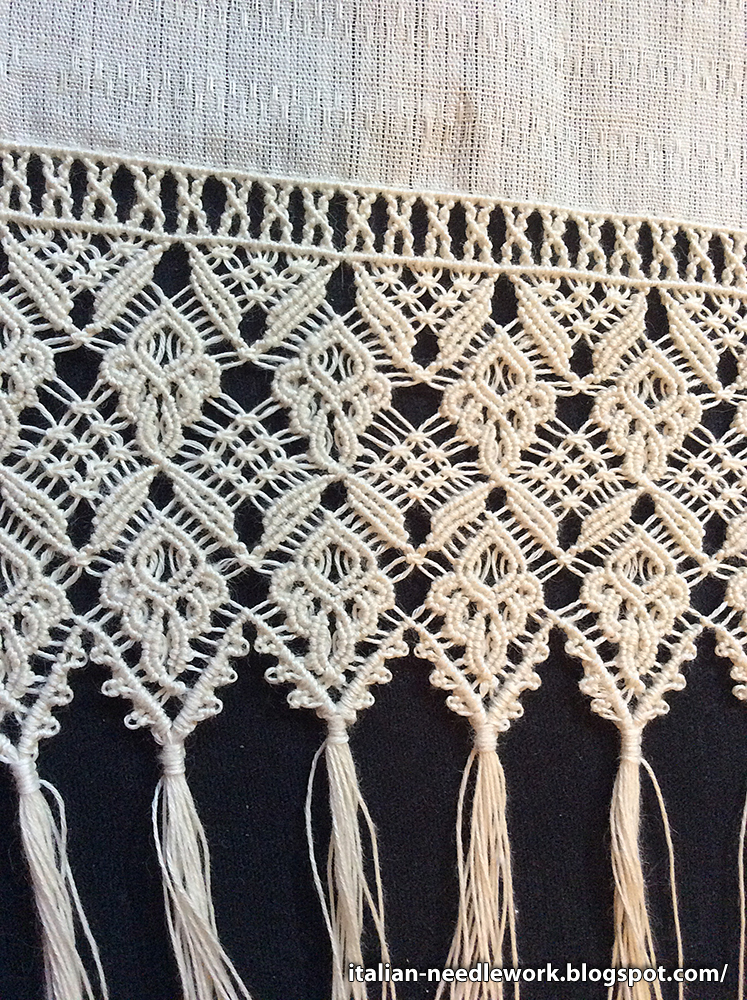
Used by permission of Jeanine from Italian Needlework blog
This is a hand towel with macramé edging. Jeanine has more information about this particular example of macramé on her website.
Jeanine also shared with me a list of websites of Italians working macramé. Thanks Jeanine!
http://www.artedelmacrame.it/gallery.php
https://www.facebook.com/adriana.lazzari
https://www.facebook.com/macramepatrizia.paris
https://www.facebook.com/laura.demelas.3
http://macramemodena.blogspot.ca/
http://www.ilmiomacrame.com/galleria/
So, now that you know what macramé can be like, you can stop thinking about it with the same preconceived notions as I have had since the 70s!
 White Threads is the blog of Yvette Stanton, the author, designer, publisher behind Vetty Creations' quality needlework books and embroidery products.

I was lucky enough to pick up most of the beautiful DMC / Therese de Dillmont publications when they were reprinted in the mid 1970s, including her 1890 book on macrame. Her designs are so lovely they would work with either fine thread or coarse string. It’s now available from the Internet Archive: https://archive.org/details/lemacramparthded00dill. The copy I have is in English, not French, so there may be an English-language edition out there somewhere. The diagrams so clear I think anyone could follow them regardless.
Thanks Elaine, that’s a really useful link!
I’ve got the 1970 DMC reprint book too – in English, but the instructions are in the Encycloedia of Needlework anyway. It’s the patterns and their steady progression from simple to complex that fascinates me, and the use of colour. The scale of the photos is about life size if worked in something like #5 pearl cotton or crochet thread of a similar thickness.
Thanks Sue, great to know about the book.
I made quite a few pot hangers and an owl in the 70s. All out of jute, which disintegrated over time. I never did make the hanging table (have the instructions though!). I suspect that the return of chunky projects plays into the tendency that everything must be fast and easy to complete. I love that towel, I never thought of using macrame for trim for other items. Now I’m off to read about the Italian version!
Thanks for sharing with us what macrame can be – I for one am not a fan of what initially comes to mind, but the Italian work is beautiful!
Catherine and Gail, the Italian work just opens up the mind to other possibilities for macramé, doesn’t it? It’s so different to what we automatically think of.