

As you will have read in my report yesterday on The Big Mountmellick Boil Up, by boiling my antique Mountmellick piece white, I found that not all of the stains were removed. And so, of course, all the suggestions came (variations depending on where the commenter lives): “Have you tried using Napisan?” “Would you consider using Oxiclean, if you have that there?” “What about using Napisan?” “Can you get Biz?”
Yes, I can get Napisan (we have some in the laundry cupboard). No, I cannot get Biz or Oxiclean.
Will I use them?
My immediate response to this is “No, those sorts of oxygen activated cleaners actually eat away at the fabric, removing the stains – yes – but also removing the fibres.” That’s my stock standard answer for these questions. But is it true?
I’m not sure. I’ve done a bit of reading this morning to learn more about these products. The main ingredient in them is generally sodium percarbonate which breaks down to form the active ingredient of hydrogen peroxide.
So on finding this out, my question was then “Does hydrogen peroxide clean by eating away the fibres?” I haven’t determined the answer to this. I simply don’t know. However, several things I read also said “it eats away at the fibres” or “it weakens the fabric”. These were really just hearsay though. Were they scientifically based statements or just received wisdom? I don’t know. I suspect they might be received wisdom. I can find no scientific basis for the statements, but then I haven’t had an exhaustive search and maybe I’m not looking in the right places, and not using the right search terms.
So, given that my original statement that “it eats away the fibres” might be untrue, would I consider using Napisan/Biz/Oxiclean? Probably not.
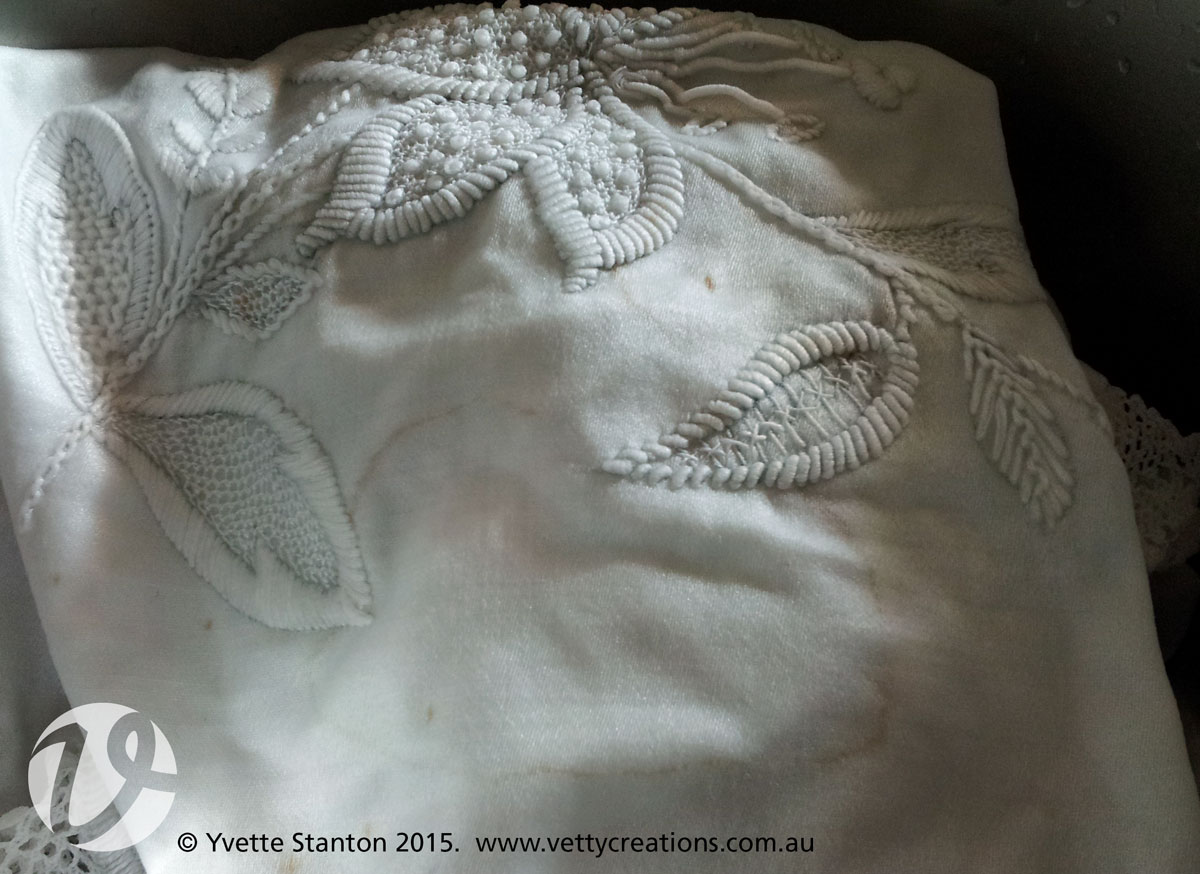 My aim was to use the time-honoured, traditional method of boiling Mountmellick embroidery to whiten it. Why did I want to whiten it? Ostensibly to remove the horrible black lines and general greyness. Why use that method? Because it is the traditional method, and I wanted to see if it worked to whiten. Did it? Yes and no. Yes, to the general appearance, no to the horrible black lines and greyness (though I think the general greyness has lightened). I also wanted to prove to myself that the method was suitable to use on antique embroidery, and wouldn’t damage it. There was no visible damage; no extra holes in the lace (though as the lace is not traditional, I wouldn’t have cared if it had!); and no failure of the stitches or fabric.
Does it matter to me if the piece now stays as is? No, it doesn’t. I’m quite happy to leave it now. I’ve proved to myself that boiling whitens whites and can reduce some staining significantly (most of the “rust” stains have gone). I have no need to try whitening it further. I will not be using this in my home and I won’t have it on display. If I was going to, I might try other cleaning methods. However, I intend only to use it as a teaching piece. As it is now, it’s got an excellent lesson contained in it: Don’t use horrible dark lines to draw your pattern on!
For me, with antique linens, my aim is not to use them, but to preserve them, as examples of the style for future generations. As an embroidery historian, I want to think of the others coming after me. I have now cleaned this piece, and that’s as far as I need to take it. I don’t need it to look new, because it isn’t!
If the antique linens were ones that had been passed down through my family, then I might choose to use them, because for me they have a different purpose: maintaining links with my forebears. So for you to choose to use Napisan etc. on your antique linens, I have no problem with that at all. If you want to use the linens and celebrate them, go right ahead and whiten them in any way that works for you. If having white linen makes you happy, go for it! 🙂
So I hope that explains why I’m choosing not to use oxicleaners. It’s about preservation really, even if the statement that “it eats away the fibres” isn’t true.
 White Threads is the blog of Yvette Stanton, the author, designer, publisher behind Vetty Creations' quality needlework books and embroidery products.

Hi Yvette,
You may be aware, there’s a place in Chatswood called International Conservation Services – http://www.icssydney.com.au/index.php. They conserve and restore historical artifacts, including textiles. I wonder what they would say about using bleach?
Michelle
Thanks Michelle. I did not know about them – that’s great to know! 🙂
Yvette, you could also try calling the textile conservators at the National Gallery in Canberra – they’re usually helpful. They gave a talk at the Canberra Spinners and Weavers Guild when I lived there.
Good luck!
Thanks for that suggestion also. 🙂