

I’ve been wondering about posting something like this for quite literally years. It will probably be controversial. It will probably put some noses out of joint. For that, I am sorry, as I do not want to hurt anyone.
However, the reason why I’ve decided to speak up about this is because of the integrity of the style of embroidery. Mountmellick is a historical style of embroidery. Historical. Traditional. That means that over the years, the accepted style has included some things, but definitely not others. It could have developed to include certain things, but as it happened, it didn’t.

So, let me come out and say it bluntly:
Mountmellick embroidery does not have toadstools. Mountmellick embroidery does not have frogs, fairies, owls, Australian native flowers, cars, trucks, horses, wheelbarrows, forks, spoons, pianos… Ok, I got a bit carried away there, but you get the point. It does not have any of those motifs in its historical selection.
If you’re dealing with a historical style of embroidery, how do you know what is historically correct?
You go back to the historical examples (found in museums, family collections etc) from the heyday of the style, and you look across the range of examples. You see which were the common motifs, stitches, style of combining stitches etc. They are the historically accurate elements because they are found on the historical examples – within the Mountmellick “cannon”, if you like. You see which motifs did not show up regularly – perhaps only once – and you notice that they are probably outliers. These are probably fanciful additions to the style by a single person, just because they liked them. You could not really say that they are “of the style”.
Mountmellick embroidery developed in the town of Mountmellick from roughly about the mid 1820s onwards. Because it developed there, it features the plants that grew there, such as oak, blackberries, fern, dogroses, thistles, and shamrocks. Despite the fact that they would not have grown naturally within the town, lilies and passionflowers were also a favourite motif. Why are these two plants accepted, but not others? Because they were accepted by a large number of the contemporary stitchers of the day. They are part of the “cannon”. They were not introduced by someone in a studio or lounge room on the other side of the world 100 years later, and stitched in the Mountmellick style and therefore said to be Mountmellick.
You can’t do this; you can’t make changes to a historical style. It is what it already is. You can stitch something “different” in the Mountmellick style, but that doesn’t make it Mountmellick embroidery. In the same way that I could dress in full Thai costume, and move in the same way they do in their traditional styles of dancing, that doesn’t make me Thai.
Where can I learn more about what Mountmellick really is?
Firstly, if you have the opportunity, explore the museum collections of the world that contain historical examples of Mountmellick embroidery. I realise that’s a little bit out of reach of most people though.
You can explore my Mountmellick Embroidery pinterest page, which has images of Mountmellick embroidery.
Learn more about Mountmellick embroidery from people who have seriously researched the style by going back to the historical examples, or grown up with it as part of their local heritage. Try these websites:
http://www.vettycreations.com.au/me.html
http://www.mountmellickdevelopment.com/quaker-heritage-families.htm#introduction
http://islandireland.com/Pages/folk/mountmellick/embroidery.html
Learn it from a reputable teacher who teaches in the historical style, not just something that has chunky white stitches on white fabric. Just because someone says it is Mountmellick, doesn’t mean it is. You can see this on Ebay all the time. Most of the “Mountmellick embroidery” on Ebay has nothing to do with Mountmellick embroidery!
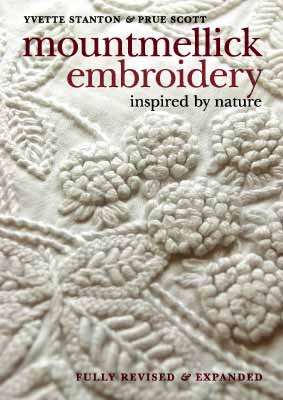
Learn about it from a reputable book, such as Mountmellick Embroidery: Inspired by Nature. And you’re thinking, “Of course, you think that’s a reputable book – you wrote it!” Yes, that is quite true, however it is also the best selling Mountmellick book in the town of Mountmellick, and is well accepted by the stitchers to whom the embroidery has been passed down, in Mountmellick.
A few years ago, I received an email from one of the ladies in Mountmellick who is very much involved in keeping Mountmellick embroidery alive in the town. She wrote, “My mum was taught Mountmellick work from a very young age from her mum who had been taught by old Mrs Jacobs. As such, mum was very fortunate as she is one of the few who was “passed down” the skill and did not have to research it to learn it. There have been quite a few modern books written about Mountmellick Work and as a general rule, my mum is unimpressed with all – yours being the one exception. Would it be possible to get a signed copy for her?”
I felt very honoured to have such a request, and realised that we must have done a good job of presenting their precious embroidery in a way that they felt proud of it.
Finally, you can ask me questions. I have researched the embroidery by looking at many, many historical examples in collections around the world. I am very happy to continue to educate people on what Mountmellick embroidery actually is, as well as what it is not.
And one more important thing about Mountmellick embroidery: It is not Montmellick, Mt Mellick, Mountmellic, or even Montmellic. Mountmellick is the correct spelling as it is taken from the name of the town in County Laois (pronounced leash) in Ireland. (Just another of my little bugbears… 😉 )
 White Threads is the blog of Yvette Stanton, the author, designer, publisher behind Vetty Creations' quality needlework books and embroidery products.

Good for you. Ingenuity and creativity is much to be admired, but it is not tradition. It shouldn’t be labeled as such.
Thanks for all this Yvette, I always want to do things as authentically as possible too.
I appreciate all the terrific research you do in each of your books, it’s great learning and seeing the countries of origin too.
Julie
I don’t find anything controversial in what you are saying. I have been very drawn to this style of embroidery and am just now in a situation that will allow me to try it out. Knowing myself, I will start out with the traditional motifs and then go on to apply the style and techniques to my own designs. Like the women who developed Mountmellick Embroidery I have a strong connection to a particular rural area and the plants that grow there. However, I would never then pass off my work as being Mountmellick Embroidery.
Hi, Yevtte! Good points!
Have you seen the American publications from the late 1800’s or early 1900’s that demonstrate Mountmellick with colored threads? I’d guess it was a matter of the original embroidery coming over with immigrants, and then developing locally in a different direction, possibly because of a difference in materials available, or simply due to local preferences. And without the proliferation of resources, research, and connections that we enjoy today, and without easy methods of communications, it would be natural for reinterpretations to develop. It doesn’t make it traditional Mountmellick, but I think those early publications account for some legitimate confusion.
Nothing beats the white on white of the real stuff!
Hi Mary, I haven’t seen them, but I know of them, and they make me shudder! I think we can take the view that everyone had the same access to information that we do today, when obviously that wasn’t the case. However, if you’re going to design and make “Mountmellick embroidery” to sell as patterns or in a class, I feel that you have a responsibility to ensure that you’re presenting Mountmellick embroidery based on the real historical style, as stitched in the heyday in Mountmellick, Ireland. If you’re not, then it isn’t Mountmellick embroidery! While people in the past may have been misled because of lack of information, people cannot make that defence today.
I think it comes down to people respecting traditions and being honest. If you are not presenting work in a classic or traditional way, call it interpretive, creative or in the ……… style. That way it is indicated that you are using aspects of a traditional style in a different way.
You are going to like one of my Irish mother’s sayings:
If a cat has kittens in an oven, it doesn’t make them biscuits.
So I fully agree with you, that Mountmellick suits the cannon of botanical designs. The variations, however well worked, are not representative of the tradition.
Love your Mum’s saying, Mary Paulger!