

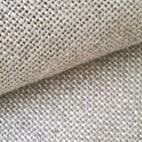
Following on from my last blog post, I’m interested in what count of fabric you feel most comfortable with. The count of the fabric refers to how many threads there are over a particular distance. 25 count fabric means that there are 25 threads per inch, across the warp and weft of the fabric. 35 count means 35 threads per inch. Sometimes it is expressed at the number of threads per centimetre.
It isn’t hard to convert between the two – to move from threads per cm to threads per inch, just multiply the quantity by 2.5. To convert in the other direction (per inch to per cm), just divide by 2.5 (might need a calculator for that one!). By doing this, we can work out that 25 threads per inch would be 10 threads per cm. 35 threads per inch would be 14 threads per cm.
On Facebook, we had a bit of a discussion about near- or short-sightedness. One reader said that being near-sighted was a definite advantage. This correlates with what the optician I spoke to the other day said too. As I am short-sighted, he said I have an advantage *for now*!
I’m happy working on 32-38 count, and have even done 45 count. I find that 25 count seems very coarse in comparison. I am short-sighted (see things up close just fine, but far away needs the help of glasses).
I find that many people baulk at anything finer than 25 count. Yet, in other cultures, 30 or 35 count is regularly used, as that is the traditional count for their culture’s embroidery. In those places, people don’t bat an eyelid about the finer count. It’s what is expected, so it is what it used.
Sometimes I wonder whether there needs to be preparatory homework for my classes on finer counts of linen. A little stitching on an ever-finer range of linens over several weeks to get their eyes in the mood for stitching on finer counts by the time they come to my class!
So, what count of fabric do you feel most happy with, and what is the finest you think you would feel comfortable with? Have you ever tried to train your eyes to work up to a finer count? Do you use magnification? If yes, what factor of magnification do you use, and how much finer can you go with it?
 White Threads is the blog of Yvette Stanton, the author, designer, publisher behind Vetty Creations' quality needlework books and embroidery products.

I use the inexpensive magnifying glasses ( 2.5 magnification) the you can pick up almost anywhere. I used to be able to work with 32 count fabric, but now I find that even 28 count is challenging.
My personal experience is that the longer I work in a single setting, the more strained and tired my eyes become. So, I don’t think working up to a finer count would work for me.
Thanks so much for your informative blog – I always enjoy seeing it pop up in my email.
Thanks Abbie. I’m not thinking of working up to a finer count in a matter of hours. I’m thinking over a number of weeks. Does that make any difference to your answer?
And thanks for your kind comments about my blog. I love to hear that people enjoy it, because sometimes I call it “the hungry beast that needs to be fed”!
I like 28 count. I like the way 32 looks when a project is done but it is so much harder to count the threads for Hardanger. Great blog Yvette! Thanks for all the hard work.
Thanks for your input Chris! Lovely to hear from you again. 🙂
I really don’t like to stitch on anything larger than 32 count, unless I’m stitching 1 over 1 on a densely woven 25 or 28 count. I like 35/36 and 40 count best. I have to use good light and readers to stitch on it, but I don’t consider that a problem. As I’ve aged. I do find that my eyes are tired after extended (3-4 hours) stitching.
Thank you Katherine. This is all very interesting. I hope many more people comment!
LOL, I wish I had 3 hours of time to stitch like Katherine!!!
I had had cataract surgery last June (now my faraway sight is fine without the cloudiness). I was hoping to get a new script (I need reading magnifiers, with just a touch of different magnification for each eye) but specialist says no new script till after 6 months….
So, I’m using my 3.5 magnifers for hobbies, I have some 4.0 glasses too but you need to be too close to the work!!
I am still OK with up to 36 count fabric. I must say though that as everyone knows with the larger holes in linen (which I use for all “Yvette projects”) a higher count is easier to see than lugana etc.
Julie
Hi Julie, I hope that you’re able to adjust to your “new eyes” successfully!
Having a lazy eye which does not work very well they don’t even test it when I go to the optician. I like Aida 14 16 18 or 11 I can see them easy enough also 22 count Hardanger I have not tried even weave. , which is the easiest. To use . I am gong to try some surface embroidery as in Mary Corbett and your most useful book Yvette But that is different from the linen for cross stitch I love all the beautiful embroidery people do. Although I will be unable to use the fine fabric. It’s good that I can at least enlarge patterns on a photocopier most especially the Hardanger ones so I can see how many holes I have to cover . I just pray my one good eye does not deteriorate as will be lost without being either to read embroider. And to do quilting. Am not an pert by any stretch of the imagination only came to this is the past few years. But enjoy what I can achieve. Thanks for listening
Irena, I’m really glad that you get so much enjoyment from your creativity.
Hi Yvette,
I love working with fine linen 36, 40 as I find that when I wash it before framing the embroidery tends to sit out of the fabric and the holes between the threads all close tightly together.
Hope you can understand that.
Gillian.
Hi Yvette, I now have prescription glasses for embroidery/reading/computer – I wouldn’t be able to do any close-up work without them. I enjoy working on 30 & 32 count linens for counted-thread techniques. I have also worked with 35 count, but this was for Näversöm, the Swedish drawn thread embroidery, and I was withdrawing 2 fabric threads and leaving 3 to make a grid to stitch on, so it is not exactly the same as a straight 35 count.
Digressing a little – perhaps Näversöm could be the subject of a future book? To the best of my knowledge there is very little in English on this lovely technique.
Cheers, Charmaine
Thanks Gillian. Yes, I can understand that. 🙂
Thanks Charmaine. I have heard of Näversöm, but know absolutely nothing about it. Thanks – something to look into!
I agree, finer counts make for finer work. I so prefer the look of fine work.
But with a few exceptions, like for a child with a lazy eye, generally the eye muscles cannot be trained. In fact my opthalmologist says training your eyes can make your sight worse! Good or bad eyesight depends mostly on the shape of your eye and no exercise will change that! She says it can be bad for eyesight to anything other than simple eye movement exercises. Apparently some eye exercise programs have been stopped altogether for making false claims so check with your doctor before doing any. People do more damage kidding themselves they can train their eyes and not using glasses, enough light etc.
I guess the answer is to look after your eyes! Do everything they say to keep your eyes healthy. Use a magnifier on fine work. Make sure you have enough light, use embroidery lamps if there’s not enough. Every now and then look up from your work and focus on an object in the far distance, so your eyes aren’t holding the same focal point all the time. Take regular breaks to avoid eye strain, the same way they recommend for computer use. And don’t be afraid of your optician/opthalmologist. Get your eyes check out regularly and make sure your prescription if you need one is up to date. It’s worth the expense to keep creating and enjoying embroidery as along as possible!
Sorry to go on so long but we have eye problems in my family so we take our eyes seriously 🙂
Thanks Emma – there’s some excellent advice there!
I didn’t need spectacles for reading until my mid-40s, when ‘my arms got too short’ as happens to most people. Before that I’d been struggling with anything smaller than 28 count for a few years. But since then I’ve discovered 3.5 reading glasses for embroidery, and I’m happy with finer counts again. (When necessary I’ll wear my 3.5s over my 2.0 everyday reading glasses for stitching, and who cares if people give me funny looks!) I do like 28 count Zweigart linen for pulled work, as it opens up so nicely, but 36 is my favourite for most other things. I have worked counted pieces on on non-evenweave linen with higher counts, 45-ish count on average, and had no problems working on it in short sessions in a good light. (I rather like the slight distortion of height to width for traditional patterns.) One day I’ll have to give up the fiddly stuff, but I think that working on fine fabric regularly helps to keep the ability to focus at the right length for it, even if re-focussing takes me longer these days.
Thanks very much Sue.
I really appreciate all these comments. They are not what I expected to hear!