

Just in case you haven’t been reading the comments from Friday’s post, I’m making this into a post of its own, because it contains Really Useful Information.
After showing you my damp stretching set up on Friday, Kathryn asked for a better description of “spongy mats” – a great question!
I have heard of people using a number of different types of things such as cork board, or polystyrene. For small pieces, in the past I have used my ironing board.
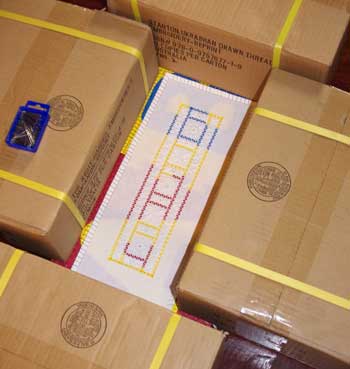 However, one of my dedicated readers, Renee, suggested to me to use those high density foam mats that have alphabet cutouts, the type that are for kids to put together as a large floor jigsaw. (You can slightly see the A and B in the photo.) I immediately saw the benefit of something like this: they can be packed away when not in use, and you can use as many or as few tiles as you need for the size of the piece.
I had been troubled by the fact that I was going to have to stretch my Portuguese whitework tablecloth for my book, and this perfectly solved the problem of what to use. I got mine quite cheaply at my local Kmart store (Australia).
Renee has glued the letterforms into her mats so that they do not dislodge. I haven’t yet done this with mine. It hasn’t bothered me that they can fall out, but if I find it is a problem then I’ll superglue mine in too. Potentially it could be a problem if I had to pin into one and the tension of the fabric caused it to pop out. This started to happen with the side of the B, in the example photographed, but you can see that the box is holding the edge of it down.
Given that there are about 30 mats within my pack, and I’ll very rarely use all (or any!) of them, I can’t imagine they’re going to wear out quickly. They will get wear and tear by being pinned into – the pin holes will gradually cause them to break down – but considering how long it will take for this to happen, and that I only paid $15 for the whole set, I think I’ll be getting very good value out of them!
The surface of the mats has texture on them, which if you’re using a not very firm fabric, could show up as texture wiggles on the surface of the fabric when it has dried. If you were concerned about this, you could use the back of the mats instead – on mine these are completely flat. I also found that a light press with the iron (after the work has been unpinned and removed from the mats!) removed any of these texture wiggles.

'Portuguese Whitework: Bullion Embroidery from Guimarães' by Yvette Stanton, due for release in early 2012.
Thanks Renee, for sharing the wonderful idea of the alphabet mats with me, and for allowing me to share it with others. It is such a Good Idea!
 White Threads is the blog of Yvette Stanton, the author, designer, publisher behind Vetty Creations' quality needlework books and embroidery products.

The cover looks fantastic Yvette!
Thanks Jeanine!