Vetty Creations header

Back to Vetty Creations website

White Threads

The three places I post regularly

Nearly everything I post on my Vetty Creations Facebook and Instagram pages, I also post here on my blog, White Threads. Though blogs aren’t particularly fashionable any more, I keep mine going for a couple of very important reasons.

Some time back, Meta had a little spat with the Australian government. It meant that they refused to put any links to Australian news websites on Facebook, and any that were there no longer worked. It’s all been resolved now, and I can’t remember what it was all about, but it brought home to me the fact that I don’t have control over who sees the things I post on FB and Insta.

And then there’s the all important “algorithm” we hear so much about. Who knows when I might fall foul of it, and when you’ll no longer receive any posts from me!

So, if it occurs to you that you’re not hearing from me anymore on Facebook or Instagram, please check here on my blog. It might be that my social media posts simply aren’t being delivered to you anymore (try interacting with my posts more – commenting and liking – and that may help), or it might be that I’m not currently well enough to post, or perhaps I have nothing to say at that time (it does happen!). But my blog should give you an indication of that.

One thing you may find is that there is far less interaction on my blog. If you’re a follower of my blog and are disappointed with the lack of commenting there, generally most of the sparkly debate and witty repartee is to be found on the Vetty Creations Facebook page. It’s where people most engage and write their own thoughts and comments. Instagram is more about the pretty pictures, so fewer people comment, or comment in less depth.

So, I just wanted to explain why you’ll find me posting pretty much the same content in those three different places. You’re welcome to follow me on any or all of them.

January 17th, 2024 | Category: hints and tips | One comment

Credentials not required!

Studying smøyg in a museum in Norway

Studying smøyg in a museum in Norway

In response to my recent post about learning wherever knowledge is to be found, Robyn replied on Facebook:

So many are focused on credentials. We fail to acknowledge the wealth of knowledge that our parents and grandparents have that they pass on to our very lucky selves.
Although I am sure great information and techniques are to be gained from the School of this and the Society of that, I am always sad to hear a very accomplished stitcher, knitter, quilter or other artist or crafter apologize that they are self-taught or learned from a grandparent.
There is nothing to apologize for. In fact, I for one, value their way of acquiring their expertise.

Robyn is so right! We don’t need credentials: our work can speak for itself.

Apart from textiles at school, I am almost completely self-taught. I’ve taken one or two embroidery classes in my life. My needlework knowledge has come from books and the study of historical needlework, and using what I know to figure things out. I have even learned from my students.

At times I’ve lamented my lack of credentials. While I benefit greatly from my design degree, I know that “trained at x needlework school” adds sway for some. I cannot claim it because I haven’t trained at one. And really, is it that important? Not to me, because I have invested in years of far more relevant private study. My study of primary historical sources means I know far more about some needlework subjects than “formal” students, because much of what I have researched is not taught in needlework schools.

We who are self-taught should be proud of that. Those of us who have learned from our grandmothers, from skilled stitchers in our guilds, from friends, from mentors, or from books can be proud of that.

Being self-taught or informally taught does not mean your work will be of a lower standard. I know that there are myriad highly skilled needleworkers who have never had any formal training, and yet their work is of exceptionally high standard.

Be PROUD of being SELF-TAUGHT. Let’s celebrate it! Please tell me about the special people you have informally learned from. What books have been useful to you as you have taught yourself?

January 16th, 2024 | Category: Embroidery classes, embroidery musings, writing books | 5 comments

How the book “Hardanger Filling Stitches” came to be

Hardanger Filling Stitches
In October 2022, I was tagged in a FB Hardanger group comment by a woman named Donna. She was wishing for a compendium of Hardanger filling stitches (she later told me she’d wanted such a book for 40 years). She tagged me, because she felt that I should write that book.

I thought about this for a very short while, and realised she was absolutely right! And so, I set about writing the perfect book for her, and for everyone else who was interested.

The book kept getting bigger and bigger, and I was happy to keep expanding it until my UK co-publishers said “You must stop at 280 pages!” It was a struggle, but I did.

In less than a year I had completed it (all written, illustrated, stitched, photographed, laid out, etc by me). I still don’t know how, as books much smaller usually take me about two years to create!

The Australian and NZ shipment arrived from the printer just days before Christmas and I had the mammoth task of sending out all the pre-orders I had received, while not at all well. Thankfully, I had the help of many, but especially my parents and husband.

Late last week, Donna’s book finally arrived in her letterbox. I had been tracking her parcel, from Australia, all the way to the US. It was so lovely to see a message from her the following morning.

“The book arrived safely in yesterday’s mail. I’m afraid I made inarticulate sounds of joy repeatedly after opening the package and reading your message. My husband was instructed to hold onto the book until my packing (for a stitching retreat) is complete, which it will be this morning just before I drive a few hours… Then, in the company of almost 200 like-minded women, I’ll have days to dip into your book. Oh! I should pack a doodle cloth to try some filling stitches over the long weekend! Thank you forever for this book. I can hardly wait to get started.”

My heart is full. The audience of one who I wrote the book for is happy, so I am happy too.

Order your copy from me (available now) or your favourite needlework store. It is currently available in Australia, soon in NZ, late February in Europe, and March in the US. https://www.vettycreations.com.au/hardanger-filling-stitches.html

January 15th, 2024 | Category: Hardanger Filling Stitches, public thanks, whitework, writing books | One comment

When is it not Hardanger any more?

Hardanger cutting experiments
These photos are the work of my friend Cathinka, who is known online as Hardangerrebel. (You can find her on Instagram and Facebook under that name.) She’s been experimenting a lot with Hardanger – particularly lately – pushing the boundaries. Her moniker is quite apt! I have her permission to post these photos and open this discussion based on them.

A question I’d like to pose is, when is Hardanger not Hardanger any more? Or, when is any traditional embroidery style not that style any more? When does it stop being that style and start being something else?

I’ve written a book on Guimarães embroidery, which is embroidery that comes from the town of Guimarães in Portugal. In that town, to sell a piece of bordado de Guimarães (Guimarães embroidery) it must be first certified. This certification process ensures that standards are maintained and the technique remains true, and “the style” remains “the style”. It is the work made by the people of the town, in their traditional style, and of a high standard of craftsmanship. Anything that is not certified, cannot be claimed as bordado de Guimarães. Anything I’ve made in that style, can really only be said to be made in the style of Guimarães embroidery.

If we apply this to other forms of embroidery, does that sort of definition hold up? Can only embroidery made in the place of origin, by the people of that place, in their traditional style, be said to be true examples of that embroidery? Strictly speaking, I think yes.

However, if we look at Hardanger, it was taken from Norway to far flung places many, many years ago. And since then, the embroidery has changed. Contemporary Hardanger is very different than old-style Hardanger, which was the reason for me writing the book “Early-Style Hardanger” – to show people what it used to be like, and to reinvigorate interest in that traditional style embroidery. And yet, it remains Hardanger. There are certain elements that make it recognisably Hardanger embroidery.

So when is Hardanger not Hardanger any more? When is any traditional style of embroidery not that style any more? How far is too far? Where is the line?

I saw these photos of Cathinka’s this morning, and immediately thought, “Oooh, Cathinka! Is that Hardanger any more?” I’m not saying it is, and I’m not saying it isn’t – I’m just pondering!

Cathinka has started to remove the mesh of threads where the filling stitches are usually worked. When you look closely at it, she’s edged those cuts in the lacy edge, just like you might at the outside edges of a piece. Is having holes like this in the middle any different than cutting away at the edges? In other pieces, Cathinka has removed the klosters, having only needleweaving and filling stitches inside a lacy edge.

Are these works, arguably without some of their distinctly “Hardanger” elements still Hardanger?

These questions are something that I have pondered at length, because when I present styles of embroidery to the world in my books, there is an element of me making the pronouncement of, “THIS is this style of embroidery. Anything else is not.” I have to be extremely careful to show the embroidery style as accurately as I can, in order to not lead people astray.

I want the cultural custodians of those styles to be happy with what I have presented, and not think, “Well, she got that wrong, didn’t she?” (Actually, in all honesty, I’m quite sure I’ve misrepresented aspects of the embroideries in my books, but I don’t want the overriding impression to be that!)

I know that people WILL then take what they learn from my books and change it; personalise it. Sometimes this starts moving it away from what would be regarded as “the style”. It is inevitable that this will happen. So how far is too far, that it is not “the style” anymore? When does it stop being “the style”?

How long is a piece of string?

What do you think?

January 13th, 2024 | Category: embroidery musings, hardanger, historical embroidery, Portuguese embroidery, whitework | 6 comments

Learn from where you can

meeting of stitchers in norway

Me (third from left) meeting with and learning from some Norwegian stitchers at Husfliden in Skien, Norway, 2016.

Many years ago, I considered training at the Royal School of Needlework. In the end, my life took a different path. With the passing of time and the benefit of hindsight, I am so very glad that I did not train there. If I had, I am pretty sure I wouldn’t be doing what I am doing. I wouldn’t have carved out the particular career that I have carved out for myself.

In my work, I focus very much on historical styles of needlework, often that others have not yet shone a light on. I research them in depth, looking at many historical examples, and drawing my information from primary historical sources where possible. I work on expanding our records of how to do techniques that might otherwise be lost. This is MY focus, and I believe that what I do adds value to the needlework world and to the cultural record.

There are many ways to learn what you want to learn. It might be through a school such as the Royal School of Needlework, the San Francisco School of Needlework and Design, or the Japanese Embroidery Center. It might be from individual tutors such as Margaret Lee for Chinese embroidery, or me for various forms of whitework, or Jacqui Carey for Elizabethan, just to name a few. It might be from studying the historical items in museums or local collections. It might be from the cultural custodians of historical embroidery, who are sometimes the few remaining who do the work. It might be from books. It might be from friends, or it might even be from your grandmother.

What I want is for needlework skills to be retained and not lost, and the learning for that to happen can come from many different places. The best place to learn is from the people who have the knowledge and the skills to teach you. It can be formal or informal. It’s just really important that it happens!

January 12th, 2024 | Category: embroidery musings, historical embroidery, travel, writing books | Leave a comment

Frixion pens – I wouldn’t touch them!

Frixion pens concerns

I saw this posted on Facebook today. It is apparently from Pilot Pen UK marketing, regarding Frixion pens and needlework. I have tried to find the source of this image, but cannot. I therefore cannot guarantee it is legitimate, but it certainly highlights some real concerns for me.

I have always been extremely wary of Frixion pens. Just because you can’t see something doesn’t mean it isn’t still there. And some time later it may indeed become obvious that it is still there.

So, for those who have been using Frixion pens or those blue fabric markers (which scare me equally!) what is a good alternative?

Sewline fabric pencil

The product I recommend is a wash out fabric pencil. The brand I recommend and sell is Sewline. Rather than being a regular graphite lead, Sewline fabric pencils use a lead made from ceramic. It washes out, and depending on the surface of the fabric you’re putting it on, it may also be able to be erased, using the eraser on the end of the pencil.

These are preferable to markers and Frixion pens because the markings are drawn onto the surface of the fabric and are inert. The lead doesn’t sink in to the fabric’s fibres. It makes a nice fine line that doesn’t bleed. It doesn’t rely on a heat-based reaction to disappear – it is washed off or rubbed off. If you can see it, it is there; if you can’t see it, it isn’t there.

If your needlework is something that doesn’t matter how long it lasts, then by all means, keep using Frixion pens or fabric markers. But if you want your embroidery to remain undamaged over time by the markings that you’ve used, then I strongly suggest changing to using a wash out fabric pencil.

You can purchase these from my online shop. I also have them with white lead for drawing on dark coloured fabrics. And there are replacement lead packs for when you have used up the six leads that come with your pencil.

The packaging has recently changed, but I haven’t had the opportunity to update my images yet – the product is still the same great product, but with protective cardboard rather than plastic packaging.

January 11th, 2024 | Category: embroidery musings, hints and tips, making stuff | 6 comments

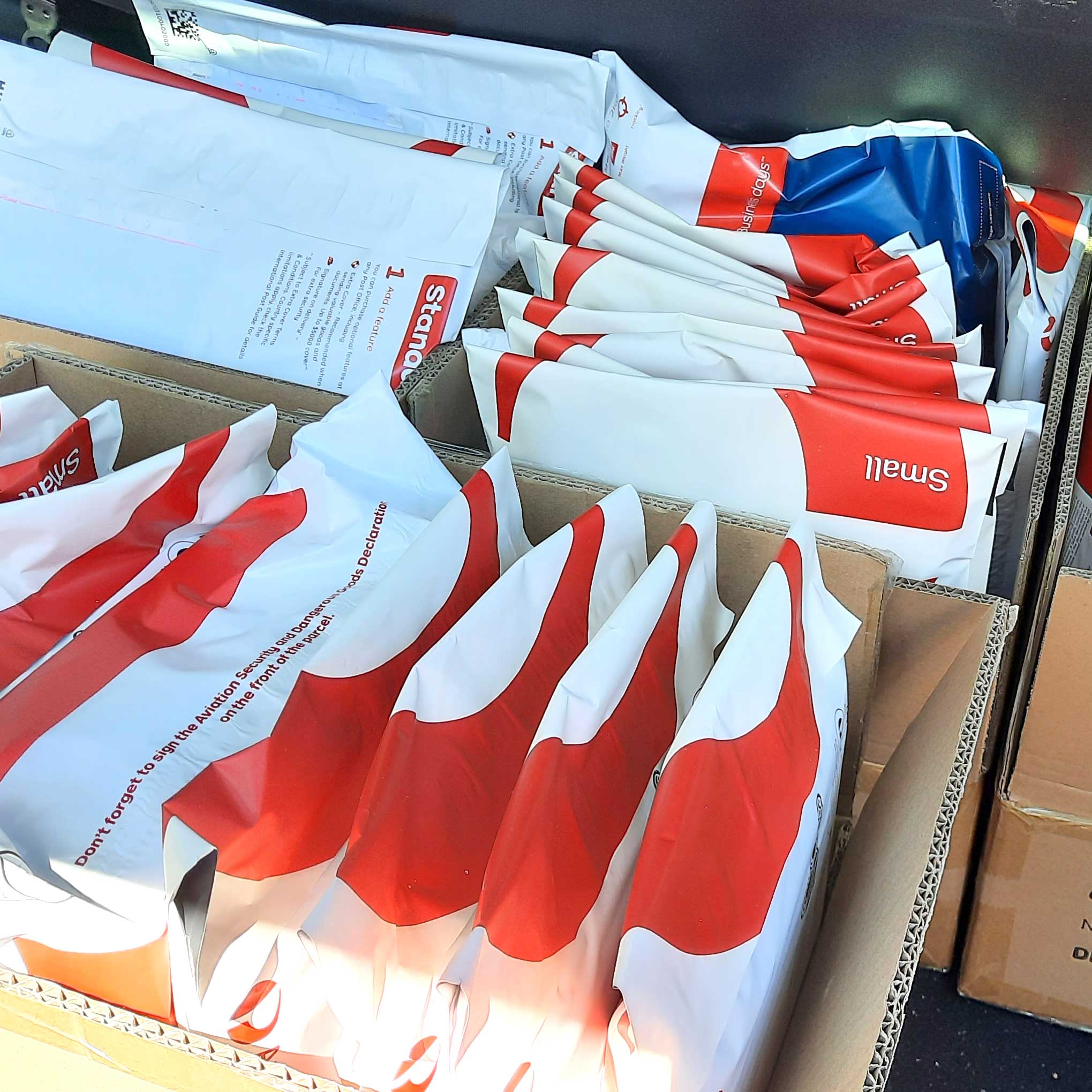
Parcel tracking notifications

parcels

I have embarked on emailing all people to whom I sent pre-orders of “Hardanger Filling Stitches” to send them their tracking information.

I am emailing both those who I understand have received their parcels and those who have not yet. For those whom the notifications show have received their parcels, I’m doing it to check that they have received them (e.g. some notifications say they are “left in a safe place”). And for those who haven’t yet, so that they can track their parcel.

It will take some days to get through them all, partly because I am unwell, and partly because I have so many emails to send that some email systems think I am sending out spam. So I need to pace my emails for both reasons!

Some emails are bouncing, because the servers think I am spamming. (I’m not! They’re legitimate emails!) If you don’t receive one and you’d like your tracking details, please email me. I *might* have more success getting through if you’ve added me to your contacts (yvette at vettycreations dot com dot au).

I do apologise for not sending this information earlier. I made the decision that it was far more important to get everyone’s parcels in the mail than to send out tracking emails. It has been difficult managing everything that I have to do, when I have limited ability to do so.

I am receiving “Your item has been delivered” notifications all day, every day, so hopefully there are a lot of happy recipients out there!

PS: I’m not emailing those who have already let me know via comment here or a message, that they have received theirs. That seems a little redundant!

January 11th, 2024 | Category: Hardanger Filling Stitches | 2 comments

Another Smøyg class finish

Smoyg panel stitched by Elizabeth A
From New Zealand, I received a photo of Elizabeth A’s completed smøyg panel from my recent class there. This looks lovely! Well done Elizabeth!

Elizabeth has plans to add some more smøyg around this panel as a border, so that she can make it into a cushion. She did warn me that this was not likely to happen soon!

If you’d like to make this design for yourself, the instructions can be found in my book “Smøyg: Pattern Darning from Norway”. https://www.vettycreations.com.au/smoyg.html

January 10th, 2024 | Category: Embroidery classes, pattern darning, Smøyg, Smøyg: Pattern Darning from Norway, teaching embroidery, travel | Leave a comment

Craft Alive Tamworth

Tamworth Craft Alive

Last year I booked to exhibit at Tamworth Craft Alive this coming March (15th-17th March 2024, at TRECC). This is my local craft show, and I wanted to be at it. There are lots of Embroiderers’ Guild NSW groups in the wider region including Tamworth, Armidale, Gunnedah, Narrabri and Singleton. And I wanted to be there to bring stitchers from rural communities in that region my books, kits, patterns, and embroidery supplies.

At this stage, my booking is on hold because I am unwell, and I don’t know if I’ll be well enough by then. BUT, if there’s any possible way that I can be better in time, I will do my darndest to be there!

If you’re in that region, please keep an eye on my social media or blog for any updates. At this stage, you should not expect to see me there, but if they have room for me, and suddenly I’m well enough, I’ll let you know that I will be there.

https://www.craftalive.com.au/events/tamworth/

January 9th, 2024 | Category: exhibitions, new products, travel | Leave a comment

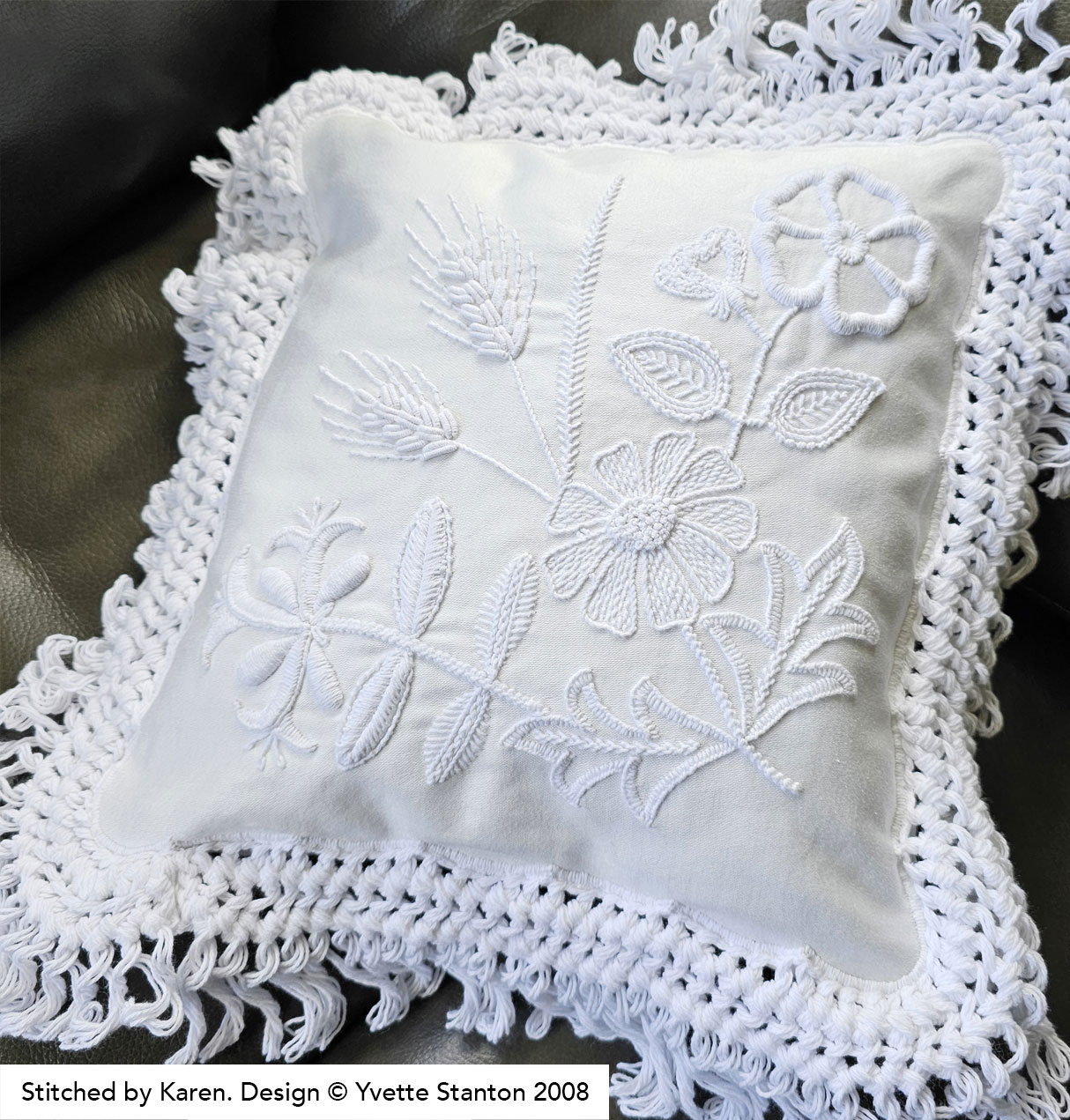
Mountmellick cushion class finish

Karen's Mountmellick wildflower cushion

Another finish from a class on my recent New Zealand teaching tour. This time, Karen’s Mountmellick Wildflower Cushion. The stitching on this is simply gorgeous – you’ve done a marvellous job, Karen!

If you’d like to make a wildflower cushion of your own, this is available as a kit. There are also two other cushions in the same range that can be made as set.
https://www.vettycreations.com.au/catalogue-kits.html#mountmellick

January 9th, 2024 | Category: Embroidery classes, mountmellick embroidery, mountmellick supplies, teaching embroidery, travel | Leave a comment
« Newer Entries  
  Older Entries »
Yvette Stanton White Threads is the blog of Yvette Stanton, the author, designer, publisher behind Vetty Creations' quality needlework books and embroidery products.

New book now available!

Hardanger Filling Stitches
Hardanger Filling Stitches by Yvette Stanton. Order your copy today!
Find us on Facebook

Archived posts

Categories

  • book reviews (88)
  • Christmas ornament swap (13)
  • colour (6)
  • crazy hair (6)
  • customer embroidery (49)
  • designing (119)
  • dressmaking (26)
  • Early-Style Hardanger (91)
  • Elegant Hardanger Embroidery (42)
  • Elizabethan embroidery (25)
  • Embroidery classes (189)
  • embroidery musings (436)
  • embroidery stitches (206)
  • errata notices (11)
  • Ethnic embroidery (49)
  • exhibitions (111)
  • exploring the needlework internet (10)
  • favourite needlework items (69)
  • FlossTube (102)
  • Frisian whitework (73)
  • goldwork (12)
  • hardanger (232)
  • Hardanger Filling Stitches (72)
  • Hardanger Filling Stitches (1)
  • hints and tips (114)
  • historical embroidery (119)
  • how-to videos (34)
  • illustration (1)
  • Inspirations (25)
  • Introducing… (90)
  • left handed embroidery (78)
  • magazines (10)
  • making stuff (271)
  • merezhka (35)
  • mountmellick embroidery (176)
  • Mountmellick Embroidery: Inspired by Nature (60)
  • mountmellick supplies (49)
  • new products (104)
  • online book previews (7)
  • pattern darning (19)
  • pattern drafting (11)
  • photography (2)
  • Portuguese embroidery (166)
  • Portuguese Whitework: Bullion Embroidery from Guimarães (74)
  • public thanks (32)
  • published projects (27)
  • Punt 'e Nù (32)
  • Sardinian Knotted Embroidery (77)
  • sewing tips (9)
  • Smøyg (41)
  • Smøyg: Pattern Darning from Norway (39)
  • soapbox (6)
  • stitch along (44)
  • stitch dictionary (45)
  • teaching embroidery (192)
  • The Left-Handed Embroiderer's Companion (104)
  • The Right-Handed Embroiderer's Companion (70)
  • travel (172)
  • Ukrainian Drawn Thread Embroidery (35)
  • Uncategorized (169)
  • video previews (5)
  • White Threads Blog (91)
  • whitework (364)
  • writing books (306)