Vetty Creations header

Back to Vetty Creations website

White Threads

Great class at the NSW guild

On Saturday I taught Portuguese Whitework at the NSW Embroiderers’ Guild. I had a lovely day with a lovely group of women. They were very accomplished stitchers and produced great results.

Personally, I was extremely pleased that after a week where my health had been up and down and all over the place, I had a FULL DAY of good health. It meant I was not troubled with any pain for the whole day, and meant that I felt pretty normal! I was so thankful to God that He provided me with good health on the day I really needed it. 🙂

During the day, we were discussing the fabric we were using (Graziano Pronto Ricamo) and several of the students reported that they found it easier to pull threads out in one direction than the other. In one direction they seemed to shred more. We eventually decided that it was the warp threads that fell apart more as they were withdrawn. Of course, there’s nothing we can do about it, but it was interesting to note.

If you missed out on this class because it was already fully booked (apparently it filled quite quickly!) I will be teaching another Portuguese Whitework class at the guild over two Saturdays in April/May next year.

November 5th, 2012 | Category: Embroidery classes, embroidery musings, Portuguese embroidery, Portuguese Whitework: Bullion Embroidery from Guimarães, whitework | Leave a comment

a little update

Sorry, I haven’t had much to say lately. I’ve been relearning/remembering how to manage the pain of CFS. It is best to just keep really warm – that keeps the pain at bay. When I am warm, the pain is just a small undercurrent. When I am not warm enough, it becomes an interrupter. Most days I have been warm enough, so that is good. I am very thankful that the CFS is only a slight relapse; certainly not full blown or I wouldn’t be getting anything done at all!

The other day I learned of some really amazing new yarn for knitting. I’ve ordered some and am looking forward to finding out if it can be used for embroidery. Hopefully it will arrive in the next few days. If it works, it might just become part of this year’s batch of Christmas decorations.

I’ve been doing more class preparation and chipping away at the app preparation. I’ve had another couple of class bookings, which is encouraging and exciting. This weekend I have a class at the NSW Embroiderers’ Guild, teaching Portuguese whitework. I’m sure we’ll have a fun day!

October 31st, 2012 | Category: Embroidery classes, making stuff | 4 comments

Reader question: my threads have run, what do I do?

Yesterday I received a sad and heartfelt email from an embroiderer. I could feel her pain as I read her email:

I just completed a small embroidery and the red thread bled. Oh dear. I was looking on the net for advice and came across your blog entry about testing a red thread. My question is what would you do if it had bled. Some people take the preventative approach and rinse all of their threads before using, some add salt, vinegar – loads of conflicting advice. Also when I wash my embroidery afterwards to get the soluble pen out is there a way of washing it that further avoids the chances of susceptible threads bleeding?

My commiserations for a dreadful day. How annoying and disappointing for you!

My first suggestion would be to only use colourfast threads. If you’re wanting to use overdyed threads, some of them are colourfast, I do believe – you may just have to search for them!

My other suggestion is to not use water soluble pens if you think it is at all likely that the colours will bleed when you do wash. Use some other method of drawing on the fabric or tracing your pattern – even water soluble pencils are better than pens, as they can sometimes be rubbed off with the eraser. Personally, I try not to use water soluble pens at all.

BUT, if your threads have already run… I am not sure. I feel at a bit of a loss to know how to help as anything I suggest may not help at all, or may indeed make it worse! In dressmaking, if I think a fabric is overly dyed, when I prewash it, I use salt and cold water only to help keep the dye in place. But if you do that with your embroidered piece you risk setting the run bits too. What would happen if you ran and ran and ran cold water over the piece? It might wash out the dyes, but then they may just “lodge” in the fabric. On the other hand, the run parts might wash out too… It is very hard to know.

Ukrainian Drawn Thread EmbroideryMy only experience of having a thread run disappointingly was with the piece that is on the front cover of my book “Ukrainian Drawn Thread Embroidery”. I cheated and used Photoshop to edit out the small patch where the iron had spurted on the black (non-colourfast, as it turned out!) thread. I just didn’t want to make it worse by trying anything else! Of course, this only fixed the picture of the embroidery, not the embroidery itself.

Does anyone have any suggestions for this awful predicament? Has this happened to you in the past, and what did you do about it?

Most of the embroidery that I do is white on white, so the dye in threads running is not something I often encounter.

October 25th, 2012 | Category: customer embroidery, embroidery musings, hints and tips | 7 comments

the great sheep’s cheese experiment of 2012

As some of you who have been reading this for a while will know, I had Chronic Fatigue Syndrome about 3 years ago, for a period of about 9 months. I considered only 9 months to be a very good run, as often CFS goes on for a lot longer than that!

When I had CFS, I was under the care of a very good Chinese doctor, who was both a GP (general practitioner) and a practitioner of TCM – Traditional Chinese Medicine. Amongst other treatments, he suggested that I should not eat any dairy food. I came off dairy food, and immediately I started to get better. After some months, he suggested that I try some again, and immediately I got much worse. At that point we decided that I would no longer have any dairy. And I got well again.

About a year later, my daughter was diagnosed with a dairy allergy, so the two of us have been dairy-free ever since. We manage quite well, but I really miss cheese.

When we were in Tasmania during the recent holidays, we visited a sheep’s dairy farm. The other half of our family enjoyed trying the samples of cheese made from sheep milk. The guy who was serving them said that he too had a dairy allergy (discovered AFTER they started the dairy!) but that about 50% of people who are dairy allergic can have goat’s dairy, and about 98% can have sheep’s dairy.

It made me wonder, maybe I was one of those 98%? As I still had a class to teach before we went home, I was not game to try some, in case I had a bad and violent reaction to it. But we purchased some and because we had access to refrigeration where we were staying, we were able to take it home with us at the end of our stay in Tassie.

On my return, I had another class the following weekend, so I waited until after that and then decided to try the cheese. It was delicious! I had no immediate reaction. After a few days I was still ok, so I offered some to Rainbow Girl as well, for her to try. She was ok with it too.

After about a week, I started to notice dull aches and pulsating pains in my joints. It was reminiscent of the pains/aches I had during my CFS. It was a small worry, so I filed the information away in the back of my brain. “I’ll just keep an eye on that.”

On Monday this week, with cooler weather, I plunged into pain. My whole body felt like I was coming down with the flu. Maybe I was, but maybe this was CFS pain returning. I have not developed the flu in the following days, so I now believe that the sheep’s dairy cheese has caused a return of CFS pain. The last cheese I had was on Sunday, and I will not be having any more.

Rainbow Girl noticed an increase in stomach aches (a stomach ache that lasted several months was why we investigated and found her dairy allergy) over the time she was enjoying the cheese also.

We both really enjoyed having cheese again. However, a life of pain is not what I want. I’d prefer to go without cheese if it means I have a life without pain. I am disappointed that I am not one of the 98% who can have sheep’s dairy products. I won’t even bother trying the goat’s dairy. The pain is not worth it.

I am now hoping that the pain goes away soon. I guess it will take a while for the cheese to completely get out of my system. I will be pleased when it does!

I realise that this has nothing to do with needlework, but CFS was a big part of my life for quite some time, and drastically affected my life. I don’t want to go there again! And it does explain my silence over the past few days.

October 24th, 2012 | Category: Uncategorized | 7 comments

a weekend at home

It was lovely to have another weekend at home with my family. On Saturday morning, I began making a new leotard for Rainbow Girl. It must seem to regular readers that I am always making new leotards for her. Well, yes, it does happen quite regularly! Because she trains 4 days a week, and keeps growing and the seasons change, she needs preferably 4 leotards.

We arrived in this new summer season and realised that she only had two summer leotards that still fitted her and she’ll grow out of them soon. So I made one a few weeks ago, and another one on Saturday morning. She was thrilled to be able to wear a hot-off-the-sewing-machine leotard (finished about 5 minutes before she left!) for Saturday’s training.

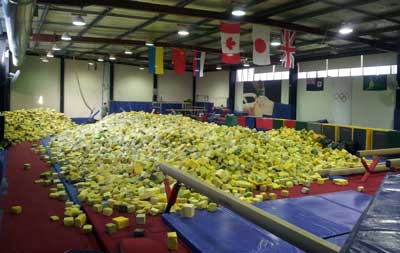
On Sunday morning I was a good community citizen, and went down to help out with the pit clean out at the gym. What is a pit, and why did it need to be cleaned? A pit is a deep area of the gym, filled with foam blocks that gymnasts usually vault into, and sometimes do bar routines over. It means that they can do the routine without needing to worry about their landing.

The pit gets to be quite a disgusting place though. Over time, the foam breaks down and turns to rubber dust. Surely it also must just fill up with dirt and other detritus? Most of us parents, it makes our skin crawl. Who knows what is in there? So for some time, a pit clean out had been planned, and all of us didn’t really want to participate, but we knew we should. Of the two parents in this family, I am the one without respiratory issues, so it was up to me to help.

The clean out started on Saturday night at about 5pm and went through to about 9pm. They had up to 30 people helping at one stage. So when I arrived at 7am on Sunday morning to help, this is what the gym looked like:
gym pit clean outAnd still there was more foam still in the pit! In the photo, the pit stretches most of the way across the far wall. It is about 3-4 metres wide and about 2-3 metres deep. And the whole thing had been filled with foam blocks.

By the time I left about an hour and a half later, the pit was nearly empty. Then they were going to have to use an industrial vacuum to gather up the foam residue and gunk still left in the pit, and start putting the blocks back in again. The most degraded blocks were going to go in the bottom, and the better ones on top. Then the rest of the gym was going to have to be vacuumed.

The bottom of the pit has large flat layers of foam covering it, and between them there are small gaps. It was easy to accidentally sink down between them and get stuck. I had to extract my leg from a hole in the foam at one stage, and it required a good hard pull to get it out. I’m glad my shoes were tied on well!

They found all sorts of things in the pit, and I can well imagine how quickly and easily things sink out of reach. On the Saturday night they found a wallet. They were still looking for the mobile (cell) phone that went missing not so long ago. I found a hairbrush, a ventolin asthma puffer, 4 small plastic koalas (I can imagine some kid at a birthday party going home very upset, having lost them), 25 cents, and best of all, a set of rosary beads! Of course, there were the obligatory hair elastics and dead socks.

I’m looking forward to seeing it this afternoon; all the foam blocks back in place again, and all the gym equipment reinstated in the absence of piles of foam blocks! It will have had to have been finished by the end of yesterday, because gym classes are back in there today, probably with the older elite gymnasts training there first thing this morning. I hope they got it done in time!

October 22nd, 2012 | Category: making stuff | 2 comments

eleven stitches

Over the past two days I have been getting stuck into working on the stitch dictionary app. In that time I have gotten 11 stitches done. Yep, just 11. It takes a long and boring time to do these. Considering there are about 170 stitches in the book, you can see that this is still going to take a while yet.

If I had minions, it could be done so much more quickly, but I don’t have minions – Vetty Creations is just me. 🙂

However, the way I am preferring to look at it (I have to encourage myself somehow!) is that that’s 11 stitches that weren’t done before, and 11 I won’t have to do again…

One of the main problems with working on the app is that it is so boring that it gives me nothing to write about here on White Threads. All I do is cut and paste all the text from each stitch into my database. Then I go through and open up all the image files for that stitch in Photoshop, and resave them, neatly cropped and nicely aligned with each other, as jpgs or pngs. See, it isn’t very exciting, is it?

I just have to keep chipping away…

October 19th, 2012 | Category: The Left-Handed Embroiderer's Companion, The Right-Handed Embroiderer's Companion, writing books | One comment

beautiful kantha blankets

I learned about this project yesterday, and immediately thought it was so wonderful that I’d have to share it with you all. It’s called Hand & Cloth.

If you receive this as an email, you’ll need to go here to view the video.

Hand & Cloth operates in Bangladesh, where women have traditionally made blankets from rags to keep their families warm. At Basha, where at-risk women are employed, blankets are made from layers of old saris which are running stitched together. They are gorgeous! I particularly love the silk sari ones.

What a lovely way to create employment for women who desperately need it. If we ever end up in an economically depressed country again, this is the sort of work I would love to be involved in – working with nationals to create gorgeous textiles, based on traditional crafts, to help women and their families have happier and healthier lives.

There is lots of information on the Hand & Cloth website about the traditions of kantha, about the project, and about how lives are being changed. They have a listing of where their kantha blankets can be purchased locally, and an online shop where you can support them by purchasing some of their gorgeous textiles.

No affiliations etc.

October 17th, 2012 | Category: embroidery musings, historical embroidery, Introducing... | Leave a comment

Needlework cruise update

Mountmellick pomegranate oval doilyI heard from the needlework cruise organisers on the weekend. Enrolments in my classes are going very nicely, and it looks like the classes will be reasonably evenly split between Portuguese Whitework and Mountmellick embroidery. I’ll be teaching a two day Mountmellick class (pomegranate oval doily), and two one day Portuguese Whitework classes (a bookmark, and a small square panel). It looks like it is all panning out very well.

I’ve never been on a cruise before (I have travelled between Ireland and Wales on a boat, but that’s not really the same!), so I’ll probably have to make sure I have something anti-seasickness with me, in case that is a problem!

But I am also really looking forward to having some days relaxing and enjoying sunshine. I’ll need to take a stack of books with me to read, I guess. Hmmm, though I suppose there will be an onboard library. I’m looking forward to meeting some tutors I’ve never worked with before – that’s always enjoyable. I always get questions from people like that about self-publishing! (And I never mind answering those questions.)

If you’re thinking that a needlework cruise sounds like an excellent idea, hop on over to the website for more information. The cruise isn’t until February, so you still have time to sign up!

October 16th, 2012 | Category: Embroidery classes, mountmellick embroidery, Portuguese embroidery, teaching embroidery, travel, whitework | One comment

never such thing as a quiet weekend!

I was home again this weekend, after having been away on holidays and/or away teaching for the past three weekends. It was lovely to be home with my family again! However, that didn’t make it any less busy.

On Saturday, The Reader and I went off to our pattern drafting course again, this week finishing off making our way through the many skirt patterns. We moved back onto tops, and I struggled to remember how to draft one, including all *my* adjustments to suit my body shape. I was heard to moan at one stage “oh, why can’t I just be the same as the pattern turns out?” I am sure that in time I will get used to making all my personal adjustments, but at this stage I am still struggling to just remember how to do the base pattern itself! Practice, practice, practice!

Yesterday, Rainbow Girl went to a birthday party at her old gym with some of her old gym friends. Because the mum of the birthday girl is one of my good friends, I stayed to stickybeak at the party, give her a bit of a hand with corralling the children during the party food section, and to have a chat to some of the other mums, many of whom I haven’t seen in ages! It was lovely to be back there again.

Last night I decided to make dumplings for dinner. Previously I have made them with store-bought wrappers, but my sister recently passed on a recipe which included the dough. The dough was so easy! I chucked two cups of plain flour and a cup of boiling water into the Kenwood Mixmaster, and gave it all a whizz with the dough hook for about 10-15 mins. I did have to stop it early in the piece to help incorporate all the still-dry ingredients, but apart from that, the dough hook did it all for me, creating lovely silky smooth dough.

You then have to roll it into 2cm thick “snakes”, and chop them into pieces about 1cm long. Each of these little blobs of dough gets coated in cornflour and then rolled out flat to about 8cm diameter. This was quite time consuming, and although my wrappers didn’t turn out very round, they worked really well. I could have easily gotten more than 50 out of the dough quantity, if only I’d had enough filling to put in them! I ran out around the 40 dumpling point!

I made up some savoury filling out of what we had in the fridge and pantry, then we steamed them in a bamboo basket. The dough worked far better than the store bought stuff – much less likely to break open, and much less likely to stick to the neighbouring dumplings (and had no extra, unnecessary ingredients such as colouring or preservatives!). I will certainly be making them again, when I have a spare 1.5 to 2 hours… 😉

October 15th, 2012 | Category: making stuff | Leave a comment

rippled hems

Following on from yesterday, in which Lilian told us about her experiments with withdrawing threads after prewashing her fabric, today we look at the effect of pulling bars tight and rippled hems.

In yesterday’s post, Lilian posed the question: “Now I am worried that when the fabric does not shrink after embroidering it, will the pulling together on the threads of the bars, scrunching the fabric up a little, come out after damp stretching? Oh dear, it keeps on posing new questions for us. How tight to pull? Do you pull the threads of the bars tight? In this particular case, it will not be very important, as the embroidery will become panels on a bath towel, so will get laundered a lot, and I daresay never ironed, but there are ‘heirloom type’ projects that you might want to know the answer to this question for, before undertaking the project!”

My reply to her was that I always pull my bars tight. I do this because traditionally, the bars were tightly wrapped, and I like to stick with tradition wherever possible. If I am going to “introduce” a “new” style of embroidery to the world, I’d like to do it as faithfully to the traditional style as I can, otherwise I may as well just make up something completely new!

Lilian’s response:

I asked the question about pulling tight on the bars, because I find that with any drawn thread work I have to be very careful not to pull so tight that the hem is pulled so tight that the edge of it will be longer than the open work and cause the hem to have ‘waves’ or slight ‘ripples’ (I am groping for the correct English word for it). On the light purple doily there is a very, very slight ‘ripple’, gone after damp stretching, but when it is left, it tends to relax and show the smallest of extra width at the seam. An Italian open hem runner I made, also has the problem (but worse), and I found it in a purple runner for my American friend as well. It is not so bad that somebody else will notice it at first glance, but I know it.

I am attaching a photo of the Italian runner.
Lilian's rippled edge runner

With the shrinkage after embroidering, I hoped that the ripples would come out, or be resolved by damp stretching. But if you prewash the fabric, will be problem be more prominent? That is my question, concern if you like. Perhaps someone out there has the answer?

It is wonderful to compare notes with you, and via your blog with so many more experienced stitchers. Thank you for your blog, newsletter and private email. I look forward to hearing more about the question of shrinking or not and if you would take the trouble of writing about the rippled hems, I would be very happy if someone has a foolproof way of avoiding that!

Firstly, I get rippled hems too, when working drawn thread work! They just haven’t really ever worried me… I’ve always just accepted that they happen.

I hear what you say about damp stretching getting rid of it for only a while, until the moisture in the air causes it to relax back to its actual state. Damp stretching is really a temporary measure to make something look exceptional for presentation. I use it before photography, or before presenting something for exhibition or to someone as a gift. For those of us who live in dampish environments with high humidity, damp stretching will not provide a permanent result!

My thoughts on the rippling are as follows, and they are just suppositions, so I could be wrong!

If you prewash, the fabric should not change further after stitching as it will have been preshrunk. This means that after washing, it should be as “stable” as it is going to get. If you don’t want it to change, then use it in its most “stable” state.

However, when we remove threads and reweave new ones in, we destabilise the fabric anyway. We should therefore stitch in such a way that the fabric remains as stable as possible throughout stitching.

While mounting the embroidery into a hoop would be my normal answer, when you’re working against a hem, as Lilian is, it’s quite difficult to put a hemmed piece into a hoop in such a way that you can stitch the hem! Also, when you put fabric into a hoop, there is a good chance that the fabric will stretch under the tension of the hoop, and therefore when you take it out again, it will relax and look different than it did in the hoop.

My suggestion – as strange as it will seem (and it may not work!) – is to work it in hand, rather than in a hoop. If you KNOW that it is not rippling as you work, then it also shouldn’t ripple when you’ve finished. That means that if it ripples when you’re pulling the threads tight by binding them and stitching them, then it will always relax back to that state.

However, it just may not be possible to stitch the desired hem (such as is shown in Lilian’s example) without pulling the threads tighter than the fabric surrounding the embroidery. I would say that any time the threads are pulled together with tighter tension than the fabric will actually allow – and sometimes we can pull them together somewhat because they usually ARE happy to move a little way from their regular woven position – that there will be rippling.

The threads have a specific length. They also will have some amount of give (or stretch) – with linen, this “give” is more when dry than when wet, as linen is actually stronger when wet. If you try to make those threads go further than their length and their give will allow, because you are stitching them in such a way as to need them to go further, then something has to compensate for pulling them too far. In the case of a drawn thread hem, it will be the fabric on either side of the drawn thread area. When you have a several layer thickness hem which will have less ease than a single layer of fabric might, then it is probably going to ripple.

So my answer to Lilian is that as far as possible, you should stitch in such a way as to keep the fabric stable, without pulling the threads too far. Minimise the chance of rippling happening as much as you can, by prewashing, and by careful stitching.

However, sometimes, rippling will still happen, because of the particular technique or pattern that you have chosen to use. We are not machines, and our embroidery is not made by machines. Sometimes we just have to accept that things will happen that we cannot stop.

I’m sorry, Lilian, if that’s not the answer you wanted to hear! It is only my thoughts on the matter, and others who are more well informed, or with more stitching experience than me, may have a different or better answer. I’d love to hear the thoughts of others on this!

October 11th, 2012 | Category: customer embroidery, embroidery musings, hints and tips | 2 comments
« Newer Entries  
  Older Entries »
Yvette Stanton White Threads is the blog of Yvette Stanton, the author, designer, publisher behind Vetty Creations' quality needlework books and embroidery products.

New book now available!

Hardanger Filling Stitches
Hardanger Filling Stitches by Yvette Stanton. Order your copy today!
Find us on Facebook

Archived posts

Categories

  • book reviews (88)
  • Christmas ornament swap (13)
  • colour (6)
  • crazy hair (6)
  • customer embroidery (49)
  • designing (119)
  • dressmaking (26)
  • Early-Style Hardanger (91)
  • Elegant Hardanger Embroidery (42)
  • Elizabethan embroidery (25)
  • Embroidery classes (189)
  • embroidery musings (436)
  • embroidery stitches (206)
  • errata notices (11)
  • Ethnic embroidery (49)
  • exhibitions (111)
  • exploring the needlework internet (10)
  • favourite needlework items (69)
  • FlossTube (102)
  • Frisian whitework (73)
  • goldwork (12)
  • hardanger (232)
  • Hardanger Filling Stitches (72)
  • Hardanger Filling Stitches (1)
  • hints and tips (114)
  • historical embroidery (119)
  • how-to videos (34)
  • illustration (1)
  • Inspirations (25)
  • Introducing… (90)
  • left handed embroidery (78)
  • magazines (10)
  • making stuff (271)
  • merezhka (35)
  • mountmellick embroidery (176)
  • Mountmellick Embroidery: Inspired by Nature (60)
  • mountmellick supplies (49)
  • new products (104)
  • online book previews (7)
  • pattern darning (19)
  • pattern drafting (11)
  • photography (2)
  • Portuguese embroidery (166)
  • Portuguese Whitework: Bullion Embroidery from Guimarães (74)
  • public thanks (32)
  • published projects (27)
  • Punt 'e Nù (32)
  • Sardinian Knotted Embroidery (77)
  • sewing tips (9)
  • Smøyg (41)
  • Smøyg: Pattern Darning from Norway (39)
  • soapbox (6)
  • stitch along (44)
  • stitch dictionary (45)
  • teaching embroidery (192)
  • The Left-Handed Embroiderer's Companion (104)
  • The Right-Handed Embroiderer's Companion (70)
  • travel (172)
  • Ukrainian Drawn Thread Embroidery (35)
  • Uncategorized (169)
  • video previews (5)
  • White Threads Blog (91)
  • whitework (364)
  • writing books (306)