Vetty Creations header

Back to Vetty Creations website

White Threads

New linens from Weddigen

This morning I have uploaded some lovely new linens to the Vetty Creations website. They are from Weberei Weddigen (Weddigen Weaving) in Germany, who are manufacturers of high quality linen fabrics for hand embroidery.

At this stage, I have chosen to stock three of their fabrics: Weddigen 121 linen (50 count), Weddigen 160 linen (34 count), and Weddigen 925 linen (40 count).

Weddigen 121 linen, 50 count

Weddigen 50 count linen, Weddigen Artikel 121
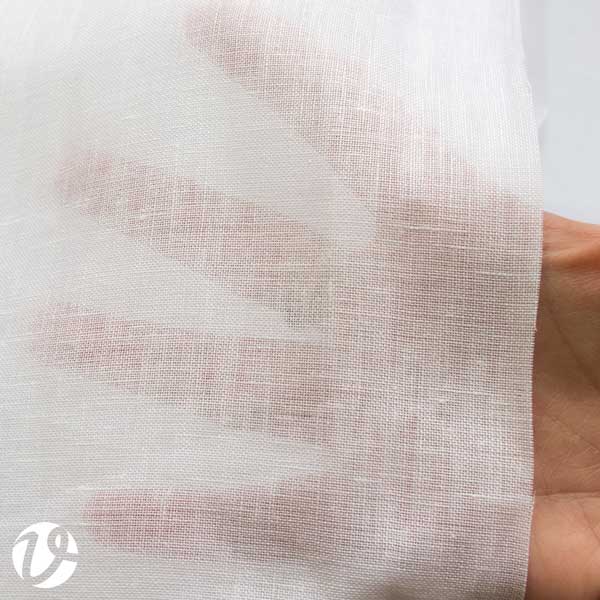
Weddigen 50 count linen, Weddigen Artikel 121


See-through Weddigen 121 linen

Weddigen 121 linen is see-through.

Weddigen 121 linen is a simply lovely fabric that I just had to stock. It is a very lightweight linen, which is see-through. It is perfect for use in shadow embroidery and other embroideries such as fine white work, that require a lightweight, gossamer-ish linen. As it is evenweave 50 count linen, you could also do counted embroidery on it, if you were game!

Unfortunately I’ve come to things a little late with regards to this linen. It is no longer being manufactured, and therefore the stock that exists will eventually run out. I will continue to stock it for as long as I can.

Specifications: Weddigen Artikel 121 linen – 185cm wide, evenweave 50 count, 100% linen, bright white.

Weddigen 160 linen, 34 count

Weddigen 34 count linen, Weddigen Artikel 160

Weddigen 34 count linen, Weddigen Artikel 160

Weddigen 160 linen (34 count evenweave) is recommended for Schwalm embroidery by specialist Schwalm embroidery teachers in Germany. It can of course also be used for Hardanger embroidery, cross stitch and other counted embroidery. It is a lovely looking fabric.

Specifications: Weddigen Artikel 160 linen – 140cm wide, evenweave 34 count, 100% linen, bright white.

Weddigen 925 linen, 40 count
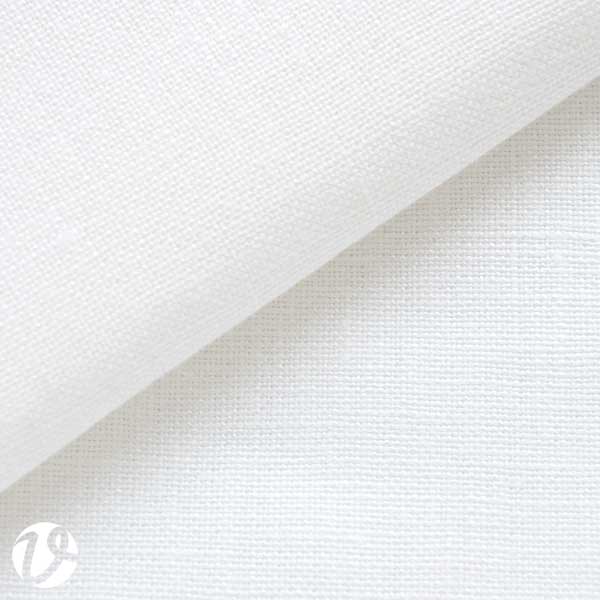
Weddigen 40 count linen, Weddigen Artikel 925

Weddigen 40 count linen, Weddigen Artikel 925

Weddigen 925 linen (40 count evenweave) fabric is also recommended for Schwalm embroidery by specialist Schwalm embroidery teachers in Germany. As with the 34 count linen, it can also be used for Hardanger embroidery, cross stitch and other counted embroidery. Because it is has so many threads per inch/cm, and is not “gappy” between threads, it can also be successfully used as a ground fabric for non-counted, surface embroidery.

Specifications: Weddigen Artikel 925 linen – 140cm wide, evenweave 40 count, 100% linen, bright white.

Is she…?
And so, these recommendations of fabrics for Schwalm embroidery and shadow embroidery might have your mind whirring… “Is she writing a book on Schwalm? Is she writing a book on shadow embroidery?” Sorry if it disappoints, but no, neither of these forms of embroidery are the subject of my next book.

All these linens are available on the Vetty Creations website. They are well priced, and while the prices are comparatively lower than other linens, the quality is definitely not lower.

August 24th, 2016 | Category: hardanger, Introducing..., making stuff, new products, White Threads Blog, whitework | Leave a comment

Lacemaking in the Rio Olympics closing ceremony

Today we have a guest post from Regina Yatiyo Otake Mattosinho who lives in Brazil. She’s going to tell us a little about the lacemaking that was featured in yesterday’s Rio Olympics closing ceremony. If you’re like me, you were more than a little surprised that lacemaking was featured in the ceremony, but I was so happy that a textile art was given the world stage!

Links to images from the ceremony, in case you missed it:
From the Sydney Morning Herald
From Team USA media
From the Sydney Morning Herald

Over to Regina who provided this information to me on Facebook. She kindly consented to me sharing it with you.

I don’t know much very well, the origin and the history behind this lace. The pattern [shown at the ceremony] is a bobbin lace. In Brazil we call it as “Renda de Bilro”. (*It’s better search the Wikipedia for the Portuguese pronuncation of it.) The Portuguese brought it when they came to colonize Brazil.

“The bobbin lace is made on a cushion with horsehair stuffing, sawdust or cotton; such cushion is generally coated fabric whose colors do not harm the view. The pad can be stuck on a wooden support, but there are tenants who simply support a chair or stool. The cushion is the basis on which to perform the lace and it attaches the card to the scheme over which will braiding bobbins , ‘ as they are concerned the bars with pins. The bobbins are a kind of wooden rod provided with a small head at one end. About it winds up the line to make income . The bobbins are always used in pairs.” Original link in Portuguese.

The pins used are thorns that every northeast house had on the backyard. It is a typical cactus in some regions of Brazil. As it is an organic material, it doesn’t oxidize.

Depending on the size of the work could take from 6 hours to 3 months to be finished.

The music that was sang during this presentation, is a Brazilian folklore song. Legends say that it was composed by an outlaw, known as Lampião. In the lates 19th and begining of 20th centuries. The chorus says something like “Lacewoman please, teach me how to make lace then I will teach you how to flirt.” It is registered on a movie “O Cangaceiro” from Lima Barreto. Lampião was a kind of Brazilian Robin Wood.

Here we have many others kind of lace that still being produced. They were brought by the European since the begining of Brazil as a colony. You can see some of them it this link that is in Portuguese.

I hope this help you to know a tiny little bit about Brazilian culture. That is very complex, because is formed by many origins and influences. Not only from the Brazilian Indian (that was also shown during both of the Olympic ceremonies) culture but also from many other countries. Including me, that I’m a Japanese imigrants’ grandaughter, married to a Portuguese descendant.

Thanks so much to Regina for sharing some of your culture with us. We really appreciate it.

August 23rd, 2016 | Category: embroidery musings, Ethnic embroidery, Introducing..., travel, White Threads Blog | One comment

Another review of Early-Style Hardanger

Early-Style Hardanger by Yvette Stanton
This morning Karen Platt contacted me to let me know she had reviewed my newest book “Early-Style Hardanger”. You can read her review at yarnsandfabrics.co.uk.

A small excerpt:
Yvette Stanton’s books are all superbly created – she gives so much more than anyone can expect of her. From the clearest photos and diagrams as well as instructions to the exciting designs, this book is so professional. I wish all creative embroidery books looked like this.

Thanks so much for your enthusiastic review, Karen!

August 9th, 2016 | Category: book reviews, Early-Style Hardanger, hardanger, White Threads Blog, whitework | Leave a comment

Singleton Mountmellick lilies workshop

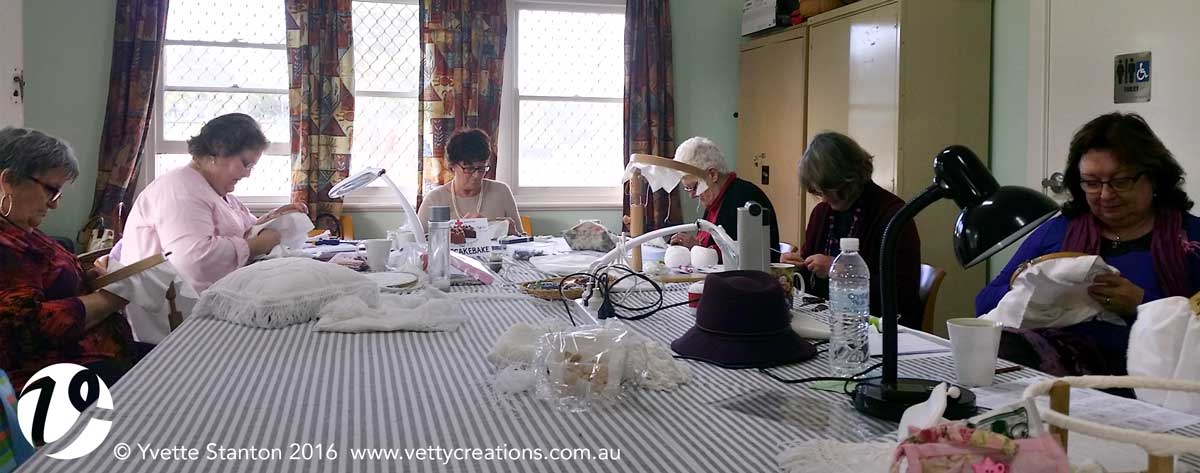
I went to Singleton in the Hunter Valley on the weekend for a workshop of Mountmellick lilies. Two projects were on offer, both featuring lilies: a cushion and a runner.

Singleton Mountmellick class

Some of the participants of the class, hard at work.

We had a lovely time, playing with stitches. We solved the problems of the world with our discussions (don’t we always, whenever we embroiderers get together to stitch?), and we enjoyd good food and good company.

Thank you to the lovely ladies of Singleton Embroiderers Guild Group for your warm hospitality. Your stitching was beautiful, and thank you for showing me all your completed projects from our last class together. I enjoyed my time and it was great to be back amongst you again.

August 8th, 2016 | Category: Embroidery classes, mountmellick embroidery, travel, White Threads Blog, whitework | Leave a comment

Mary Corbet Hardanger book review

Early-Style Hardanger by Yvette StantonBefore I hop in the car to head off to Singleton for a lovely weekend of Mountmellick embroidery classes, I just wanted to make sure that you’ve seen Mary Corbet’s review on Needle’n Thread of “Early-Style Hardanger”.

If you’re familiar with Mary’s book reviews, you know how thorough they are, and this one doesn’t disappoint. Lots of photos of the book and lots of text pointing out all the things she loves about the book.

Mary has said some very nice things about the book, summed up here:

“In a Nutshell
If you love whitework, if you love counted whitework techniques, if you love Hardanger, if you love regional styles of embroidery, if you love linen, if you just love good instructional books – you’ll love this book! And you’ll want it in your needlework library!”

But don’t take my word for it, go and read her whole review!

I have asked Mary to change one thing, and it is her prerogative if she does or not: in the last bit about where you can get the book, I’ve asked her to mention that it should be available in most good needlework stores, and if they don’t have it, they should be able to get it for you. I think it is really important that we support not only needlework authors, but needlework shops. If we don’t, there won’t be any left for us to enjoy.

So for those of you who don’t have a local needlework store, you can purchase your copy here from me at Vetty Creations. I’m happy to post worldwide.

Thank you Mary for your kind words and wonderful review.

August 6th, 2016 | Category: book reviews, Early-Style Hardanger, White Threads Blog, whitework, writing books | Leave a comment

Happy World Embroidery Day!

Celebrate World Embroidery Day 30th JulyToday is World Embroidery Day. I’m going to wear some embroidery, and if I find the time (???) I’m going to stitch in public today. Celebrate loud and long! 🙂
How will you celebrate?

July 30th, 2016 | Category: embroidery musings, White Threads Blog | Leave a comment

lots of research

Over the past week or two, I have been doing heaps of research for the next book. It’s so interesting. At the end of each day I realise that I have learnt so much! I’ve been doing lots of looking at images, identifying patterns across them – things that turn up regularly – and things that are more unusual.

I have been learning very obscure words from the language of the culture I am studying. When you learn a language generally, the sorts of words I need for studying the technical aspects of a style of embroidery are not usually among the first you might learn!

I have been investigating symbols which are used in motifs, and their names in the language of the culture.

I have been trying to understand what garments or items the embroidered pieces I’ve been looking at come from, trying to understand what they were used for. Some are immediately obvious, but others are not.

I have also been investigating likely materials and threads to use. It is very hard to find the “right” things that are universally available (because they are never universally available!)

There has been a lot of “Oh! That’s what that is!” as I have made discoveries and come to deeper understanding. And the worst thing is, that it all stays quite secret, for now. As you know, I don’t reveal what my next book is on until much later through the process. I’m nowhere near that point yet!

So all that is to say that I’m not ignoring you, but I can’t really say what I am doing, except in the vaguest of terms.

Thanks for all your feedback on the recent postings of my Norway research trip diary. I’ll look at putting the diaries from some of my other trips up over the next while. They will be a little different as those trips were also made into family holidays, whereas the Norway one was me travelling by myself for research purposes only.

July 28th, 2016 | Category: embroidery musings, historical embroidery, White Threads Blog, writing books | 2 comments

Norway research trip wrap up

I hope that you have enjoyed my diary from my trip to Norway in 2014 to research for Early-Style Hardanger. I certainly enjoyed reliving it!

All the posts are listed in order below so that you can check whether you missed any.
Day 1 and 2 – Sydney to Oslo
Day 3 – Olso to Bergen
Day 4 – Norwegian Constitution Day, Bergen
Day 5 – Bergen to Utne
Day 6 – Hardanger Folkemuseum
Day 7, 8 and 9 – Heading home

I did want to address something from the final post. The taxi driver who took me to the airport wondered how you could gain enough knowledge to write a book from just a few days. The answer to that is that I didn’t! Much of my research was done beforehand, and much was done afterwards. But the important thing for me in a trip like this is to visit the place where the embroidery comes from, learn about the culture, meet the people, and SEE as many historical examples as I can.

I don’t go knowing nothing, and expecting to learn it all there. I learn as much as I can before so that I have good questions to ask. I see the work, speak to curators and artisans, and ask as many questions as I can. Conversations happen in person that just don’t happen over email.

Visiting Is Sinnus

Visiting Is Sinnus cultural association in Teulada, Sardinia

You can see small details that you’d never see in a book or on the internet. Much of the time those pictures don’t show you the back of the work, or how a garment is constructed, or how something is hemmed. These are the sorts of things you can learn with a curator or embroiderer at your side.

And sometimes it is only through seeing the work in person that you can understand scale, fabrics, threads etc. I wouldn’t have believed that linen thread could look as shiny as silk, if I hadn’t seen it with my own eyes. Fine, fine Hardanger on 50ish count linen isn’t something you see most days, but you can at the Hardanger Folkemuseum.

It is these things that I go to see, and why my research trips are invaluable to me as a needlework historian. I am convinced that this research and the photos that I take while I am there, make my books much, much better than if I stayed at home and did it all by remote.

It has been lovely to receive so many emails and messages over the past week telling me how much you’re enjoying the travel diary. Thanks! It’s always nice to know that you’re producing interesting content that people actually want to read!

Would you like to experience Sardinia and Guimarães by reading along and armchair travelling via the diaries from my research trips there? Would that be of interest to you?

July 24th, 2016 | Category: Early-Style Hardanger, embroidery musings, hardanger, historical embroidery, travel, White Threads Blog, writing books | 10 comments

Days 7, 8 and 9: Heading home

Utne, Bergen, Amsterdam, Abu Dhabi, Sydney
20th – 22nd May 2014

Breakfast was at 8am again. This time I was in the larger dining room as there had been about eight guests for the night. There was hot food this time, so I enjoyed some bacon. I didn’t bother with an egg. I’ve had enough eggs lately…

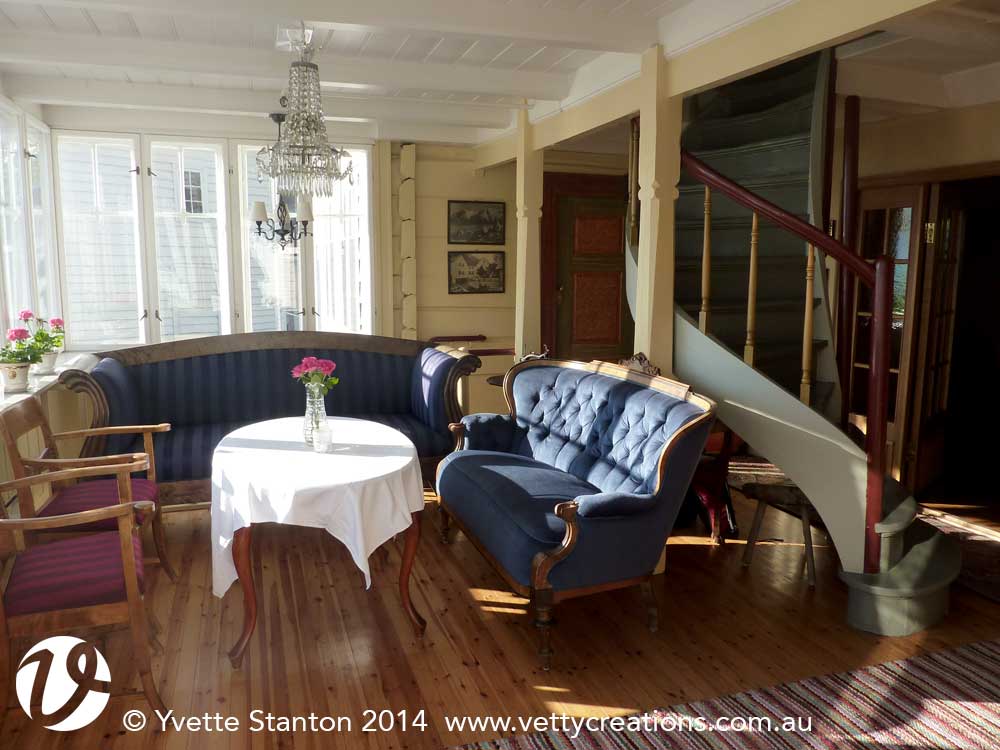
Utne Hotel interior

Utne Hotel interior

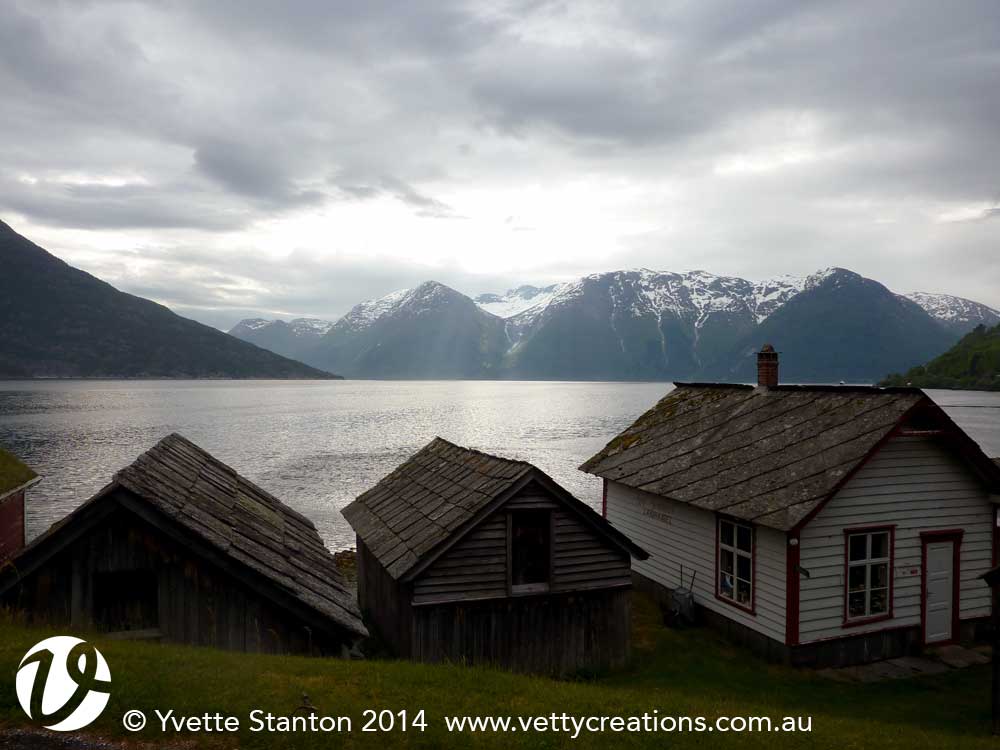
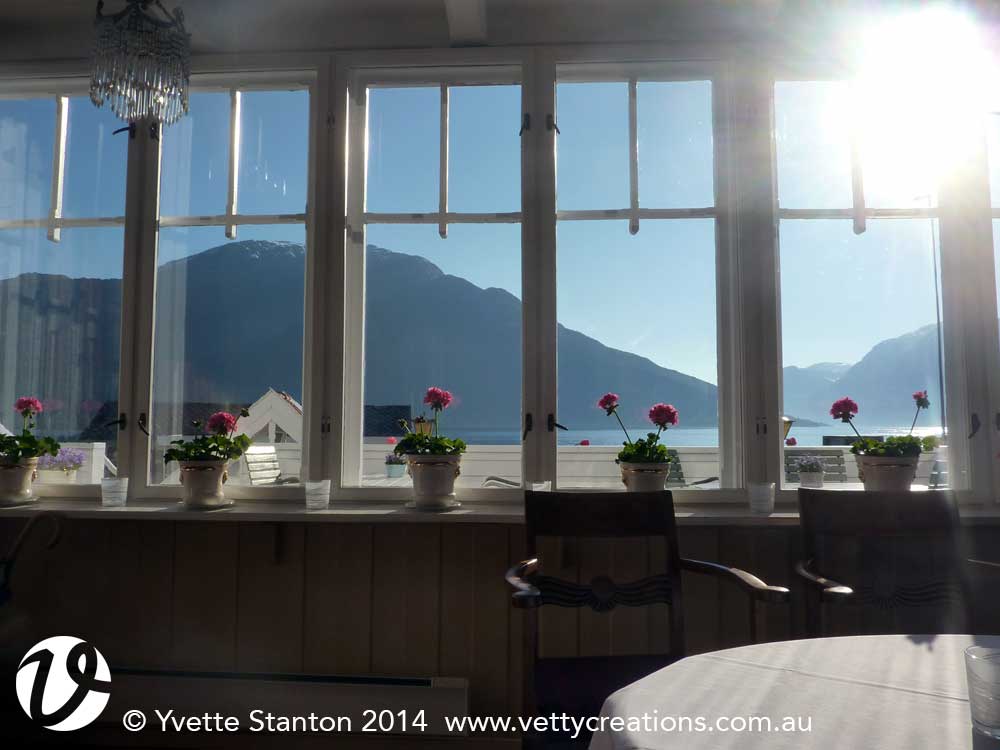
Overlooking Hardangerfjord

Overlooking Hardangerfjord from the Utne Hotel

I left the hotel and sat by the fjord to wait for the ferry. I embroidered while I waited. It was a sunny morning again, and lovely to be outside enjoying it.

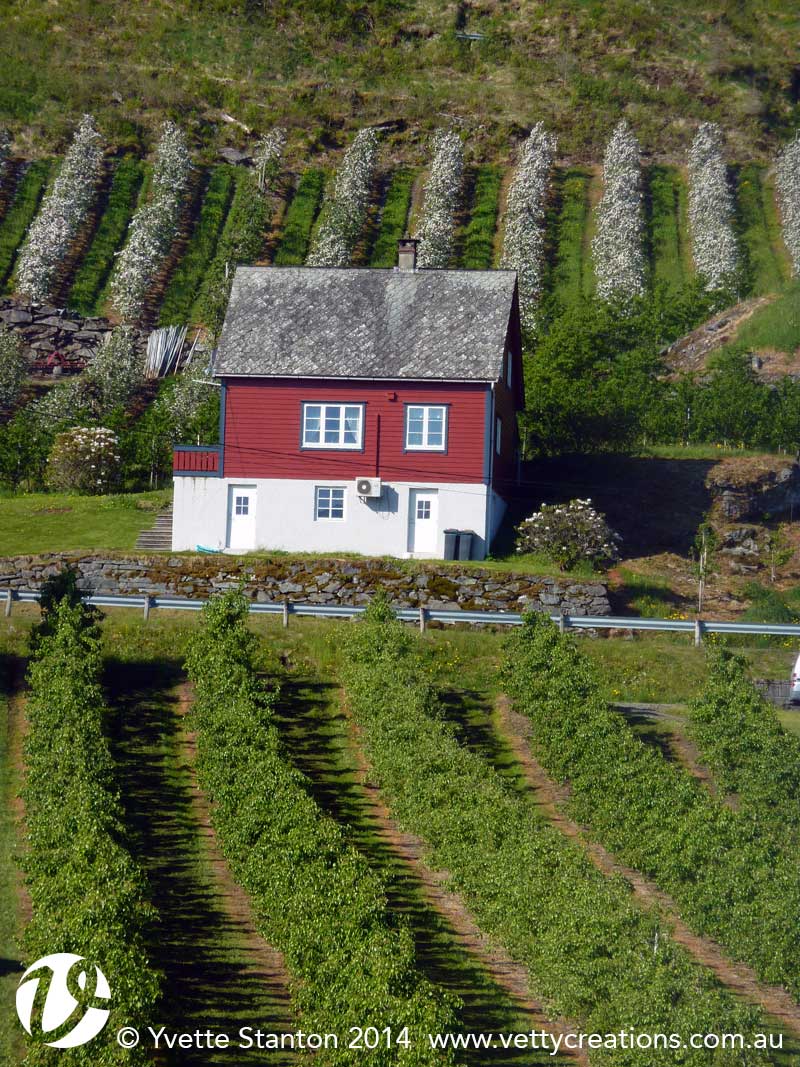
Utne farm

An Utne farm. The area is famous for its stone fruit.

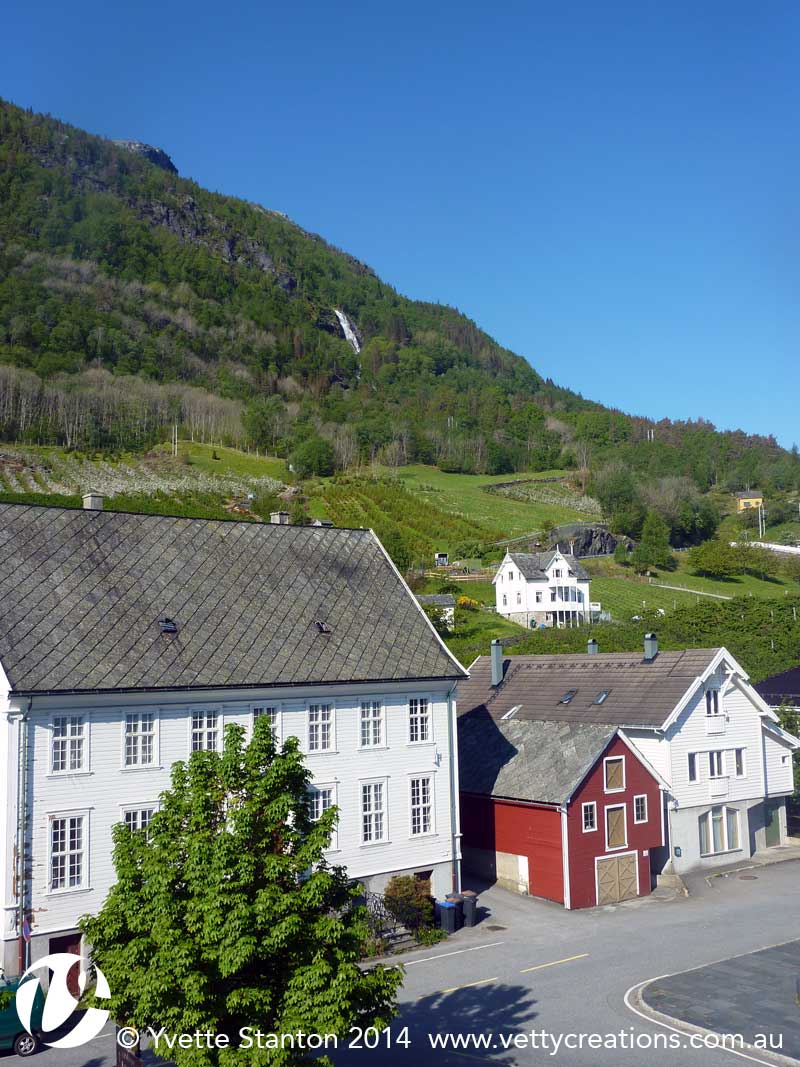
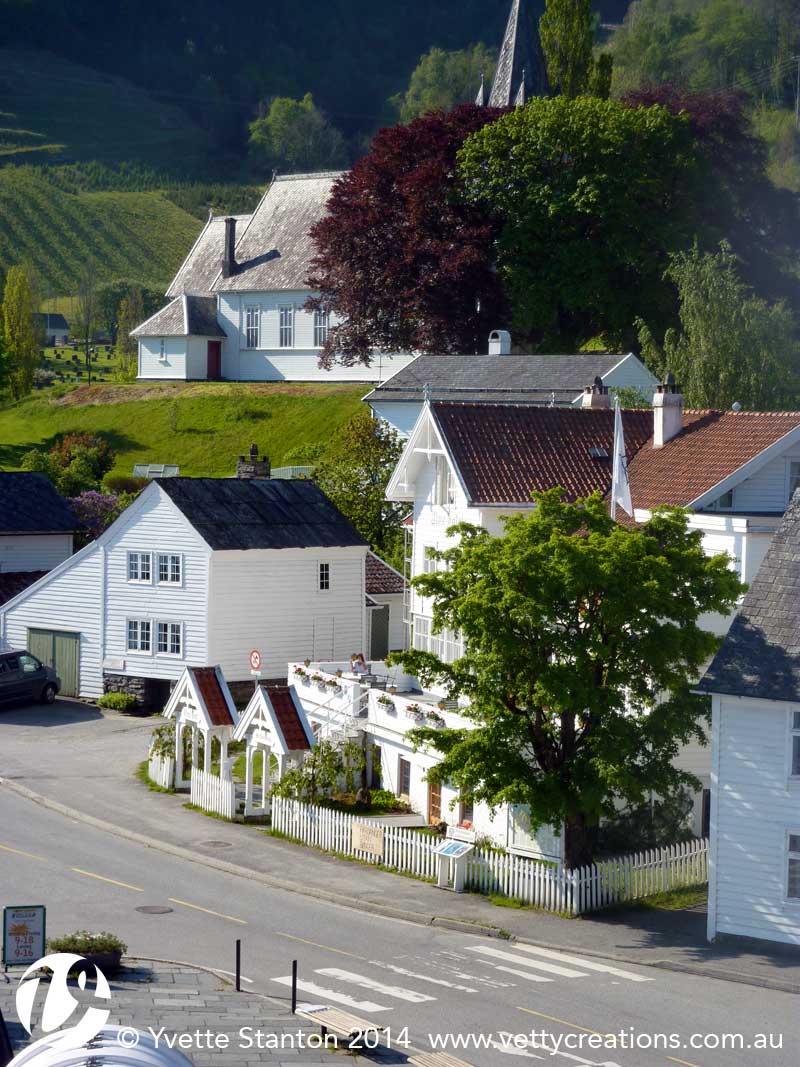
Utne

Pretty buildings in Utne

The ferry came at about 9:30. I paid my fare and went up on deck. It was extremely calm and not particularly windy. I was the only walk on passenger. The rest were in vehicles.

Utne Hotel

Saying goodbye to Utne Hotel

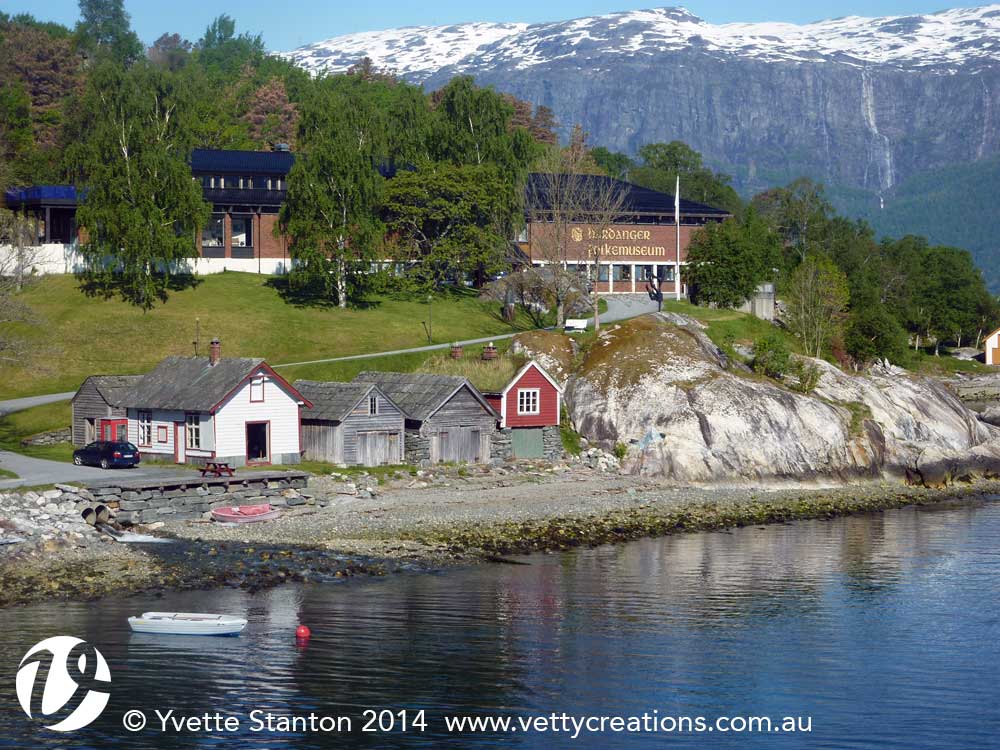
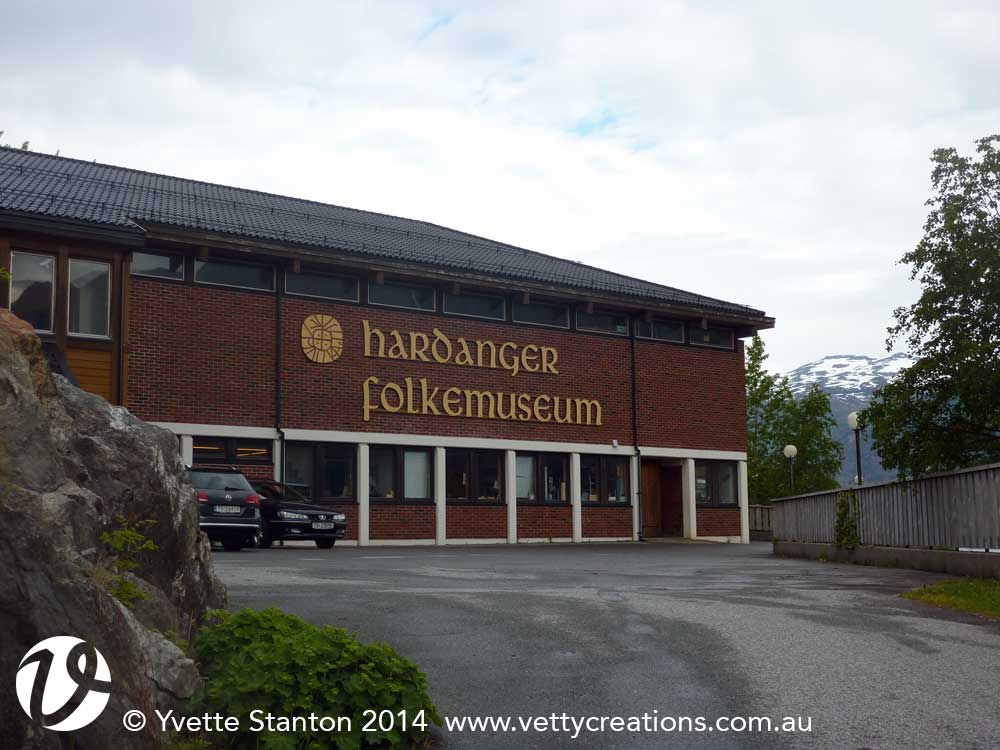
Hardanger Folkemuseum

Hardanger Folkemuseum

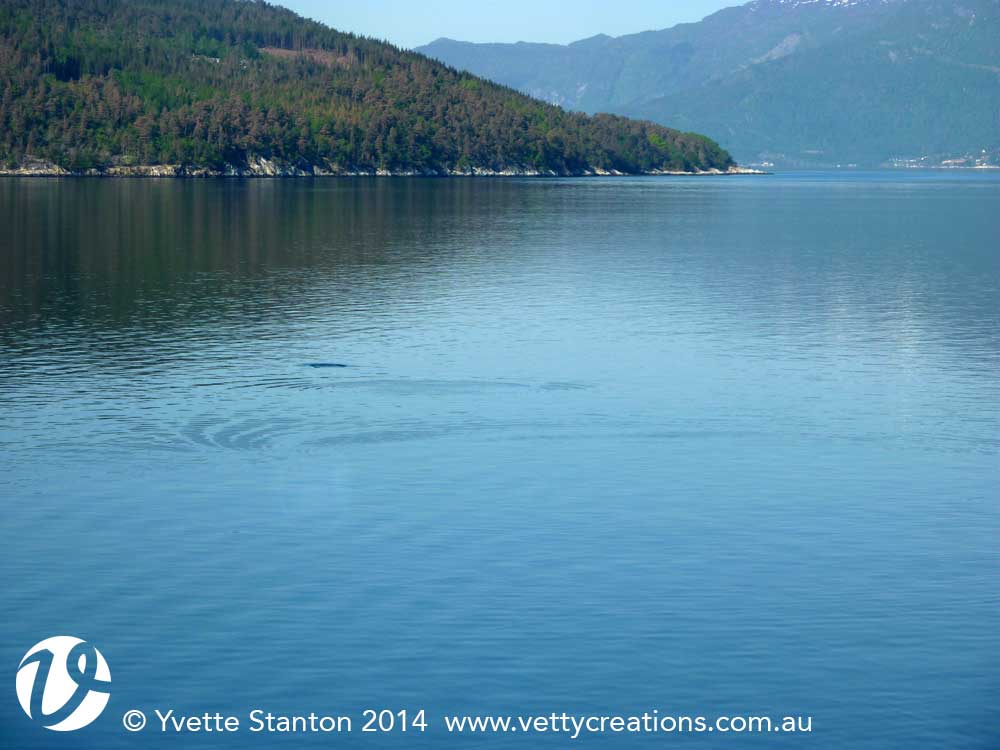
As we crossed, I saw tell tale signs of a sea creature. I only ever saw a blob and the water rippling outwards, however the couple I’d had breakfast with the day before said there had been dolphins the other morning, so that’s probably what it was.

something in the water

There’s something in the water…

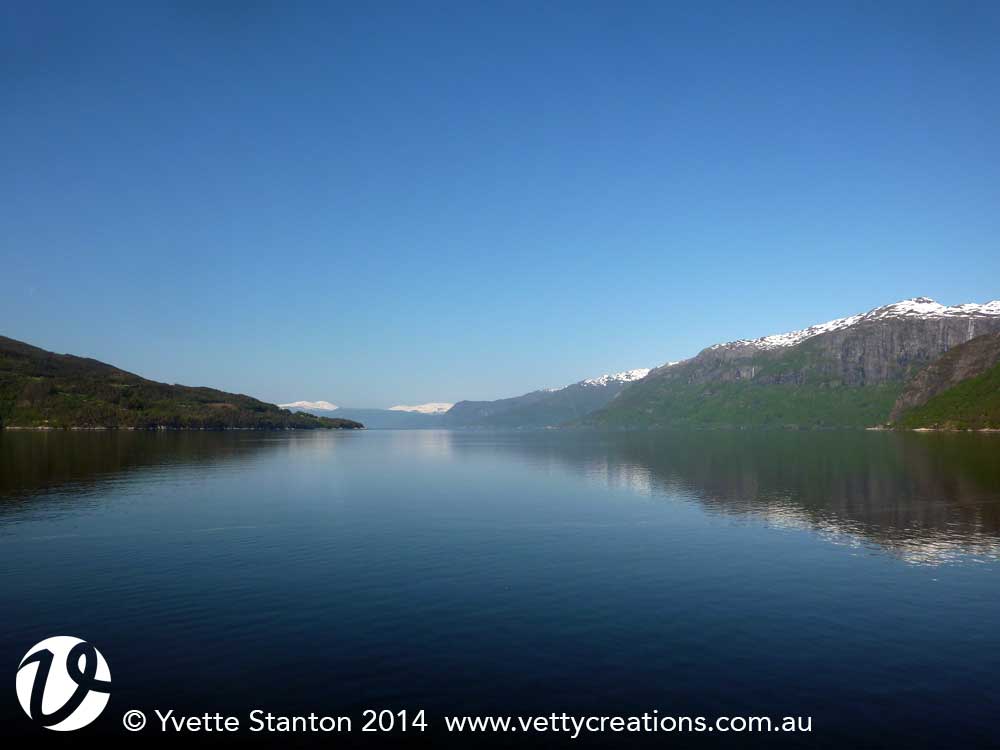
stunning Hardangerfjord

The stunning Hardangerfjord

The ferry took me across to Kvanndal on the other side of the fjord. I waited about ten minutes for the bus to take me to Norheimsund. The bus journey took me alongside the fjord. At one point, the driver had to back back a little way so that a car could pass. It was a very narrow road in parts.

car ferry

The car ferry at Kvanndal

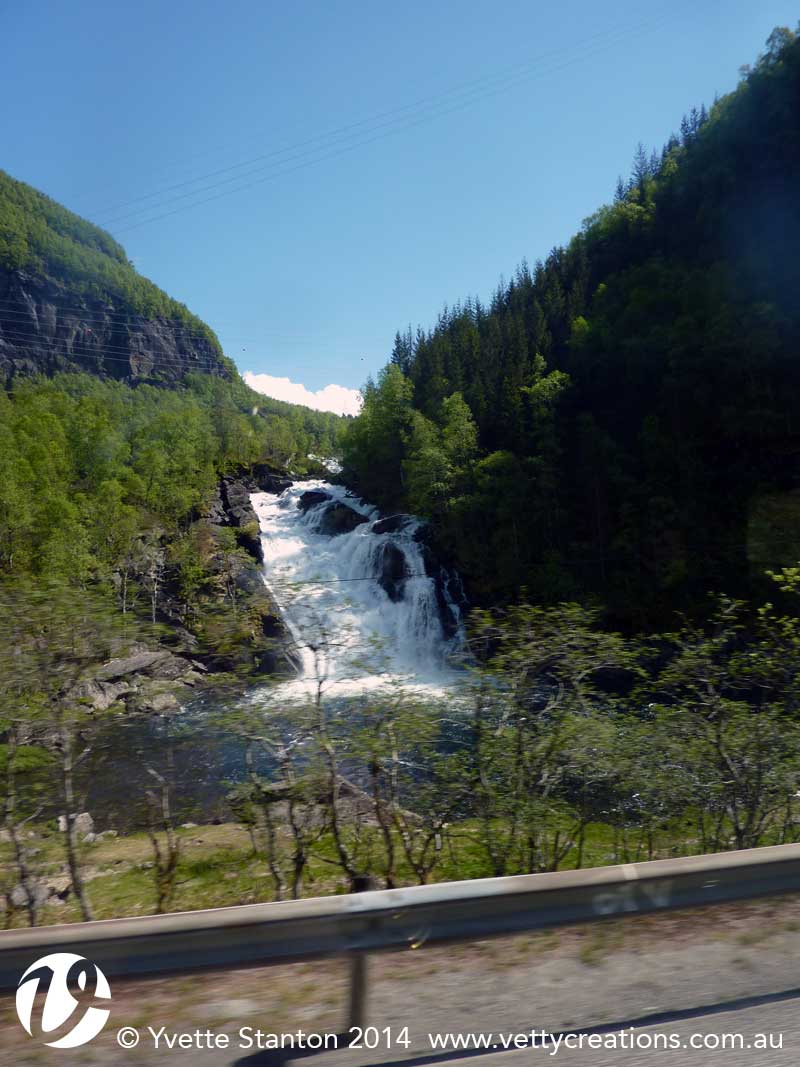
The fjord was beautiful, and there were many foss (waterfalls) from all the snow melting way up on the mountain tops. We passed a couple of fish farms in the water as well.

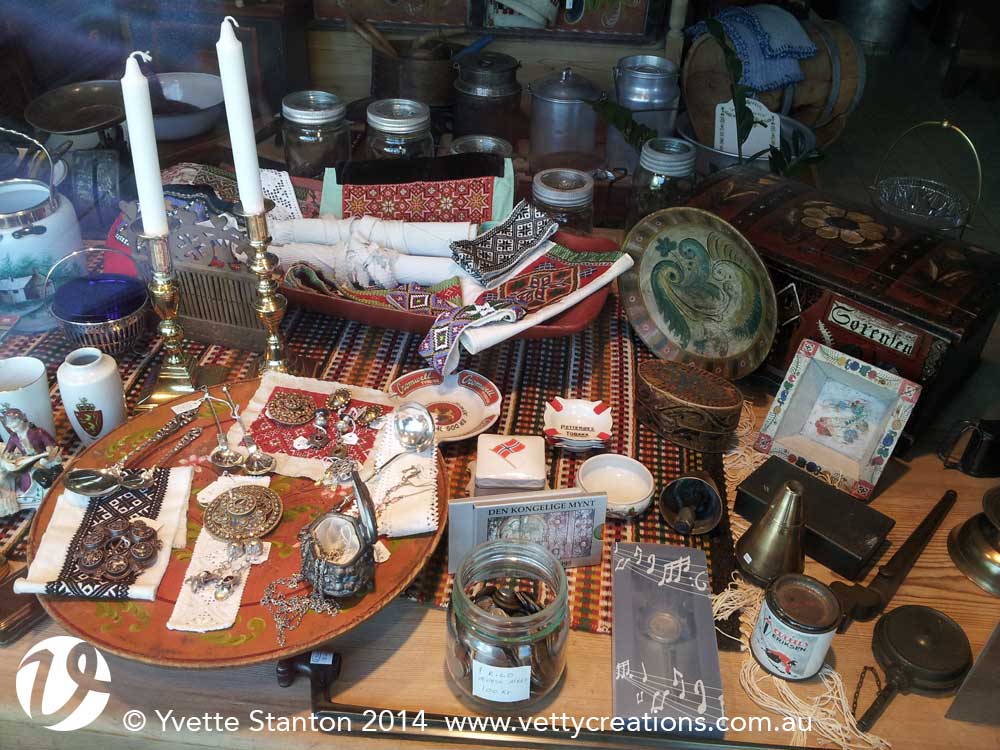
In Norheimsund, I had a little wander around some of the shops and found an antikk (antique) shop which had some very interesting things in the window. It had some beaded bibs, two headdress rolls, a holsaum cuff, and what looked to be a Hardanger yoke opening. There also were some Hardanger shirts. I hate to think what they might have cost, so it was probably good that the shop only opened on Fridays and Saturdays!

Antique treasures

Treasures in the antique shop

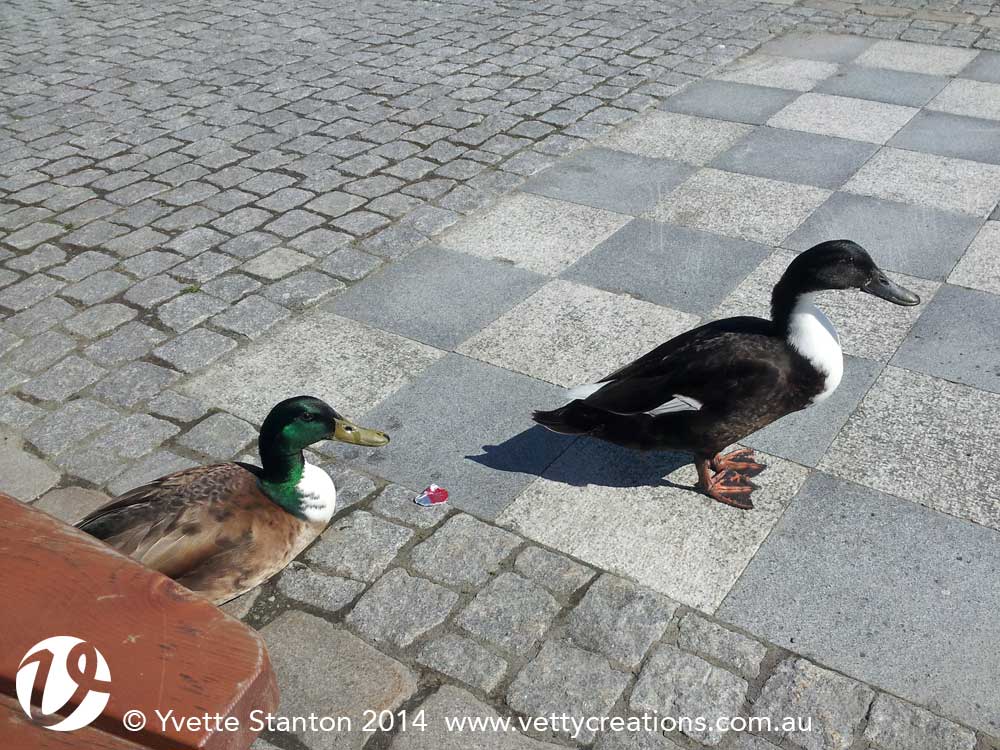
I sat in the sun and ate my lunch while waiting for the bus. There were two ducks who were convinced they deserved a share of my lunch. They stood right at my feet. Again, these ducks didn’t understand English! They only went away when I had finished and a little girl came along to chase them. I think “shoo” might be a universal command!

ducks

The ducks who wanted to share

The bus to Bergen took about 1.5 hours. It was a beautiful trip. Last time I had written my diary so missed a lot of the scenery. We went through countless tunnels. We passed a ski resort area, and travelled alongside rushing torrents of ice cold water (I’m imagining the temperature) coming down from off the mountains.

Ice cold water

Ice cold water

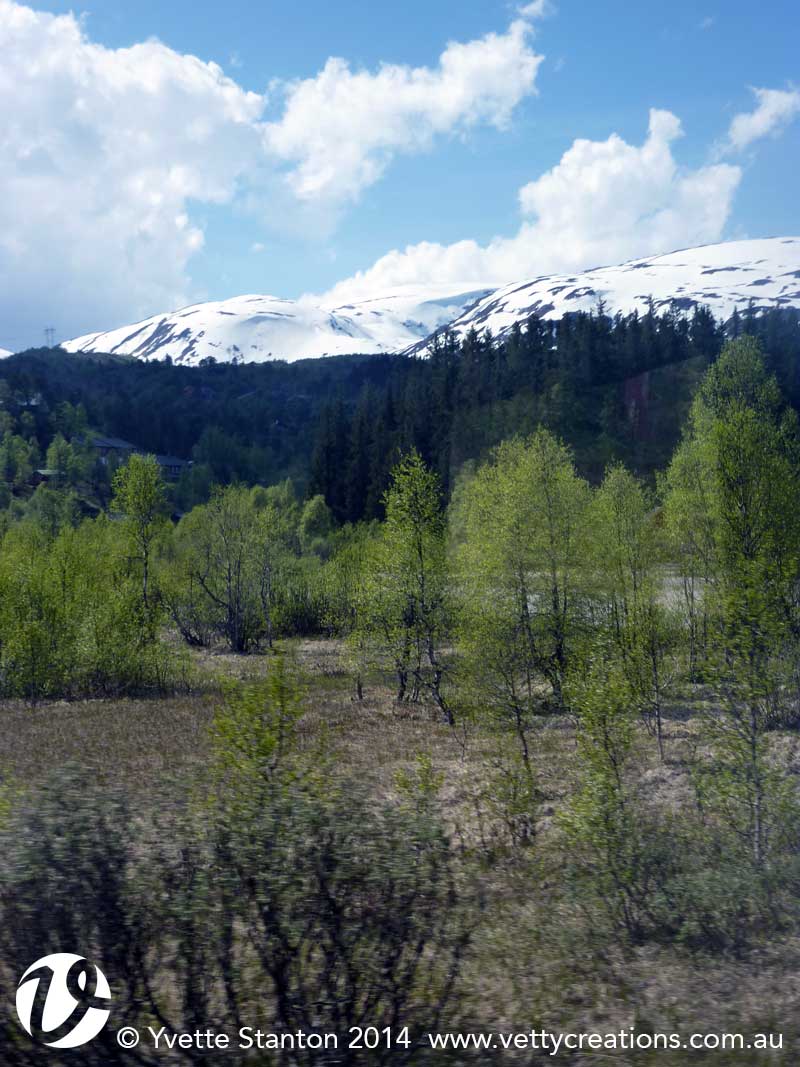
Snow-capped mountains

Snow-capped mountains from the bus.

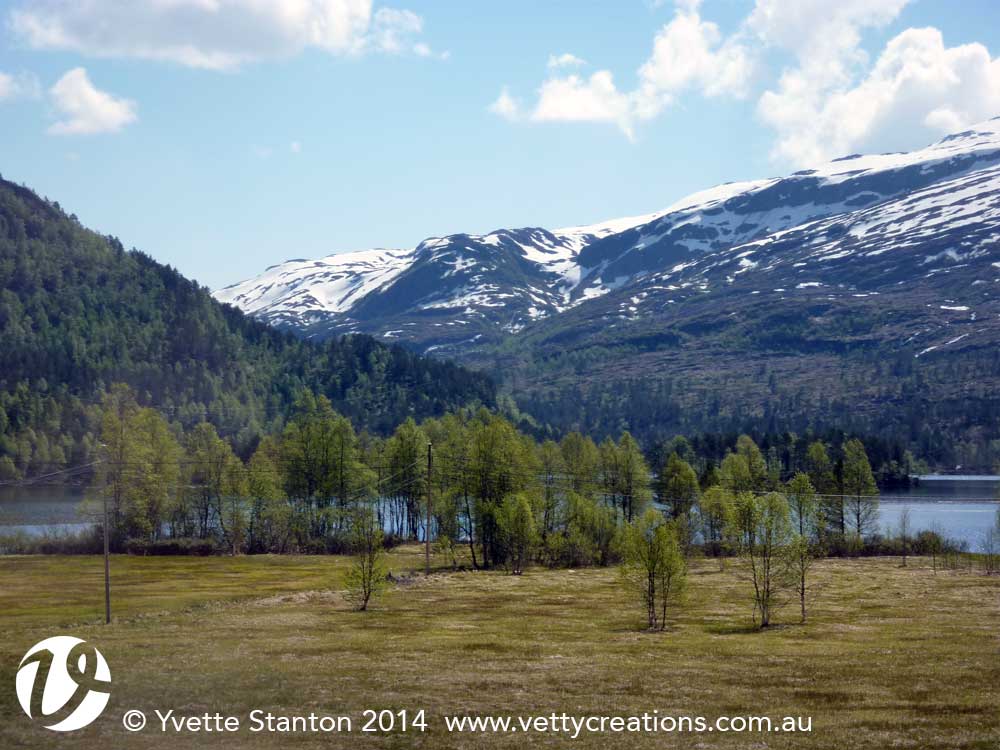
Snow-capped mountains

Snow-capped mountains from the bus.

In Bergen it was quite warm, with many dressed very much for summer and lounging in the grassed areas in the park. I went to Husfliden to get some more linen hardanger thread.

Next I went to the tourist info centre to get some information on how to get to my hotel, which was near the airport in preparation for my early departure the next morning. I knew that I could probably just catch the airport bus, but I wanted to go with a local bus option if possible, and it would be much cheaper. The fellow was helpful-ish but he really wasn’t sure how to advise me. He gave me three bus numbers which would get me close to where I needed to go.

I did a little more souvenir shopping, and headed back to the bus station. There was an information desk there, so the girl gave me an exact bus number, and then the stop to catch it from and to. The bus driver told me which stop was mine, and then I followed my nose to get closer and closer to where I could see the hotel was. It was up a couple of back streets. There was a main road way, but it was much longer.

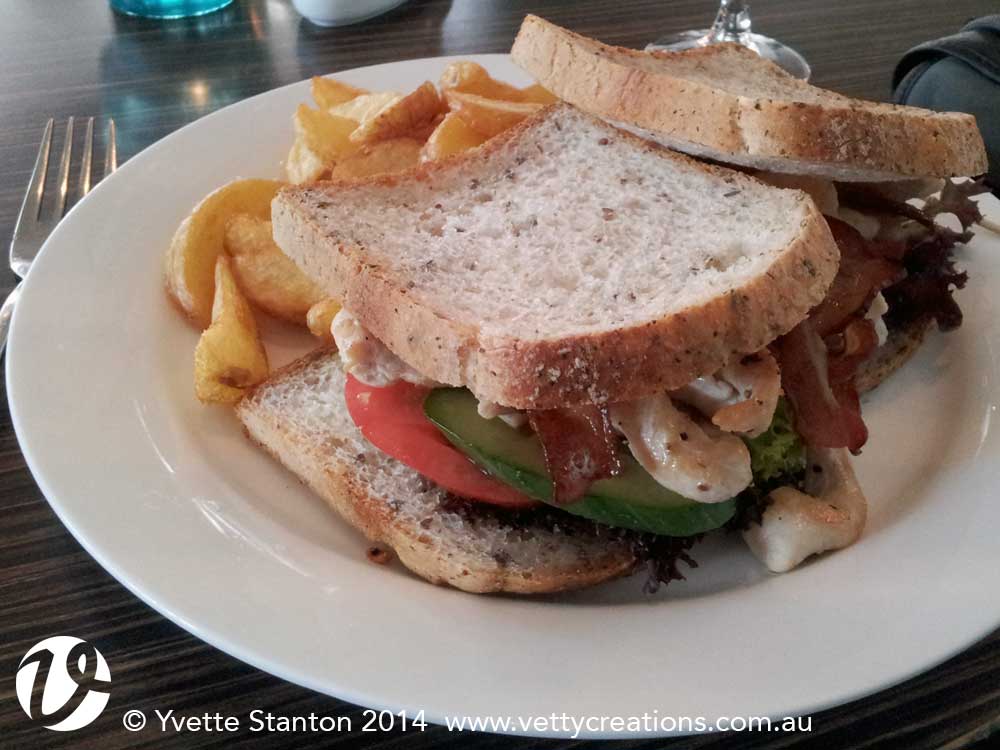
I checked in at about 5pm and then went to what turned out to be quite a palatial room! I dumped my stuff and got onto the internet to make contact with the world again. At 6pm I decided I could not stomach another self-catered in-hotel-room meal, so headed down to the restaurant. I chose a chicken and bacon sandwich with salad, which they they had to completely redesign for me to remove the dairy and wheat. It ended up being delicious, and only kr155, which isn’t too bad for such a delicious, huge meal.

sandwich

delicious sandwich – I’ve made it right through to the last diary entry before showing you boring food photos!

I went back to my room and sorted out everything, chucking away heaps of papers and extraneous packaging.

I was in bed by 7:30pm and asleep soon after. I woke at about 11:30 and never went back to sleep. My alarm went off at 3:30, so I showered and headed downstairs to check out. Outside, I waited for my taxi which they’d ordered for me the afternoon before.

Off to the airport with a driver who was rather amazed that you could gain enough knowledge to write a book from just a few days. He wanted to know whether we see kangaroos all the time. Ah, no. We don’t see them in the cities. (I decided not to confuse him by telling him that my brother had actually seen one just down the road from our house a few years ago, at dusk one evening.)

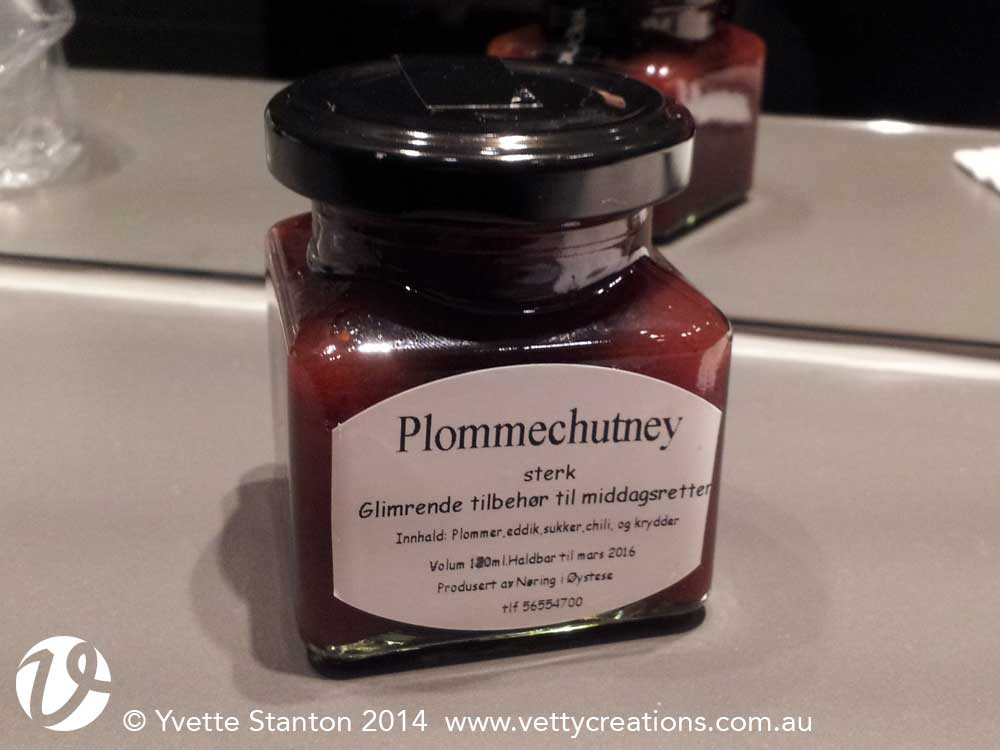
At the airport, I checked in, and the one dodgy sized thing I had in my Liquids-Aerosols-Gels bag (it’s 120ml, not 100, but I’ll see if I can get it home) made it through. The fellow glanced at it, but it is obviously close enough that he didn’t bother to check it. Phew.

contraband plommechutney

Contraband plommechutney – 120mls instead of the maximum 100mls

I’m now waiting for my flight.

[This is where the diary ended. I made it home safely, via Amsterdam and Abu Dhabi. From memory, the flight from Abu Dhabi to Sydney was practically empty and I was able to stretch out and sleep along three seats for much of that flight. I still have very clear memories of my family coming to pick me up from Sydney Airport. It was good to be home!]

July 24th, 2016 | Category: Early-Style Hardanger, hardanger, travel, White Threads Blog, writing books | Leave a comment

Day 6, Hardanger Folkemuseum

Hardanger Folkemuseum, Utne
Monday 19th May 2014

This morning breakfast wasn’t until 8am. I showered, made my lunch and tidied my stuff into my bags. I then went down to breakfast and met the only other people who stayed here last night, a couple from Hampshire. While on business in Norway about 25 years ago, they had met (at this hotel? They certainly stayed here) and married within a year. This was a special return visit, probably for a wedding anniversary.

They had been here for about five days, and informed me that no staff live onsite, so the three of us had it to ourselves last night. I informed them that I had run amok! 😉 They had been told that there was another lady staying last night, but they had actually wondered whether the staff had made me up, so that if they heard someone else moving about, they wouldn’t think it was the ghost that apparently haunts the hotel! I assured them I was very real!

Breakfast consisted of some very nice freshly baked GF bread, some orange juice, cold meats, tomato and capsicum. It was a little odd – the mix of things to eat – but nice all the same. I’d already had some of my grapes prior to breakfast seeing I was hungry before 8am.

After breakfast, I headed off to the museum. Agnete had said I could come any time after 8:30. I think I got there about 9 and she greeted me almost immediately.

Hardangerfjord

A more overcast view of Hardangerfjord

Hardanger Folkemuseum

Hardanger Folkemuseum

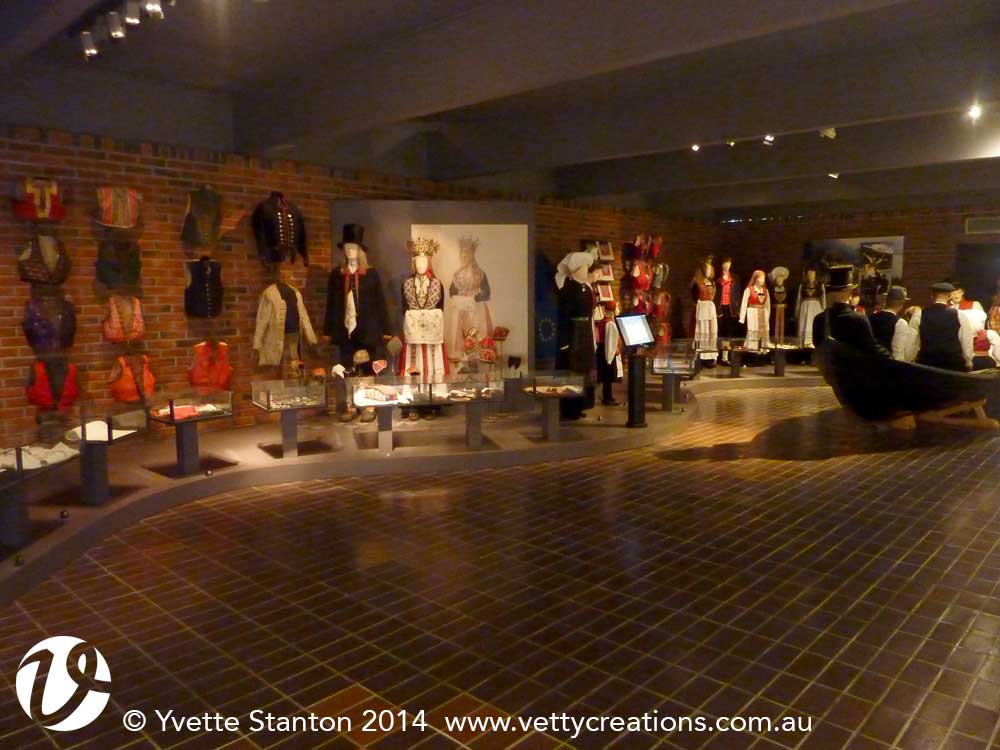
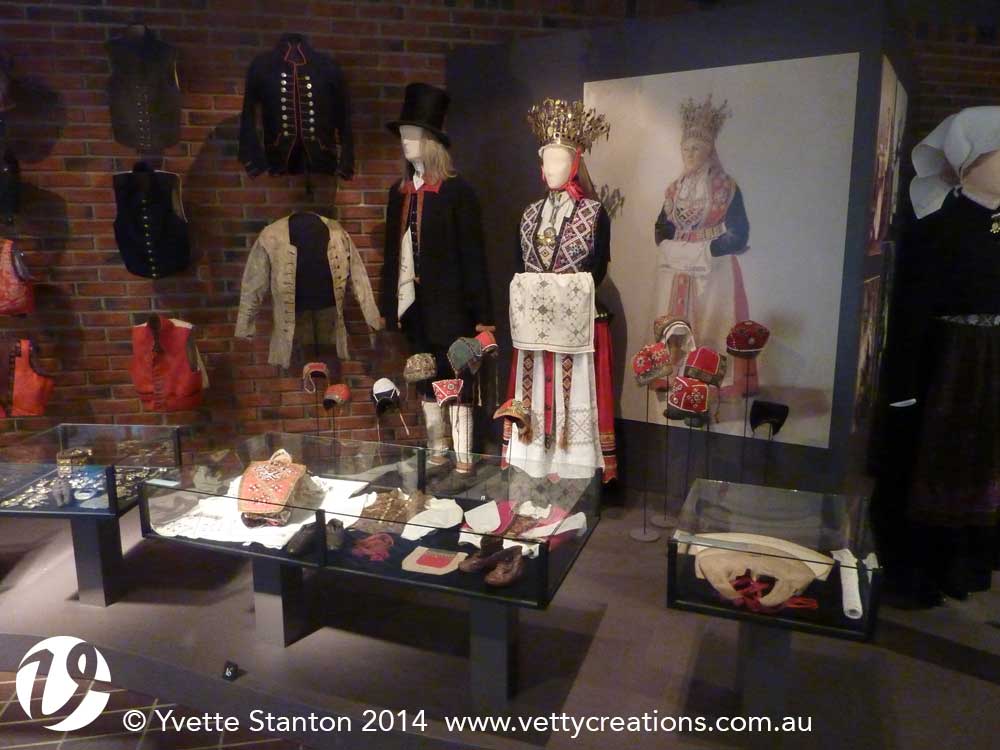
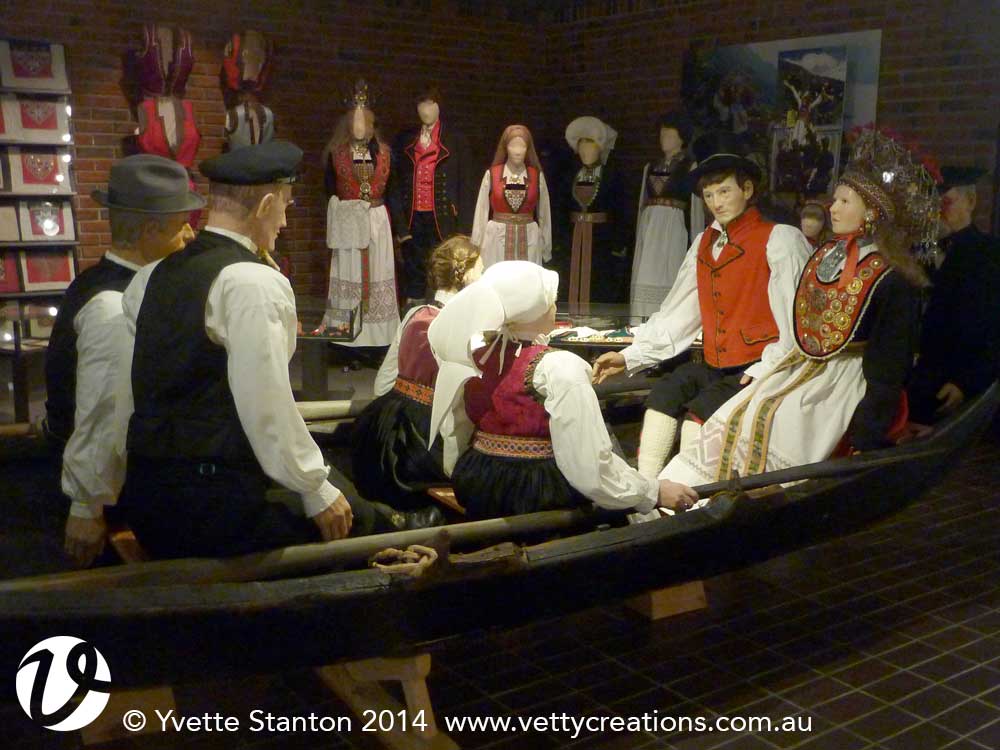
We went upstairs to the embroidery display. Along one side of the room were glass display tables, and along the other were mannequins with various styles of dress, and wall displays of other clothing. In the centre of the room was a boat with mannequins dressed as if they were going off to church in the boat – a common thing in times past according to the fellow at the boat museum yesterday, where they had several church boats.

Hardanger Folkemuseum

Hardanger display at Hardanger Folkemuseum

Bunad display at Hardanger Folkemuseum

Bunad display at Hardanger Folkemuseum

Hardanger bride

Hardanger bride

church boat

Off to church wearing their best clothes, in the church boat

I started photographing and we started discussing what I was seeing. She told me lots and lots, and also about her background in how she’s there as a curator, and how she became interested in embroidery. She sounded like she was creative like me when little. She learned Hardanger from an older neighbour who was very welcoming of her interest and excited to teach her. Agnete now teaches others at the museum. On Friday she had a lady from Switzerland who came for some lessons from her.

Agnete told me many interesting things, like the fact that some hardanger embroidery is now outsourced to Ghana! They would not tell you it was from Ghana, in the shop, unless you asked.

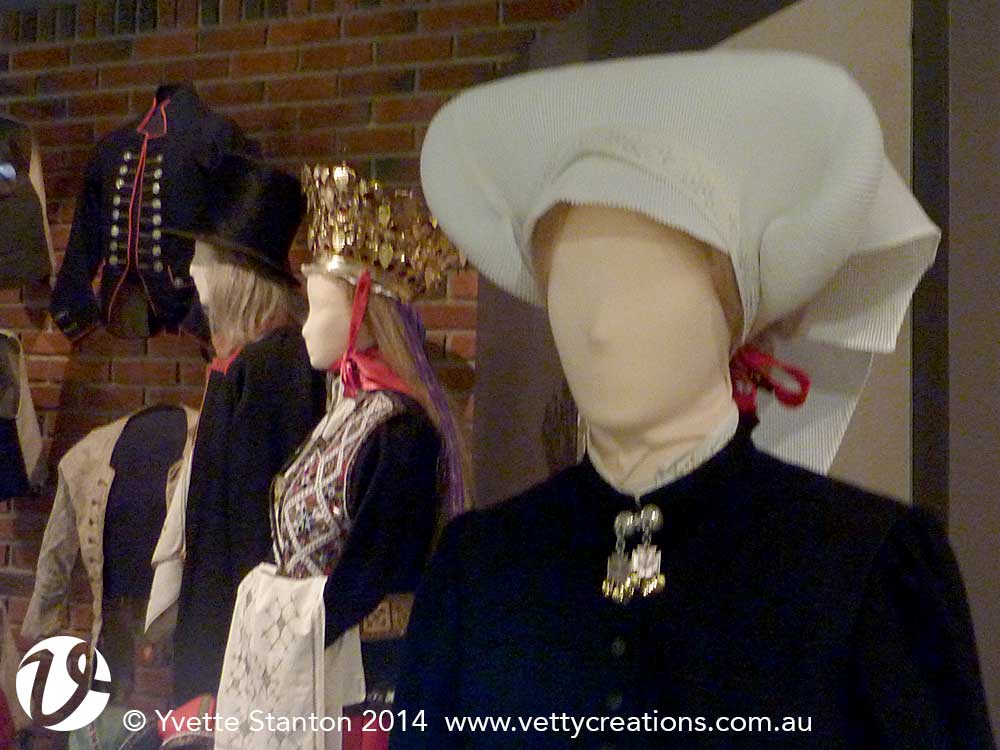
I asked her if there was any danger of the embroidery dying out. She emphatically said no! She did, however tell me the sad tale of the married women’s pleated headdresses. You start with a square of white linen fabric. It is starched, then folded. It is put onto a board of some sort then very finely pleated. It is mounted on the head over a support. It is draped in a very particular way. If it rains, the headdress will flop, because the starch will no longer hold it’s shape. The problem is that the only woman left who knows how to do the pleating properly is very old, and is forgetting things. She has passed on some of her knowledge to others but no one person knows it all. Agnete is very worried about this. She said if they can find someone to do a study of it, and learn the whole procedure, there will be no problem in funding it. However, it looks like the skill might become lost. Like the boat museum, they want to preserve the old ways by keeping the skills alive, not just by keeping the items in glass cabinets.

headdress

Mannequin wearing the married woman’s headdress

Agnete told me that in Japan, there are temples that every 20 or so years, they dismantle them and rebuild them again, in so doing, keeping those skills alive. It is an amazing way to preserve the past.

Later we went through to the cafe area and we talked about different stitches, and she showed me eyelet clusters. I wasn’t very wrong in the way I had devised to make them!

After that, Agnete left me, and I went back to photographing more things and in more detail. When I had finished I went downstairs to the all important museum shop and added some more weight to the things I will take home with me… I think I’ll be wearing the puffy jacket at check in! (That saves 600 grams!)

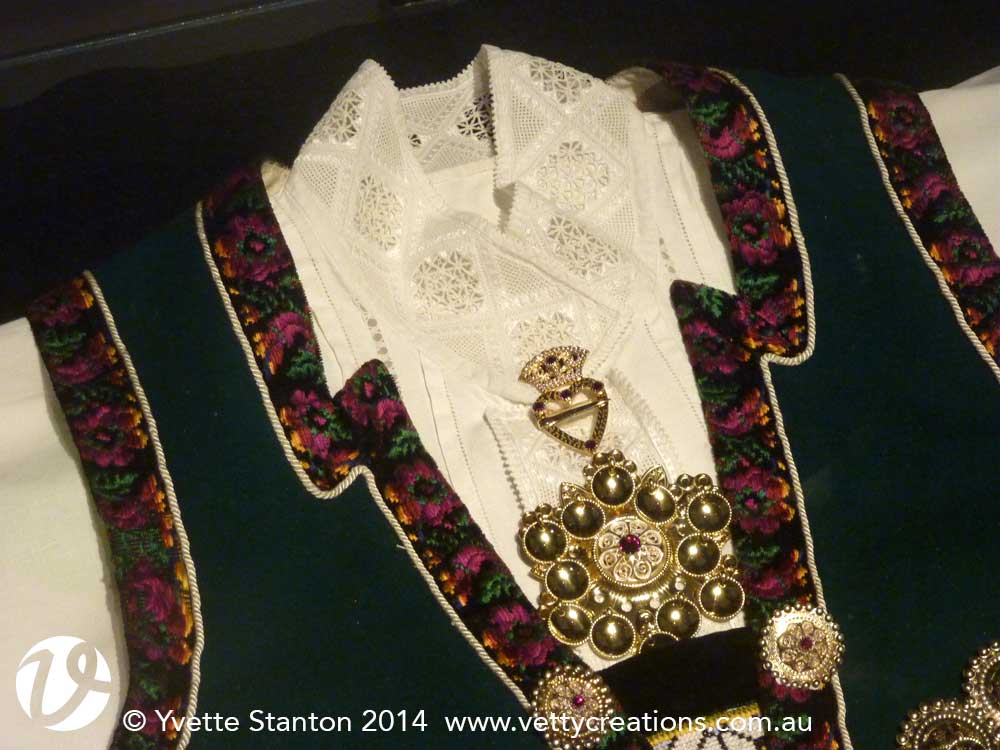
Hardanger shirt, waistcoat and jewellery

Hardanger shirt, waistcoat and jewellery

Whitework shirts

Whitework shirts

I then went down the street and sat at a picnic table across the road from the hotel, in front of a most magnificent view (!) to eat my lunch. A few tiny little finches desperately wanted to share my lunch with me, but I told them I was sorry but it was mine. I realised then that they probably didn’t understand English, so no wonder they didn’t get the message!

little bird

The little bird who wanted some lunch

Hardangerfjord

A more overcast view of Hardangerfjord

After I’d eaten, I got out my embroidery and tried out Agnete’s way of doing the eyelet clusters. It worked beautifully, and created slightly larger holes than my way. I’m swapping to hers from now on!

I then did a dump of what I could from my brain into my notebook. It is important to get these things on paper quickly. I realised that I hadn’t taken a photo of Agnete, and I really wanted one, and really it would best if I could measure the embroideries so that I could work out what count they were. Relying on someone else to do it for me was a big ask, and as I was there, it really would be best for me to do it while I had the chance. So back to the museum I went.

I asked the girl at the front desk if I could borrow a ruler to do some measuring, and while she was very willing to lend me one, it took her quite a bit of looking to actually find one. I was very apologetic for making her go to all that effort.

I also asked if I could take a photo of Agnete, so she went and got her for me. I took my photo of Agnete, then got on with all my measuring. It won’t be very accurate, as I was measuring from some distance, because they were in glass cabinets. However, it will be better than nothing. It will give me a reasonable idea of the thread count, which will be helpful.

Agnete

Agnete Sivertsen, Director of Hardanger Folkemuseum

It was a little bit colder when I left the museum this time – after 3ish? – so I went back to my room and spent the next couple of hours writing the introduction to the book and matching up photos to the text. It’s going to be a beautiful introduction!

I could have been out exploring the locale this afternoon, but this trip is actually about writing a book, and I felt it was best to do it while it was fresh. Agnete is happy to check anything for accuracy, so I will definitely take her up on that later down the track.

This evening I will do some more embroidery before going of to sleep. It’s 8pm and way too light still! I couldn’t liken it to any particular time of day at home because the light seems very different.

July 23rd, 2016 | Category: Early-Style Hardanger, hardanger, travel, White Threads Blog, writing books | 4 comments
« Newer Entries  
  Older Entries »
Yvette Stanton White Threads is the blog of Yvette Stanton, the author, designer, publisher behind Vetty Creations' quality needlework books and embroidery products.

New book now available!

Hardanger Filling Stitches
Hardanger Filling Stitches by Yvette Stanton. Order your copy today!
Find us on Facebook

Archived posts

Categories

  • book reviews (88)
  • Christmas ornament swap (13)
  • colour (6)
  • crazy hair (6)
  • customer embroidery (49)
  • designing (119)
  • dressmaking (26)
  • Early-Style Hardanger (91)
  • Elegant Hardanger Embroidery (42)
  • Elizabethan embroidery (25)
  • Embroidery classes (189)
  • embroidery musings (436)
  • embroidery stitches (206)
  • errata notices (11)
  • Ethnic embroidery (49)
  • exhibitions (111)
  • exploring the needlework internet (10)
  • favourite needlework items (69)
  • FlossTube (102)
  • Frisian whitework (73)
  • goldwork (12)
  • hardanger (232)
  • Hardanger Filling Stitches (72)
  • Hardanger Filling Stitches (1)
  • hints and tips (114)
  • historical embroidery (119)
  • how-to videos (34)
  • illustration (1)
  • Inspirations (25)
  • Introducing… (90)
  • left handed embroidery (78)
  • magazines (10)
  • making stuff (271)
  • merezhka (35)
  • mountmellick embroidery (176)
  • Mountmellick Embroidery: Inspired by Nature (60)
  • mountmellick supplies (49)
  • new products (104)
  • online book previews (7)
  • pattern darning (19)
  • pattern drafting (11)
  • photography (2)
  • Portuguese embroidery (166)
  • Portuguese Whitework: Bullion Embroidery from Guimarães (74)
  • public thanks (32)
  • published projects (27)
  • Punt 'e Nù (32)
  • Sardinian Knotted Embroidery (77)
  • sewing tips (9)
  • Smøyg (41)
  • Smøyg: Pattern Darning from Norway (39)
  • soapbox (6)
  • stitch along (44)
  • stitch dictionary (45)
  • teaching embroidery (192)
  • The Left-Handed Embroiderer's Companion (104)
  • The Right-Handed Embroiderer's Companion (70)
  • travel (172)
  • Ukrainian Drawn Thread Embroidery (35)
  • Uncategorized (169)
  • video previews (5)
  • White Threads Blog (91)
  • whitework (364)
  • writing books (306)