

Despite my coming down on Pinterest rather hard yesterday for their perceived lack of interest in upholding copyright, I actually find Pinterest to be a useful tool. And I know many of you do too.
Darla commented on my blog post the other day saying,
I will use Pinterest to find things I might enjoy stitching, but if I can’t determine who designed it so I can purchase it, it remains where it is in cyberspace.
This is a perfectly good and acceptable way to use Pinterest. Darla uses the image searching capacity to find things of interest that she can then purchase through the regular channels. If she can’t find out who the designer is, then she doesn’t use it, however pretty or perfect it might be.
Dima said,
I always try to do a thorough search if I find something on Pinterest. I personally don’t like pinning stuff on Pinterest unless it’s from the direct source. To help find the source, you can do a google image search. It doesn’t always work, but I’ve gotten good results with this method.
I have noted before that many people don’t know how to do a Google image search. If this is you, and you’d like to know, please let me know and maybe I can do a video or write a post explaining how to do it.
Ways I have used Pinterest, that I feel show respect to other creators
I use Pinterest when researching unusual forms of embroidery. I look for images of folk dress to try to find embroidery that I might not have noticed before. When I find images of interest, I dump them onto a private Pinterest board so that I can find my way back to the source of those images again, which, in my case are usually museums. It’s a really useful visual research tool.
I’ve used it when researching product packaging, such as paper bags. When I find one that’s a suitable size and price, I create a pin for it on a private board. Then I can go through them all at the end and work out which one to purchase. It’s like a visual spreadsheet, where instead of having to type in (or paste in) the information, I just use a link to the original information instead.
I have also used it to build up reference for possible project applications. There are only so many framed things we can have on the wall. Maybe my readers would like to make embroidered potholders? If I think that’s a good idea, I can put a pin of a pot holder on a private board. Or a picture of a pencil case, or a long table runner, or a hand towel. Then the board becomes a repository of ideas that I can draw from. Note that I’m not collecting things I’m going to copy. I’m collecting ideas for things I could put embroidery on.
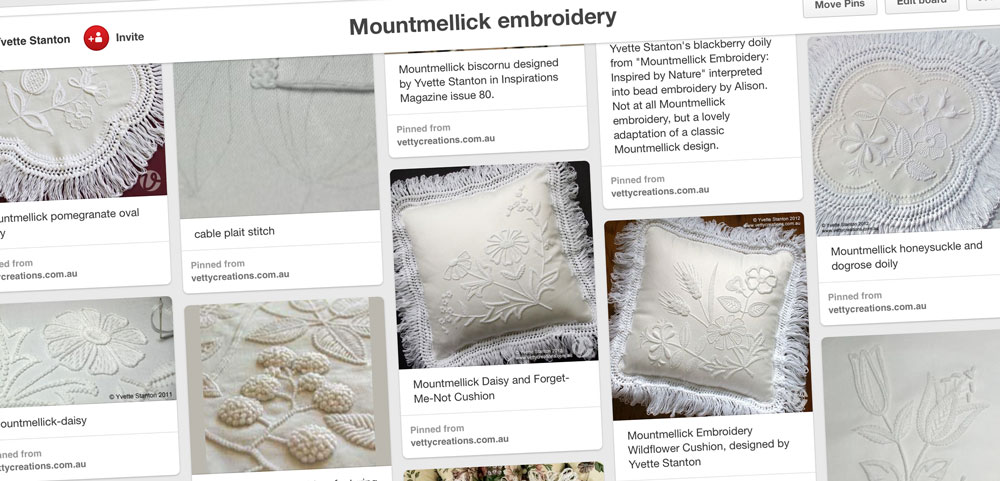
My Mountmellick Pinterest page
Another way I have used Pinterest is to collect together reference images (usually from museums, or my own images) of embroidery for a class I might be running. Then I provide the link to the board to the students so that they can access the images, if they’re wanting to do more research. It’s like providing them with a bibliography, but instead being links to images.
There are many ways to use Pinterest that allow us to act in ways that show respect for other creators of work. It is just a pity that some use it for illegal and unethical means. (We could, however, consider that even the act of *pinning* an image that is not our own, breaches copyright, seeing we are “reproducing” an image that we do not own the rights to. As you can see, this is a legal minefield…)
Ways I don’t use Pinterest
I don’t upload charts – mine or anyone else’s. I don’t download charts. And if I did go looking for charts it would ONLY be so that I could then purchase them through legitimate means.
Using Pinterest to download charts that have not been put there by their copyright holders breaches the copyright of the copyright holder. And how do you know if they’ve been put there by the copyright holder? Chances are, they haven’t, so my rule of thumb is to make the assumption that they have not. And therefore I wouldn’t touch them with a barge pole.
Copying anything which is covered by copyright, whether it is for your own personal use, or to sell the resulting product, or to share the chart/instructions/pattern, deprives someone of the payment for that usage. It is stealing.
Uploading charts that you do not hold the copyright for, breaches copyright and also enables other people to breach copyright. It is stealing. In the case of “freebies” put out by designers, I still wouldn’t share these designs, because they’re not my designs to share.
How can you help?
If you are a concerned citizen, and you see things on Pinterest that you think might breach copyright, please report it to the designer, preferably with a link to where you found it. Then they can act on it.
The other thing you could do is to go through your Pinterest boards and if there are any charts pinned there, you could remove them. That way, others will not find them on your boards and re-pin them on their boards. You’d be removing yourself from the chain of “sharing”.
Pinterest is a great tool, and I’m glad to be able to use it. However, I want to use it only in ways that respects others and their rights.
Thank you to all of you who use Pinterest in a way that respects the rights of others.
—
Note: I’m not a lawyer, and I think that will be quite obvious from what I’ve written here. Do not take this to be legal advice.
 White Threads is the blog of Yvette Stanton, the author, designer, publisher behind Vetty Creations' quality needlework books and embroidery products.

I use Instagram in a similar way. The app allows you to save others’ posts and group them into collections. Unfortunately you can’t share these with others, re-order the posts in the collections, or write notes – but at least you can be almost certain that what you are saving was uploaded by the copyright holder. I like Pinterest but it’s so frustrating when I can’t find the source of something I really like even after an intense reverse image search.