

Thank you all for your great comments on the rainbow dress design yesterday. There were some very carefully considered responses, and I enjoyed working through your reasoning with you. I really appreciate the thought that went into the answers. Its been fascinating reading of others’ points of view.
Last night after the girls had settled in bed, I pulled out the dress design and got to work. The dress is going to be a surprise for the Rainbow Child for her birthday. I’ve asked her if she’d like a rainbow dress (yes!) and she’s tried on the muslin for a fitting, but that’s all she’s going to know about it before she opens her birthday present on the day!
The TR (Transformation, Reconstruction) process which I am basically using for this design is an interesting one. First, you make the basic dress (a muslin) of your choosing in plain, cheap fabric. I just used some white stuff I had lying around, left over from something else. Then you put the muslin on the dressform (I don’t have one, so I got my eldest who’s about the same size to do it for me, the other day when Rainbow Child was out at gymnastics) and draw the design lines on it.
Last night I worked on the curves of the design to make them more pleasing – which could have been more easily done with french curves, but I don’t have any. Then I started cutting along the lines, to make my new pattern pieces. BUT, I should have marked the notches on them BEFORE cutting! So after they were all cut out, I had to realign them all back where they’d been and mark the notches. These will help me to match up the different parts of the curves when I’m sewing it back together again, so they’re really important.
Once I had them all cut up, I had to work out how much fabric I was going to need of each colour. At this stage we’re still working with Colour 1, Colour 2, Colour 3, etc as I haven’t yet made my final decision on which colour version to choose.
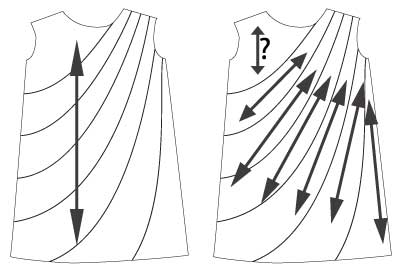 In working out how much fabric I’d need, I had to decide how to work with the fabric grain (the direction of the weave of the fabric). Should I just use the grain in the same way it was on the muslin, or should I change it so that it basically runs down the centre of each colour swash? I’ve worked it out so that its based on the original grain, but just in case I change my mind, I have given myself enough grace in the fabric measurements that I can change to the other way if I want. Changing the grain could make a difference to the way the dress hangs. I suspect the only way I am really going to know which works better is to give it a go.
The dress is sleeveless, because I’m pretty sure my daughter is going to want to wear it all year round. I figured with sleeveless, she can wear it in summer and also put a long sleeve top under it for winter. I’m going to line the dress to make it more comfortable to wear – I don’t want all those seamlines being scratchy!
Hopefully today I’ll get the chance to check out my local fabric shop for suitable fabrics. I think poplin might be a good choice, as they have lots in stock in a great range of colours. Hopefully enough to make a rainbow! Poplin is cheap, so if this whole thing is a disaster then I won’t have outlayed too much money. Its also quite a firm weave, so should work well with the many curved seams. I’ll probably line it with poplin as well, rather than a bemsilk type lining, as I think I’d rather a polycotton against a child’s skin than a polyester. I’ll need to choose a neutral colour for the lining, so that it doesn’t show through the lighter fabrics.
So that’s where the dress design is at, for now. If any of you experienced dressmakers have any advice on handling the fabric grain, I’d love to hear it. Thanks!
 White Threads is the blog of Yvette Stanton, the author, designer, publisher behind Vetty Creations' quality needlework books and embroidery products.

Hi Yvette,
Cut the grain to match the original, other wise it will fall funny and all those odd grainlines will fight against each other.
The easiest way to do it is to mark the grainline on your patterns before you cut them apart. (Like in the first sketch) Make them as long as you can. If it doesn’t reach across to the side sections, then measure a parallel line from the original grain line over on the other side.
This grain will make your seams on bias so matching notches are a necessity, and I would put two on each seam, as well as marking any center front positions. With the notches, I would use a single notch towards the top, and double notches towards the hem. This will make it easier to work out which way up they should go.
A general rule with grainlines is parallel to CF or CB. Yes they can be different, but an understanding of how the fabric will fall is essential.
Other hints with your patterns are to :-
1. Mark RSU ( right side up) because the patterns are one way. This will eliminate mistakes in cutting ( especially printed fabric)
2. Number them in order on a little plan ( like the sketch), then number the patterns the same. You could also label them with the colour that you want each one to be cut in for your rainbow dress. I am sure you do not want the rainbow colours mixed up.
3. Label front patterns as “front…..” & back patterns as “back…..”
4.Remember to add seam allowances where necessary. As you are taking this off a pattern already made, it may already have seam allowances on it, so you need to add them where you have changed it, other wise it will be smaller.
Another hint with stitching the seams is to sew from the bottom up. This will help to avoid stretching the seams.
I hope this is helpful and not going over something you already know. I have taught patternmaking in the past and can see lots of places where mistakes could easily be made with this design. If the patterns are cut & labelled correctly, there should not be too much trouble.
Good luck with your project & I look forward to seeing the results.
Hi Yvette,
This is a great design! I’d cut it out with the grainline on each piece like “photo 1” – that is the finished dress will have all grainlines running vertically on the centre front. Am I making sense here?? The dress won’t hang straight if you don’t. Can’t wait to see the finished dress.
Ooh Jenny, aren’t you an absolute dear to share all that with me! 🙂 Thank you very much!
Thanks for confirming that the left version would be best for grainlines. I haven’t marked them on my pattern pieces because the fabric I have used for my pattern pieces clearly shows its grain. So it is already visible on the pattern pieces which makes it nice and easy.
I’ve marked LOTS of notches. I figured that too many couldn’t hurt!
For seam allowances, because I’m going to need to add seam allowances between fabric pattern I cut up to make my new pattern pieces, I cut them off everywhere, so that I just need to add it all around. I thought that if I left some of the original on, it would just end up confusing me!
I have a few questions:
What is CB and CF with regards to grainlines?
And what difference will sewing from the bottom up make? I’ve never heard of doing that before. Is that something that will work particularly for this pattern and its bias cut lower pattern parts, or is that something you would generally recommend?
Most of the rest of it I already know and have followed, but hearing it again is NEVER tiresome!
MUCH appreciated – thank you. Now I’m off to find your website. 🙂
Thanks Julie. Great to have another person confirming that I should keep the original grainlines. 🙂
Hi, Yvette. I will also confirm that you should keep all the grainlines running parellel to the center front and center back of the garment. Otherwise all those pieces cut on the bias will hang very strangely when put together. Because you will be putting together so many bias edges, you can’t have too many notches, and you will need to pin very well. You may want to baste the dress together first, because any place that the grain is not exactly straight will cause the edges to ripple and pull. A firm fabric is a good idea, as it will be easier to handle and hold its shape better. Hope this helps. If you have more questions, feel free to email me. Sandi
Hi Yvette,
To answer your questions, CF = center front & CB = center back. Grainlines in general are marked parallel to the center front or back, with the emphasis on parallel. Any slight deviation from parallel will cause the fabric to hang funny or twist.
Sewing from the bottom will help stop that bias from stretching so much. Sometimes they mark stitching direction in commercial patterns with tiny arrows. If they do, it is on the instruction sheet some where, not on the pattern itself.
To be honest, I am not a fan of using precut fabric as a pattern. Fabric can stretch, no matter how firm, especially on those bias & curved edges. If it was me, I would have cut it in paper, added seam allowances, then tested it in something cheap.
I hope this helps & if you need anything else answered, feel free to email me privately.
Thanks Sandi!
Once again Jenny, thanks for your generosity in sharing all this very useful information with me. Much appreciated!