Vetty Creations header

Back to Vetty Creations website

White Threads

Mountmellick and silk

This morning I was catching up with Mary Corbet’s Needle’nThread, where she revisited an older post of hers on society silk. This was because the author of a book and expert on the subject, Donna Cardwell, contacted her regarding the post.

In her comment, Donna mentioned that there were many different types of silk thread used in those days, and listed a number of them, including something called “Mountmellick silk”.

Mountmellick silk?!

What on earth??

Mountmellick embroidery is whitework embroidery, using white cotton satin jean fabric, with matt (non shiny) cotton thread. Silk thread, however, is shiny and is obviously not cotton. How therefore, do the two relate?

My suggestion is that this was an effort on the part of silk manufacturers to market more of their thread. There is no relationship between Mountmellick embroidery and silk thread, but they were attempting to make one.

My further reading on “Mountmellick silk” has revealed that it was white thread, and the suggestion was made that if you wanted to work Mountmellick in colour, then you should use a different type of silk that came in a variety of colours. (Personally I would never advise working Mountmellick in colour, as one of the things that makes Mountmellick embroidery its own style, is that it is ALWAYS whitework.)

In the dim dark recesses of my mind (and I can’t check this easily as I am away from my office and all my notes on the subject) I seem to remember that at some point, one of the silk manufacturers produced a booklet on Mountmellick embroidery. I have never seen this booklet (though I’d most definitely like to!) and have always wondered how a silk manufacturer handled the subject. My suspicion is that they promoted their silk threads in conjunction with Mountmellick embroidery, therefore making it a less-than-traditional interpretation of the style of needlework.

Silk embroidery is lovely. Mountmellick embroidery is lovely. However, the two styles are separate, and in the interests of keeping Mountmellick traditional in style, they should not be combined.

Here endeth the lesson. (Yes, I realise that was a very preachy post!)

NB: By discussing this subject, I am not intending to make out that Donna Cardwell does not know what she is talking about – that is not my intention at all! I completely acknowledge that Donna was simply telling Mary the different types of silk that were available during the time when society silk was popular. I do not think that this suggests that Donna recommends using silk thread for Mountmellick embroidery. Having never talked with Donna about this, I do not know her opinion on the matter, and maybe she doesn’t actually have one, anyway.

February 9th, 2010 | Category: historical embroidery, mountmellick embroidery, whitework | 5 comments

The Left-Handed Embroiderer’s Companion at Nordic Needle

I was thrilled to find that my new book The Left-Handed Embroiderer’s Companion: a step-by-step stitch dictionary was included in this week’s Nordic Needle newsletter.

I’ve had a bit of a soft spot for Nordic Needle, ever since I won their annual Hardanger design contest back in 2000. That win was what set me off on the publishing path, so to me they’re a special bunch of people!

So, obviously that means that if Nordic Needle is convenient for you – they are located in North Dakota, USA and specialise in mail order – you can order from them. They sell all my books. And if you’d rather order directly from Vetty Creations, of course you can!

Just so you know, I have no affiliation with Nordic Needle at all. 🙂

February 8th, 2010 | Category: The Left-Handed Embroiderer's Companion | Leave a comment

Is this the mini wet?

Here in Addis there are two main distinctions in season: wet and dry. The main wet season is around September, and it is known as the big wet. There is also a mini wet around March.

So we expected to be here for just some of the mini wet.

I was walking home from the supermarket the other day, picking my way out along the terribly uneven surface of the path beside the road, thinking “I wouldn’t like to do this in the wet season – it would be horrible.”

On Thursday night, we had some very heavy rain. On Friday, we had a rainy day. You don’t get random rainy days here in Addis, you either get dry days or wet season days. So people started asking, even though it is only early February, “is this the mini wet?” The Ethiopian lady who I heard it asked of, shrugged her shoulders and said “could be…” (After all, how’s she supposed to know?!)

Then over the weekend, we had more rain at night. And I don’t just mean rain. I mean torrential rain.

Last night it stormed (with lightning and thunder) and torrential rain for most of the night. It was quite wild out there.

This morning though, we have already had sun, so hopefully that will remain with us.

If it can be arranged that all the rain falls at night, then that will be quite convenient for me! However, it still makes the roads and the walking paths beside the road extremely sloshy and muddy.

And because we are in an old building, on the top floor, with corrugated iron sheets as the roofing, when the rain slows, we hear drip drip drip into the roof cavity. As yet, we haven’t had any come down to us, but I think that is only a matter of time…

Lying in the comfort and dryness of our bed last night, I couldn’t help but think how many people must die during the wet season here, due to inadequate shelter. Quite a sobering thought. And not one that I know how to do anything about.

February 8th, 2010 | Category: travel | Leave a comment

Who is Mike Leyland?

Shortly after we arrived here in Addis we managed to procure a reasonable map of the city. This is no mean feat, as such things are extremely difficult to come by.

Both my husband and I are map people. If I ever had to retrain to start a new career, I’d love to be a cartographer. When I worked for a publisher before starting my own business, I worked on a couple of map books and absolutely loved it.

Anyway, on this map there are street names. Street names are not actually used by anyone in Addis (other than perhaps tourists who go by what’s in their guide book) because no-one knows the street names, not even taxi drivers.

One of the street names on the map is Mike Leyland Street. Now if you’re an Australian like me, you will remember Mike and Mal Leyland from from their TV shows in the 1970s and 1980s about travelling around Australia. In fact, my husband and I can sing all three of the theme songs of the different permutations of their show: “…ask the Leylands, ask the Leylands, ask the Leyland Brothers!”, “Leyland brothers in the great outdoors, come along and join em, come along and join em…”, and “Leyland Brothers World (chk a chk a chk) Leyland Brothers World (chk a chk a chk) Leyland Brothers Woooorld!”

Sadly, the Mike Leyland that we Aussies all know and love died last year of Parkinson’s disease.

But who is Mike Leyland that he should have a street named after him here in Addis?

And while we’re at it with life’s little mysteries, why is there a street in Ku-ring-gai Chase National Park on the outskirts of Sydney named “Liberator General San Martin Drive”? Why is it named after the liberator of Peru?

February 6th, 2010 | Category: travel | Leave a comment

Blog completely retrieved

As you’ll know if you’ve been reading this blog over the past week, I very cleverly wiped the entire thing on about Tuesday.

I set about retrieving what I could from Google caches, but not all of it was there. I then put out a plea for anyone who had subscribed to the blog and therefore had copies of recent posts, to please email them to me.

Wonderful, wonderful Méri heard my call, and said that she had the feed in her Google reader and would I like her to email it to me? YES PLEASE!! (Thanks Méri!)

She also told me that strangely the feed had not updated in a few days, and she had come looking on my blog and discovered that there were extra posts that she had not received.

I had noticed that this might be happening too, but as I had only just signed up for my own feed, I wasn’t sure whether I had done something wrong and it was only affecting me.

So today I set about solving another problem: getting the feed to update. In the process of doing this, I found the feed that MĂ©ri had obviously received in her reader, and was able to use it to completely retrieve all the missing posts. The only thing I’ll never get back are the comments, but that’s ok.

I did leave the re-written post on Addis Textiles as is, as it was the only one I had re-written, and I don’t mind the new version as it has more embroidery details than the first one.

I think I did manage to fix the feed problem – don’t ask me how, I’m still not sure! So hopefully now it should work.

Thanks so much to MĂ©ri for helping me out in my time of need! 🙂

February 5th, 2010 | Category: Uncategorized | Leave a comment

Observations of minutiae

Manufacturers of toilet paper here haven’t yet perfected the art of perforations between sheets. Some sheets are very short, some are very long (within the one roll), and it is a rare day indeed when the perforations extend the whole way across the width of the roll.

Some Ethiopian honey, when candied, has the colour and texture of earwax. I’m not sure about the taste, as I don’t like honey at the best of times… My daughter caused a small stir in class at school when she told one of her classmates that she had earwax sandwiches that day!

Margarine here is not often refrigerated in shops. And even if it is, it most likely wasn’t on its journey here from (usually) the Netherlands, via Dubai. This means that it is as unspreadable as butter. We have taken to keeping a small container with about 2-3 days worth on the countertop, so that its not there long enough to go rancid, but at least it will be spreadable.

Taxis are blue and white – except if you are at the airport, and then they are yellow. The streets are filled with small Russian Ladas, all painted in blue on the bottom half, and white on the top half. Most are beaten and battered, testament to the irregular driving conditions…

Addis taxi with coffin on roof

Addis taxi with small coffin on roof

February 4th, 2010 | Category: travel | 5 comments

You may notice…

If you’ve been reading this blog lately, you may now notice some things missing…

Today I gave myself the task of fixing the problem which meant that if you clicked on one of the categories or an archive month, instead of bringing up the relevant posts, it gave an error message.

I decided that the way to fix that was to upgrade the version of WordPress that had been installed, to the latest one. I had a hunch that would fix it.

Before upgrading though, it recommended that you back up the entire database used to hold the blog. So, following the instructions, I set about doing that… and proceeded to completely wipe the ENTIRE blog. Oh, how happy I was. I’m sure you can imagine!

Thankfully, everything that was on the old blog at Blogspot was able to just be re-imported, but all the posts after that – everything written while here in Addis, was lost. I have managed to find just a few of the older Addis ones from the Google cache, but not all were cached. Tantalisingly, Google said that some were cached, but when you clicked on the link, they weren’t really. 🙁

So if you remember my singalong about being attacked by the giant tortoise, I’m sorry but that’s gone now. (My daughter was a bit upset about that.)

So, I am very sorry to have deleted the posts. On a brighter note, when I reinstalled WordPress, before doing anything, I updated to the latest version, and yes, it did fix the problem…!

Oh, and on the off chance that someone reading this had subscribed to the blog and still has copies of the emailed posts for the last week or so, I’d be FOREVER GRATEFUL if you could send them on to me so that I might be able to resurrect some of the missing ones. Thanks!

February 3rd, 2010 | Category: Uncategorized | Leave a comment

Addis textiles

This is a recreated post, following my accidental deletion of the whole blog…

Today I went with Jacqui to see textiles in Addis. We started off by heading to the textile area on the road to Entoto, which is the mountain to the north of Addis.

In Addis, the shops are set out in an interesting way. Like shops seem to congregate with like shops. So if you need bathroomware, you go to the bathroomware area where there are a lot of that type of shop. If you want textiles, you go to the textile area, where there are a lot shops selling textiles.

We went into many small textile souks, with me observing lots of different styles of traditional and more modern dress. As well as clothing, there were also woven textiles used as tablecloths, bedcovers etc.

With Jacqui asking questions of the shop owners (thankfully she has some Amharic) I learnt a little of the different styles of dress from different regions. The traditional dress is mostly made of white fabric, some like cheesecloth, others a more heavy weave. It would depend partly on the skill of the weaver, I guess, but also partly on the climate of the region that the clothes come from.

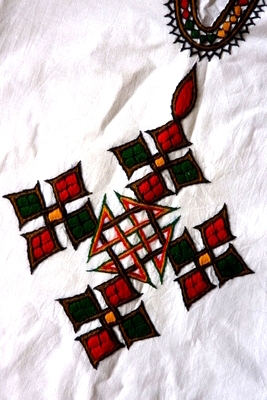
Ethiopian blouse with traditional style embroidered cross

Ethiopian blouse with traditional style embroidered cross, in Addis style.

I purchased a blouse in the Addis style, which has a large embroidered cross on the front, with borders of embroidery at the edges of the garment. It is in traditional Ethiopian colours: red, yellow and green – the colours of the Ethiopian flag. The stitches used are mostly chain stitch, with small amounts of cretan and buttonhole stitch.

Crosses are a common motif in Ethiopian embroidery and are based on the processional and ceremonial crosses that are used in the Ethiopian orthodox religion.

Following this, Jacqui took me to Sabahar, a wonderful silk shop over the other side of town. The business is run by a lovely Canadian woman who saw the possibility of incorporating newly introduced “wild” silk species with the traditions of Ethiopian weaving.

Ethiopia has a tradition of weaving that is not found in other eastern African countries. Indeed the oldest known example of tablet weaving is Ethiopian, and currently in a museum in Canada.

Sabahar creates woven homewares and personal accessories that are just absolutely gorgeous. They have recently been accredited for fair trade, and have built the business on fair principles of pay and conditions. The worms are raised by Ethiopians in rural areas, the silk is spun, dyed and woven by Addis locals. The dyes used are natural plant dyes, and create the most beautiful range of colours.

Sabahar silk scarf

Beautiful silk scarf in greens, using natural plant dyes, and stunning glass beads.


I could have spent all day at Sabahar, and all of my money. I only spent some of each, but I will have to go back!

In the afternoon Jacqui took me to Alert Leprosy Hospital. Here I saw some of the finest embroidery that I have seen in Ethiopia. Much of the embroidery for sale seems to be quite coarse, but the work done and for sale at Alert was of very high quality.

cushion featuring Ethiopian embroidered cross

cushion featuring an Ethiopian embroidered cross, from Alert Leprosy Hospital

Once again, many designs were based on Ethiopian crosses, and I purchased a cushion cover that should go well with our lounge at home. It is worked entirely in chain stitch, using woollen yarn on a ground of heavy cotton fabric.

We were able to observe the artisans working at their crafts: weaving coir doormats, weaving fabric to be embroidered on, embroidering the designs, knitting clothing and spinning the cotton for weaving (by hand, on spindles!) The dexterity of these men and women, some of whom showed the visible evidence of their encounters with leprosy, was amazing.

I had a wonderful day exploring some of the textiles of Addis. Thanks Jacqui!

February 2nd, 2010 | Category: embroidery stitches, historical embroidery, travel | One comment

I’m going textiling

Today I’m going textiling! A lady from the school community has offered to take me, so we’re heading off to the textile part of town on the way to Entoto. And there’s the possibility of also visiting a silk shop owned by some parents at the school.

I’m really looking forward to it. 🙂

February 2nd, 2010 | Category: travel | Leave a comment

Desta Mender

Yesterday I met the amazing Dr Catherine Hamlin at church. I knew that she went to that church, but since we had been attending, she and I hadn’t been there on the same Sundays yet.

Dr Hamlin was with the Bennetts. Mark is the CEO of the Fistula Hospitals, and Annette, his wife, is the head of the midwifery school. We were talking with Mark at first, then Annette and Dr Hamlin came over and introduced themselves.

Dr Hamlin just put out her hand and said “I’m Catherine Hamlin”. She was humble, gracious and completely without airs and graces. She was very interested to hear that it is my plan to come and help with the embroidery group.

After church, we went with some friends out to Desta Mender. This is the long term facility for patients of the fistula hospital, whose wounds have not been able to be completely cured. At Desta Mender, they teach them how to look after their health, and also teach life skills to help the girls.

In the last year or so, Rae Newman, a lovely lady from Australia (who I have also had the delight to meet) trained some of the residents, and they opened a cafe at Desta Mender. She did a great job, because her staff do a great job.

We had lunch at Juniper Cafe, and enjoyed really delicious pies and salad. The salad dressing was a little heavy-handed on the garlic, and I feel like I will be breathing garlic until we get home to Australia
, but it was so lovely out there. There is a dam with ducks, and you overlook the surrounding countryside, which is very pretty.

We finished off our lunch with the delicious tasting, but 1cm high pavlova that John and I had made. It did rise up to about 5cm in the oven, but as it cooled it dropped down to about 1cm high. Oh well. It tasted great!
You can also buy the pies as takeaway, so we came home with 6 frozen pies to enjoy another day. We came home feeling extremely tired, but having had a wonderful time.

February 1st, 2010 | Category: teaching embroidery, travel | Leave a comment
« Newer Entries  
  Older Entries »
Yvette Stanton White Threads is the blog of Yvette Stanton, the author, designer, publisher behind Vetty Creations' quality needlework books and embroidery products.

New book now available!

Hardanger Filling Stitches
Hardanger Filling Stitches by Yvette Stanton. Order your copy today!
Find us on Facebook

Archived posts

Categories

  • book reviews (88)
  • Christmas ornament swap (13)
  • colour (6)
  • crazy hair (6)
  • customer embroidery (49)
  • designing (119)
  • dressmaking (26)
  • Early-Style Hardanger (91)
  • Elegant Hardanger Embroidery (42)
  • Elizabethan embroidery (25)
  • Embroidery classes (189)
  • embroidery musings (436)
  • embroidery stitches (206)
  • errata notices (11)
  • Ethnic embroidery (49)
  • exhibitions (111)
  • exploring the needlework internet (10)
  • favourite needlework items (69)
  • FlossTube (102)
  • Frisian whitework (73)
  • goldwork (12)
  • hardanger (232)
  • Hardanger Filling Stitches (72)
  • Hardanger Filling Stitches (1)
  • hints and tips (114)
  • historical embroidery (119)
  • how-to videos (34)
  • illustration (1)
  • Inspirations (25)
  • Introducing… (90)
  • left handed embroidery (78)
  • magazines (10)
  • making stuff (271)
  • merezhka (35)
  • mountmellick embroidery (176)
  • Mountmellick Embroidery: Inspired by Nature (60)
  • mountmellick supplies (49)
  • new products (104)
  • online book previews (7)
  • pattern darning (19)
  • pattern drafting (11)
  • photography (2)
  • Portuguese embroidery (166)
  • Portuguese Whitework: Bullion Embroidery from GuimarĂŁes (74)
  • public thanks (32)
  • published projects (27)
  • Punt 'e NĂč (32)
  • Sardinian Knotted Embroidery (77)
  • sewing tips (9)
  • SmĂžyg (41)
  • SmĂžyg: Pattern Darning from Norway (39)
  • soapbox (6)
  • stitch along (44)
  • stitch dictionary (45)
  • teaching embroidery (192)
  • The Left-Handed Embroiderer's Companion (104)
  • The Right-Handed Embroiderer's Companion (70)
  • travel (172)
  • Ukrainian Drawn Thread Embroidery (35)
  • Uncategorized (169)
  • video previews (5)
  • White Threads Blog (91)
  • whitework (364)
  • writing books (306)