Vetty Creations header

Back to Vetty Creations website

White Threads

knitted blankets

Over the last few weeks I have been corresponding with a lovely lady who is part of the Queensland Country Women’s Association. She asked if I would be going to the Fistula Hospital at all. I was. She said that the ladies in her CWA group do a lot of charity work for various causes, including making knitted blankets, many of which are sent to the Fistula Hospital.

For the sake of the ladies in her group, she asked me if I would let her know if whether they have an effect – whether they make the lives of the ladies better.

What I say here is based on my knowledge of Ethiopia, my observations and the conclusions drawn from that. It is not based on interviewing anyone. However, I think it might be pretty accurate.

When you go to the hospital, most of the patients who are out in the grounds are wearing their blankets as head scarves/shawls. Scarves are extremely common in Ethiopia, with netellas being lightweight, cheesecloth style scarves used to cover women’s heads, and gabis, which are heavier and used as wraps/headcoverings/blankets. So to see the ladies using the blankets as scarves really was not that surprising.

I asked our guide about the blankets. She said that each woman is given one on arrival at the hospital. Then they receive another one when they leave. Most blankets donated are from Australia, the US and the UK.

I imagine that to receive such a bright and colourful gift would be wonderful. The fistula patients arrive at the hospital in dirty, smelly clothes which are unable to be cleaned because of the constant leaking, due to their injuries.

Many regional clothes from around Ethiopia are white. The countryside these people live in is extremely dusty (red, brown dust), yet they manage to keep their clothing white. I am constantly amazed by it! However, the women who suffer from fistulae are unable to keep their clothing white, and while I do not know this for sure, I imagine that this is a source of some shame to them.

A bright, knitted blanket would probably be unlike anything the women have ever owned before. To see the women wearing their scarves, it was as if from them they received a message of love and care, and that in turn gave them dignity.

So Yvonne, and all your QCWA friends (and anyone else!), please keep knitting blankets. They really do make a difference. The message they send is so valuable to these women whose lives have been prematurely destroyed (but are now getting a second chance), and who so often have been rejected by community and even family. To have a gift of love and care is almost beyond measure.

March 20th, 2010 | Category: travel | 4 comments

Addis Ababa Fistula Hospital

Yesterday my husband and I went to visit the Addis Ababa Fistula Hospital. (The girls were at school and my husband was happily granted permission to play hookey for a number of hours!)

What a special place that is! I had wanted to visit for a very long time, having read both the books about it “The Hospital by the River” and “Catherine’s Gift”. I have also knitted squares for Wrap With Love, an Australian charity that sends blankets to needy people around the world, including the fistula hospital.

What made the visit so special? Its hard to put my finger on it really, but I think its a lot to do with the fact that there are people who are devoting their lives to curing women of the horrible childbirth injury that is obstetric fistula. So often, these women have their lives stripped away from them far too early. Fistula surgery gives them the chance to live again, and even to have a family again. Having been up north here in Ethiopia, and looked out over the countryside, with its lack of roads, or terrible roads, you can see why medical help is not on hand for so many, and how this awful problem comes about.

Dr Catherine Hamlin, who came to Ethiopia with her late husband Reg, 50 years ago to begin this work (although they didn’t know it at the time!) is a delightful woman. She is now 86, and operates only on Thursdays – her favourite day for operating. As we were there on Thursday, she was at the time, currently in the operating theatre. Our guide for the hospital tour described her as “saintly”. I’d say that’s about right.

I was thrilled to be able to purchase some embroidered tablecloths made by patients at the hospital. They each had the name of the stitcher written on them, making them very special. The money goes directly to the women, as pocket money. (All their care is free of charge.) I don’t know if those two women have now returned to their families and villages, but wherever they are, I pray that their lives are happier and healthier now.

March 19th, 2010 | Category: favourite needlework items, travel | One comment

Wishing on a star…

Still thinking about needlework books (actually, come to think of it, when do I ever stop?!).

Since my post the other day about favourite needlework books, I’ve got some of you thinking about the embroidery books you can’t do without. What about the books that you have to do without because they haven’t been written yet? If there was one needlework book that you wish had been written, but hasn’t yet, what would it be?

I have several that fit this category, and all of them are on my list of books to write! If I could just wish them into existence without all that hard work, I would!

So what needlework book/s do you wish someone would write?

March 18th, 2010 | Category: embroidery musings, favourite needlework items, writing books | 2 comments

a few days away

On the weekend we took a break and went away with some friends to Negash Lodge, near Wollisso about 1 1/2 hours south west of Addis. We left after Friday afternoon’s activities were complete, and then got stuck in traffic trying to leave Addis.

Eventually we made it out of town. The road was thankfully sealed and very good. The drive took us through very flat farming country. I loved seeing the farms and villages with their tukuls (traditional houses). Some were round, which is what I am used to seeing, others were square, and others were hexagonal. There were also many of the newer types of traditional homes with the mud and straw walls, and corrugated iron roofing.

It began to get dark, and we were only working with very vague instructions of where to find the lodge. We eventually were able to discern the name “Wollisso” (or some variant spelling, of which there seem to be many) on a town sign. Our instructions said something about the main road, a church and an unexpectedly rough road. Hmm… not really much to go on there, and we had the added bonus that the town was without power, so there was no street lighting with which to read signs off the side of the road.

We went pretty much all the way through town, then turned around and came slowly back. Eventually our friend who was driving saw a sign saying “Negash Lodge”, but with no indication of WHERE it was. We therefore just assumed it was down the adjacent road. This road was unsealed. But it was not unexpectedly rough. That’s not because we were expecting it to be rough – it just wasn’t rough!

Eventually we found it. Yay! Because of the traffic, it had taken us a lot longer to get there than we had anticipated, and the stress of trying to find somewhere with only vague instructions, in the dark, had been decidedly tiring!

We spent the weekend eating, sleeping, lounging by the pool, swimming, eating, protecting our food from vervet monkeys, resting, eating, eating…

We saw quite a bit of wildlife, with there being many vervet monkeys, only too willing to steal the food from your table. There were also Colobus monkeys, and rock hyraxes. We saw several unusual (to me) birds, and glimpsed a deer making its way through the resort.

The houses were all constructed in the style of various Ethiopian people groups. Ours was Dorze house, which was like a beehive made from woven bamboo fibre. It was very tall, and had a loft where the girls slept. They really liked it, and decided they’d like a house just like it at home. Somehow I don’t think NSW planning or bushfire laws would allow it…

We had a lovely weekend away with friends. The kids all got on really well, and we enjoyed the adult company. The food was great, though there was way too much of it!

March 17th, 2010 | Category: travel | 2 comments

Favourite needlework books

Over the last few days I have reviewed some of the books on my bookshelf. These were some that I used during the writing of my stitch dictionary The Left-Handed Embroiderer’s Companion: a step-by-step stitch dictionary. There were of course, others, and we may get to them in the future.

Coming to spend three months here in Africa, I had to decide, at the beginning, what books I would bring with me. In the end I brought just one: my left-handed book! I knew that it had in it all the stitches that I was likely to need, and as it happens, I’ve been using it as a prop at my very first ever author’s talks at my daughters’ school this week! (I think it is hilarious that they want me to do author’s talks, but as you can imagine, its not every day they have access to authors here!)

Anyway, it made me think about which needlework books I would place on the pile if I was going somewhere where I could only take five.

  1. The Left-Handed Embroiderer’s Companion: a step-by-step stitch dictionary by Yvette Stanton (me!). I’d bring this because I put the stitches in there, so I know the wide range of stitches it has in it.
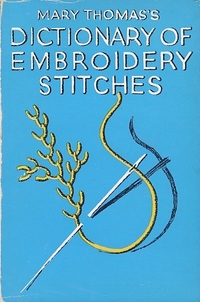
  2. Mary Thomas’s Dictionary of Embroidery Stitches by Mary Thomas. This is a small book, jam-packed with good stuff. It would have to go in the pile. See my recent review.
  3. The Stitches of Creative Embroidery by Jacqueline Enthoven. This has a great range of stitches too. Not heaps of diagrams, but lots of interesting text. Good inspiration pics too.
  4. Three Hundred Years of Embroidery 1600-1900: Treasures from the collection of the Embroiderers’ Guild of Great Britain by Pauline Johnstone. I bought this book many years ago at the Art Gallery of South Australia. I have always liked it, and often just go back and have another look. I guess I like it because it is full of historical embroidery.
  5. I’m sorry, I’ve sat here and thunked and thunked, but I can’t come up with a fifth book, when I am thousands of miles away from my actual book collection…

So, what are your five most favourite needlework books – the ones that would have to go with you if you could take only five? And WHY those particular books?

If five is too hard (as it was for me), then fewer is ok. 🙂

If you come up with some suggestions that I’m not familiar with, I’ll have great delight in looking them up!

March 16th, 2010 | Category: book reviews, favourite needlework items | 6 comments

The Constance Howard Book of Stitches

Another book from my bookshelf: “The Constance Howard Book of Stitches” by Constance Howard.

The Constance Howard Book of StitchesThis book has been repackaged in recent years with an appealing modern-looking cover. Unfortunately the insides are all still black and white – there was an errata notice in mine saying that the colour plates mentioned were not actually included.

I nearly didn’t delve into this book when I first picked it off the shelf at my guild library, because of the black and white photos. (I do like colour!) But on closer inspection I saw how this book is absolute gold in terms of the inspiration it provides for using stitches in creative and interesting ways.

I was going to borrow it from the library, but then I realised that it would be a book that I would refer to again and again, and decided that I actually needed to purchase my own copy. So I did!

This book was invaluable to me as I created the inspiration stitch panels for my book The Left-Handed Embroiderer’s Companion: a step-by-step stitch dictionary. It prompted me to push my experimentation with stitches much further than I otherwise would have.

I love the way it uses different textured threads, different weights of thread, different scales of stitch… and I even grew to love the fact that all the thread shows up as white (in the black and white photos) because it stopped me from being distracted by colour, and allowed me to only see the stitches.

The book is not very instructional on how to work the stitches. There are some basic instructions, but you will probably want to use another book to teach you the stitches.

However, this book is pure inspiration.

March 15th, 2010 | Category: book reviews, embroidery stitches | Leave a comment

The Complete Stitch Encyclopedia by Jan Eaton

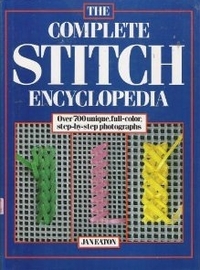
Another review of a book from my personal bookshelf: “The Complete Stitch Encyclopedia” by Jan Eaton.

The Complete Stitch Encyclopedia by Jan EatonThis book is an excellent reference for those who want to see a lot of different stitches. It has a wealth of information, and there are surface stitches, counted stitches, insertions and edgings. Each one has their own photograph of either the finished stitch or the stitch during construction, and a paragraph or two about the stitch.

The book is divided into text pages and image pages. Each text page has information about the stitches that follow on the image page, including alternate names and a quick description of how to work the stitch. Because the written information is on one page, and the accompanying photo on the next, it does mean that you have to flip back and forth a bit. Perhaps this could have been better organised.

The photos are generally quite clear, though often only having one photo for each entire stitch process does mean that you have to glean a fair bit of information from the written instructions. For those of us who are used to step-by-step stitch directions in the style of Country Bumpkin’s A-Z books, this takes a bit of getting used to. There are a few stitches in this book that I just could not figure out from the text and diagram combined – there just wasn’t enough information. I find this a good book to look up stitches or get ideas from, then go elsewhere to learn how to do them.

All the stitches in this book are separate from each other. There are no pictures showing them combined, or used for any particular purpose. This is not a book to inspire creative use of stitches; it shows them in isolation only.

Despite these drawbacks, the range of stitches is what makes this book so good. There are just so many, and with the stitches grouped as they are, it makes interesting reading figuring out which stitches are related.

In summary, I wouldn’t rely on this book to teach me new stitches, but I do look to it as a good place to find new ones.

March 14th, 2010 | Category: book reviews, embroidery stitches | Leave a comment

Mary Thomas’s Dictionary of Embroidery Stitches

Today I am going to post a review of a book from my bookshelf: “Mary Thomas’s Dictionary of Embroidery Stitches”. This is a book I own and love.

Mary Thomas's Dictionary of Embroidery StitchesIn recent years, this book was completely overhauled and revised. Unfortunately I don’t like the new version at all. It looks cheap and nasty, and just doesn’t appeal to me. It gives me the impression that it has been “dumbed down”.

My copy of this book is the 1934 edition, and it is a real gem. It is a small hardcover book, with text and line drawings. It has a wonderful range of stitches, and while some of the instructions can be a little hard to follow, it is a book I would not be without.

Occasionally I would look at the method presented for a complicated stitch with lots of thread and needle manipulation and think “Surely there has to be an easier way than that?” So I would sit there and persist until I was able to get the exact same result, using an easier method. Often it would take some time and problem solving, but it was always great when I achieved it.

The text of this book is fabulously interesting. Its the type of book I would read from cover to cover, because it is so fascinating. (Yeah, maybe I should get out more – who reads stitch dictionaries from cover to cover?!)

If ever I want to look up a stitch, this is the book I go to (well, it used to be, before I wrote and published my own stitch dictionary!). Every embroiderer who is interested in stitches should own a copy of this book.

March 13th, 2010 | Category: book reviews, embroidery stitches | 2 comments

where to see and buy textiles in Addis

For those who love textiles, Ethiopia is a surprisingly rich place. Before we came here, I knew that Ethiopia had many different regional styles of cultural dress, but I really didn’t know what I might find in the way of embroidery.

I was surprised to find that embroidery is easily found in Ethiopia, though you do have to look carefully to find good quality.

When we were on our northern tour, I kept a lookout for places to see and buy embroidery, but what I saw was very crude and not for the discerning embroidery buyer. Doesn’t mean that good quality work wasn’t there – I just never found it. Of course, I did see embroidery and Ethiopian textiles every day: particularly in the country, traditional clothing is common on older women.

Since being in Addis, I have learned of and visited several places that are worth recommending for those who might want to purchase Ethiopian textiles and embroidery.

Keep in mind that people do not use street names in Addis, so the best I can do for you is to describe locations in relation to other landmarks. (Good luck in finding the places!!)

Shiro Meda
This is the best place in Addis to see traditional textiles. It is a market area on the road to Entoto Mountain in the north of the city. If you head north from Arat Kilo up towards Addis Ababa University, and keep going, you will soon find Shiro Meda market area on both sides of the road. If you find you’re going up the mountain already, you’ve missed it (how?!) and will need to turn around and look more carefully on your way back!

Here you can find habesha tibeb (traditional Ethiopian dress), in many different regional styles. Some are made with coloured woven borders, others are embroidered – some by hand, others by machine. Obviously you will expect to pay more for hand embroidered work, as opposed to those with woven details or machine embroidered.

Depending on the amount of embroidery, and its quality, you could pay several thousand birr for a beautiful hand-embroidered traditional tibeb from the Axum region. (I do desire one of these, but as that’s several hundred Australian dollars, I can’t justify it for something I will admire greatly but never wear!)

There are also much more simple hand embroidered garments in the Addis style. I bought a reasonable quality women’s blouse with hand embroidery on the front for 100birr (and I’m not saying that’s a good price because I didn’t haggle, but I was happy to pay it).

Gabis are heavy woven shawls used for warmth as clothing and blankets, and netelas are lightweight, cheesecloth style scarves with beautiful woven bands on the ends. These and other traditional clothing can be found here. You can also find woven or embroidered tablecloths, bedcovers, and cushion covers.

If you want modern habesha (national Ethiopian) clothing, you can get it made to measure here, in most of the little souks. Just choose your fabric and the style and order it. I have no idea about turnaround times or prices, as I have not done this. But it can be done!

Hilton Hotel
This is probably the second best hotel in Addis, after the Sheraton. It is located in the Kasanches area. The Hilton has a good range of souvenir shops, and despite it being in one of top hotels, the prices are good and reasonable. Don’t feel that you’ll be being ripped off by buying at the Hilton, because you won’t be.

Here you can buy beautiful woven scarfs, hand embroidered clothing, pot-holders, cushion covers etc. There are many different shops – some on the outside, near Novis Supermarket, others inside on entry level, and still more downstairs on the pool level.

To enter the Hilton, you will have to pass through a bag check, possibly a pat-down search, and you may need to show ID.

NGO bazaar
On the last Sunday of each month at IEC (International Evangelical Church) in Sarbeit, the NGO (non-government organisation) bazaar is held. There is a small cover charge for entry (something like 3 birr per person) and then you are free to wander, enjoy and purchase!

We were only here for one of these, but it was an event NOT to be missed. I think ALL westerners in Addis turn up at this on the day it is on. All roads lead to Rome, and all Westerners go to the NGO bazaar.

You can purchase good quality souvenirs and gifts, including a great range of textiles and embroidered items such as the ubiquitous scarves, pot-holders, cushion covers, aprons, fabric toys etc. There is also a great range of pottery, jewellery, wood work, processional crosses, woven wool mats and hangings, and food.

And all proceeds go to NGOs working with Ethiopians to improve their lot. Some of the NGOs I recognised included Alert Leprosy Hospital, and the Gemini Trust which supports families with twins (as a twin, this had resonance for me!). So, great products, great causes.

Sabahar
Beautiful handwoven silk and cotton products, as part of the fledgling silk producing industry of Ethiopia. Uses Eri silk, which is soft and has a slight sheen. Gorgeous colours, mostly from natural dyes. Clothing such as scarves and gabis, and homewares such as throws, bedcovers, cushions and tablemats.

This is in Mekanisa, and is not easy to find. When you’re on the right road, its behind the Salam Nurses College, but you’ll have to find that first. Best to ask an expat to show you where it is – hopefully they’ll know! Taxi drivers will have no idea where it is, though of course they’ll know where Mekanisa is.

Otherwise, Sabahar scarves can be purchased at the Ethnological Museum gift shop, or at more inflated prices in one of the shops at the Sheraton.

A place I don’t know the name of
This is really specific, isn’t it?! There is a shop which is something to do with small/micro businesses on the road heading southish to Mexico roundabout, just past the Ethiopian Roads Authority (ERA), sort of opposite Wabe Shebele Hotel. I haven’t been to this shop (hence not knowing its actually name), but going past in the taxi, it looked to have a great range of textiles.

Various souvenir shops dotted all around the city
There are souvenir shops everywhere. In some of these you can find beautiful woven and/or embroidered textiles. We explored a good number on Churchill Avenue, near the Tewodros Square cannon. Purchased some simple embroidered Addis-style garments (blouse and top) for our daughters. Do try them on though, as when we got home, we found that on one of them the head-hole was too small, and required some swift alterations, so that the little dear could wear it that day – so excited was she!

There are also a lot of souvenir shops in the Posta Bet area (that’s ‘Post Office’), though we haven’t personally explored these.

There will be other places, but as I don’t know of them, I can’t share them with you!

March 12th, 2010 | Category: historical embroidery, travel | Leave a comment

things I will not miss about living in Addis

There are of course some things that I will not miss about living in Addis:

  • washing all our clothes by hand
  • the lack of reliable electricity
  • bleaching all our fruit and vegetables
  • the taste of the drinking water
  • the smog
  • so many potholes in the road
  • the smell of fruit street
  • the breakfast cereals we have here
  • the smell of open drains
  • whatever insect it is that bites us while in bed
  • not being able to drink tap water
  • seeing real poverty and not knowing what to do about it
March 11th, 2010 | Category: travel | Leave a comment
« Newer Entries  
  Older Entries »
Yvette Stanton White Threads is the blog of Yvette Stanton, the author, designer, publisher behind Vetty Creations' quality needlework books and embroidery products.

New book now available!

Hardanger Filling Stitches
Hardanger Filling Stitches by Yvette Stanton. Order your copy today!
Find us on Facebook

Archived posts

Categories

  • book reviews (88)
  • Christmas ornament swap (13)
  • colour (6)
  • crazy hair (6)
  • customer embroidery (49)
  • designing (119)
  • dressmaking (26)
  • Early-Style Hardanger (91)
  • Elegant Hardanger Embroidery (42)
  • Elizabethan embroidery (25)
  • Embroidery classes (189)
  • embroidery musings (436)
  • embroidery stitches (206)
  • errata notices (11)
  • Ethnic embroidery (49)
  • exhibitions (111)
  • exploring the needlework internet (10)
  • favourite needlework items (69)
  • FlossTube (102)
  • Frisian whitework (73)
  • goldwork (12)
  • hardanger (232)
  • Hardanger Filling Stitches (1)
  • Hardanger Filling Stitches (72)
  • hints and tips (114)
  • historical embroidery (119)
  • how-to videos (34)
  • illustration (1)
  • Inspirations (25)
  • Introducing… (90)
  • left handed embroidery (78)
  • magazines (10)
  • making stuff (271)
  • merezhka (35)
  • mountmellick embroidery (176)
  • Mountmellick Embroidery: Inspired by Nature (60)
  • mountmellick supplies (49)
  • new products (104)
  • online book previews (7)
  • pattern darning (19)
  • pattern drafting (11)
  • photography (2)
  • Portuguese embroidery (166)
  • Portuguese Whitework: Bullion Embroidery from Guimarães (74)
  • public thanks (32)
  • published projects (27)
  • Punt 'e Nù (32)
  • Sardinian Knotted Embroidery (77)
  • sewing tips (9)
  • Smøyg (41)
  • Smøyg: Pattern Darning from Norway (39)
  • soapbox (6)
  • stitch along (44)
  • stitch dictionary (45)
  • teaching embroidery (192)
  • The Left-Handed Embroiderer's Companion (104)
  • The Right-Handed Embroiderer's Companion (70)
  • travel (172)
  • Ukrainian Drawn Thread Embroidery (35)
  • Uncategorized (169)
  • video previews (5)
  • White Threads Blog (91)
  • whitework (364)
  • writing books (306)