Vetty Creations header

Back to Vetty Creations website

White Threads

Left-handed book stockists list up

I’ve now put up a stockists list for “The Left-Handed Embroiderer’s Companion”. It includes Australia, New Zealand, United States and United Kingdom.

It is FAR from exhaustive, so you are welcome to tell me where you bought your copy! And of course, I can add other countries.

If you are a shop who stocks “The Left-Handed Embroiderer’s Companion” and are willing to regularly have it in stock or readily and happily order it in for customers, please let me know. Seeing it on your website would be a great way to let me know that you have it for sale. If you need a cover picture to use on your website, please just let me know, and I will be happy to supply one. I can also supply a book blurb for you.

Happy local purchasing!
May 20th, 2010 | Category: The Left-Handed Embroiderer's Companion | Leave a comment

Stockists list – The Left-Handed Embroiderer’s Companion

The other day I received a phone call from a left-handed lady in another Australian city who was feeling a little frustrated that she could not find a copy of The Left-Handed Embroiderer’s Companion to purchase locally. I suggested a number of needlework shops to her that I felt sure would stock it. She went off happily, ready to continue her efforts to purchase the book.

I have begun approaching needlework shops around Australia to ask them whether they stock the book, so that I can put together a stockists list. I understand and support the fact that many of you like to purchase locally wherever possible so that you can support local businesses. I think this is really important, so that we can keep those shops open.

I have begun collecting a list of stockists – for Australia only at this stage – and will soon post it on my website. If you have purchased The Left-Handed Embroiderer’s Companion from your favourite local embroidery shop, please let me know, so that I can check whether I should add it to my list.

As you can imagine, I find it rather difficult to keep up with all the many needlework shops around the country, so if you can help me, I’d be very grateful.

If you are not in Australia, you are welcome to let me know where you have purchased your copy too. I expect that it will take a little longer to get an international stockists list together though!

May 19th, 2010 | Category: The Left-Handed Embroiderer's Companion | 4 comments

having an idea

I have an idea percolating around in my head. It’ll probably never happen, but I’m thinking about it!

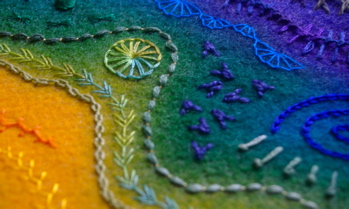
close up embroideryFollowing my enjoyable experiences working with Colourstreams hand-dyed wool felt for my left- and right-handed stitch dictionaries, I have recently learned of a thing called prefelt. My question was “What is prefelt?”

Really, its just that – a thin wool “fabric” that is the precursor to felt. It has been lightly needlefelted to hold it together somewhat. It cannot be used as a fabric as is, as it is too flimsy, and won’t properly hold together. However, if put through a felting process, such as with warm soapy water and agitation, it turns into felt.

Now, I have seen some gorgeous felt creations, incorporating silk hankies. I am particularly thinking of a jacket that Annie Huntley of “Room for Threads” wore last year at the Sydney Craft and Quilt Show. The colours were wonderful.

I dream of making some clothes out of this sort of fabric, on which I would heavily embroider. What better advertisement for my skills and use of embroidery than wearing it? I loved to use the Colourstreams felt to embroider on, but I think I would also love making my own felt to embroider on.

But the question is, when would I find the time?! Also, I feel that it would be helpful to take a class in how to do the silk hankie in combo with prefelt thing. Does anyone know of classes of this type anywhere in Sydney? Or some good online tutorials on working with prefelt?

May 18th, 2010 | Category: designing, embroidery musings, embroidery stitches | 4 comments

memories of addis

Today at church we viewed a DVD from friends of ours who are still in Addis, teaching at the same school that we were at earlier this year. Their family is also supported by our church.

At the beginning of the DVD was a short promotional bit about the school, and about life in Addis. We saw scenes of streets we knew, buildings we recognised, places we’d been, and students and teachers that we recognised.

I loved watching it! It brought back so many memories and tugged at my heart. It made me realise that I really did leave part of my heart in Addis.

May 17th, 2010 | Category: travel | 2 comments

illustrations versus words

Mary Corbet made an interesting observation the other day. She pointed out that many older instructional embroidery books have many more words and few diagrams/photos, whereas newer embroidery instructional embroidery books have many diagrams/photos and fewer words.

This is quite true. I think about one of my favourite old stitch dictionaries (published in 1934), Mary Thomas’s Dictionary of Embroidery Stitches, and it has many words, and few diagrams.

Contemporary stitch dictionaries, such as mine and the A-Z books by Country Bumpkin, tend to have many diagrams and fewer words. When I write my books, I have both words and diagrams, as I know that some people are visual learners, who learn better through seeing things, and some are verbal learners, who learn better through words. But while I still have words, the ratio of words to images is much lower than in old embroidery books.

So why is there such a difference between older books and contemporary stitch dictionaries?

As a book designer, who is involved in the production of books, I wonder if it was simply a matter of cost. Before the introduction of digital book design and production processes, it was an expensive process to put pictures into books, whether illustrations or photographs.

I know that many people say that they find it much easier to learn by being shown something, instead of having it described to them. A visual book is therefore closer to a class, and being actually shown something. I suspect this makes it much easier for many people to learn.

When I first started out in book design, all illustrations needed to be scanned on a drum scanner. Photos could be drum scanned for those presented as prints, or for a better result, slides (positives) would be scanned. Scanning negatives tends to make strange things happen with colour, so using positives was a more successful way of doing it.

If anything about the image needed to be edited, it was a job that generally required a highly skilled retoucher to make any changes.

The scanned images would then be inserted into the layout.

Before scanning, pictures were part of an even more intensive process. But I’m too young to know much about that! 🙂

So putting images into books was a labour intensive, and therefore expensive process.

These days, when I put a book together, I use my digital camera for photos, plug it in and upload the images onto my computer. I can then place them into my layout. It is a quick and easy process.

I create my illustrations on my computer using Adobe Illustrator. As I have been doing this for years, for me it is now a reasonably quick process, though some of the diagrams for “Ukrainian Drawn Thread Embroidery” took me all day – and that’s no exaggeration!

Having digital illustrations means that they can easily be edited and for step-by-steps, previous diagrams can be used and built upon for the next step.

Comparatively, using images these days is a quick and easy process, and therefore much cheaper.

So, I wonder if it was very much a question of economics that older books have more words and fewer images, and newer books have fewer words and more images. Many people like images, and with the improvement of technology, we are fortunate that they are much more cost effective to include in instructional embroidery books.

May 16th, 2010 | Category: embroidery musings, stitch dictionary, writing books | 2 comments

Book review: How to bead

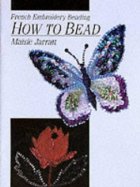
how-to-beadI would like to share a book with you that I keep coming back to, time after time. “How to Bead: French Embroidery Beading” by Maisie Jarratt.

Before writing this, I headed over to Amazon to see if they had any reviews. Yes, they do, and some of the reviewers did NOT like this book. I do. And here’s why.

This book focusses on embroidery beading. I’ve seen many books on beading, but often they are not about how to incorporate beading into your embroidery. That’s the part of beading that interests me. I know that people can make lovely beaded jewellery and things like that, but beading comes alive for me when the beads are sewn on fabric!

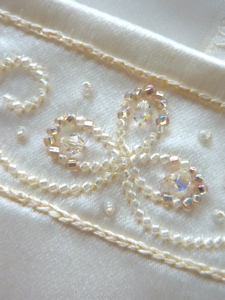
beading close upThis book goes through techniques for sewing beads – mostly seed beads and bugle beads – on in straight lines and curves. Maisie also deals with sequins and specialty beads. These are the techniques that I used in my beaded dress (detail shown left – this is my work, not an example from the book).

For those who wish to learn tambour beading, there is a very small amount of information (with photos) in this book. I have never tried this, and I do not know if these instructions would be all you’d need. But Maisie did write another book on tambour beading that you could look out for, if you were interested (I don’t have it, so can’t comment on it).

There are diagrams in this book that illustrate the techniques shown. Admittedly, they are hand drawn in a very rough style that many of us are not used to in these days of computer generated illustrations. However, while they are not the most attractive things you have ever seen, they do the job!

None of the projects in this book are anything that I would ever make. To me they are rather dated looking (the book was published in 1991), but they’re not why I bought the book anyway. I bought this book on a whim in a bookshop one day. It seemed interesting and was a very reasonable price. I had no need for it at the time.

However, in the years since, I have used this book to teach me how to sew beads onto embroidery in a quick and effective technique. I like it, and am extremely pleased to own it.

May 15th, 2010 | Category: book reviews, favourite needlework items | 2 comments

no longer procrastinating

I am no longer procrastinating! I think that I just needed to admit to myself that that is what I was doing, and that was enough to kick me into action!

Yesterday I spent some time with Kirsten Edwards planning for our joint stand (G32) at the Sydney Craft and Quilt Show at Darling Harbour, June 16-20. I set up some of our stand in our lounge room, just to get an idea of how much stock would fit, and how it would look.

I left it there for the time being, so that I can add things to it. My husband walked in from work last night and said “oh, there’s a shop here!” While I was making dinner (with my 6 year old who had to help as part of this week’s homework!) he said that he went to the shop, but no-one was there to serve him!

I can assure you that there will always be someone to serve you at our stand at the actual show – just not in my lounge room!

In the past week I have been asked to contribute three new projects to various magazines, so I need to get cracking on them. One is already made, but I need to write the instructions. One is the embellishment of a piece of clothing, and another is a shadow work curtain (probably!). I’m sure I will enjoy all of them.

And then, of course, there are TWO books waiting to be written. There are other projects to work on also, so I just don’t have time to procrastinate!

May 14th, 2010 | Category: designing, published projects, writing books | 4 comments

Public thanks: Phil Bush

When I was at school, apparently I told my mum in about Year 10 that I wanted to be a book designer. I don’t remember doing this. When it came time to choose what I wanted to do after school, there were a few options that appealed to me: graphic design and science – perhaps medical science research.

Because I loved art so much, in the end I opted to study graphic design.

My university degree was called Bachelor of Design in Visual Communication. I hated first year. It was boring and general and I think they actually used it to weed out the students who weren’t likely to stick with the course. We did a subject that I really disliked called creative problem solving. I don’t know why I hated this subject so much – its now something I do ALL the time, and a skill that I am so pleased to have! Perhaps it was too much for my green just-out-of-school brain.

I made my way through uni, never really fitting in with most of my cohort – I just wasn’t “way out” enough. I really enjoyed illustration, photography, design computing and 3D model making, but really disliked animation, and film making sorts of subjects. It seemed that I was a “print” girl.

In my final year, I had to do a major project, and I chose to do book design. WIthout even realising it, I had come back to my long-forgotten dream. I gained my degree with honours, and was terribly pleased to have completed it, and finally be out of there!

I saw a job advertisement for a position as an in-house book designer with a major international publisher. (This sort of job is REALLY rare because most book designers work freelance.) The applicant needed one year of experience – which I didn’t have. But I applied anyway. I made my way through the selection process, and was successful in gaining the position.

I LOVED it. My boss’s name was Phil Bush. He gave me so many opportunities to learn so much. I pestered him almost every day, looking for more to do. I think I must have driven him mad. However, as I grew more experienced, I was able to work more independently, and make decisions for myself and recognise the next job to be done.

When he gave me opportunities to do important things like design a cover for a book, he always gave me great feedback on what he liked and didn’t like. He never used any of my cover designs, but then neither should he have – because they weren’t very good!

But I was learning and I loved it. I was also re-gaining my self-confidence in my abilities. Uni had really stuffed my self-confidence. I was NEVER the person they wanted me to be. I wasn’t hip. I wasn’t way out. I didn’t push my designs as far as others might (and this is something I have had to work hard on). I began to feel that I wasn’t actually very creative. But working this job, I came to see that I was good at what I did. I was the person they needed in the job.

Later on, when I went on maternity leave, Phil was struck down with throat cancer. From his diagnosis to death was only about 7 days. We were all in shock.

I learnt so much from Phil. I still wonder why he gave me the job. I have no idea what it was about me or my sample designs that I did for him, that made him choose me. But I am terribly grateful and thankful that he did.

May 13th, 2010 | Category: public thanks | 3 comments

procrastination

I have a bad case of procrastination at the moment.

I often fall into a hole like this after sending off a book to the printers. I think perhaps its due to a feeling of loss that the BIG project is no longer there to be worked on. When there’s a big project to be worked on, its always easy to know what to do: something towards it. But when there is no big project on the go, it is much harder to get motivated.

Don’t get me wrong, there’s lots to be done, but they’re all little things compared to a book, and I’m having trouble sorting out their levels of priority.

But really, I have no good excuses. I need to get myself into gear.

May 12th, 2010 | Category: Uncategorized | 5 comments

Mary Corbet’s gorgeous new look

If you’re like me, you’ll love reading Mary Corbet’s Needle’nThread. She’s had a complete makeover. I love the colours and feel of the new website. It will take a little while to get used to where things are found, but I’m sure I’ll soon be alright.

I had a bit of a look around there this afternoon. Later I received an email from a friend pointing out that I was the only person who had their own category on Mary’s website. I had not noticed that at all!

So I duly went back to check it out (laughing all the way!) and found that while I am not quite the only person with their own category, that’s its just me and Trish Burr, who have that honour.

If you’re wanting to see this for yourself, in the right-hand column, there is a section entitled “Categories”. At the bottom of that section if you click where it says “more categories” you’ll see the full list, including me and Trish.

Quite amusing, I think, that I should be a category!

May 11th, 2010 | Category: embroidery musings | One comment
« Newer Entries  
  Older Entries »
Yvette Stanton White Threads is the blog of Yvette Stanton, the author, designer, publisher behind Vetty Creations' quality needlework books and embroidery products.

New book now available!

Hardanger Filling Stitches
Hardanger Filling Stitches by Yvette Stanton. Order your copy today!
Find us on Facebook

Archived posts

Categories

  • book reviews (88)
  • Christmas ornament swap (13)
  • colour (6)
  • crazy hair (6)
  • customer embroidery (49)
  • designing (119)
  • dressmaking (26)
  • Early-Style Hardanger (91)
  • Elegant Hardanger Embroidery (42)
  • Elizabethan embroidery (25)
  • Embroidery classes (189)
  • embroidery musings (436)
  • embroidery stitches (206)
  • errata notices (11)
  • Ethnic embroidery (49)
  • exhibitions (111)
  • exploring the needlework internet (10)
  • favourite needlework items (69)
  • FlossTube (102)
  • Frisian whitework (73)
  • goldwork (12)
  • hardanger (232)
  • Hardanger Filling Stitches (72)
  • Hardanger Filling Stitches (1)
  • hints and tips (114)
  • historical embroidery (119)
  • how-to videos (34)
  • illustration (1)
  • Inspirations (25)
  • Introducing… (90)
  • left handed embroidery (78)
  • magazines (10)
  • making stuff (271)
  • merezhka (35)
  • mountmellick embroidery (176)
  • Mountmellick Embroidery: Inspired by Nature (60)
  • mountmellick supplies (49)
  • new products (104)
  • online book previews (7)
  • pattern darning (19)
  • pattern drafting (11)
  • photography (2)
  • Portuguese embroidery (166)
  • Portuguese Whitework: Bullion Embroidery from Guimarães (74)
  • public thanks (32)
  • published projects (27)
  • Punt 'e Nù (32)
  • Sardinian Knotted Embroidery (77)
  • sewing tips (9)
  • Smøyg (41)
  • Smøyg: Pattern Darning from Norway (39)
  • soapbox (6)
  • stitch along (44)
  • stitch dictionary (45)
  • teaching embroidery (192)
  • The Left-Handed Embroiderer's Companion (104)
  • The Right-Handed Embroiderer's Companion (70)
  • travel (172)
  • Ukrainian Drawn Thread Embroidery (35)
  • Uncategorized (169)
  • video previews (5)
  • White Threads Blog (91)
  • whitework (364)
  • writing books (306)